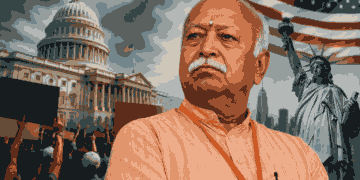




















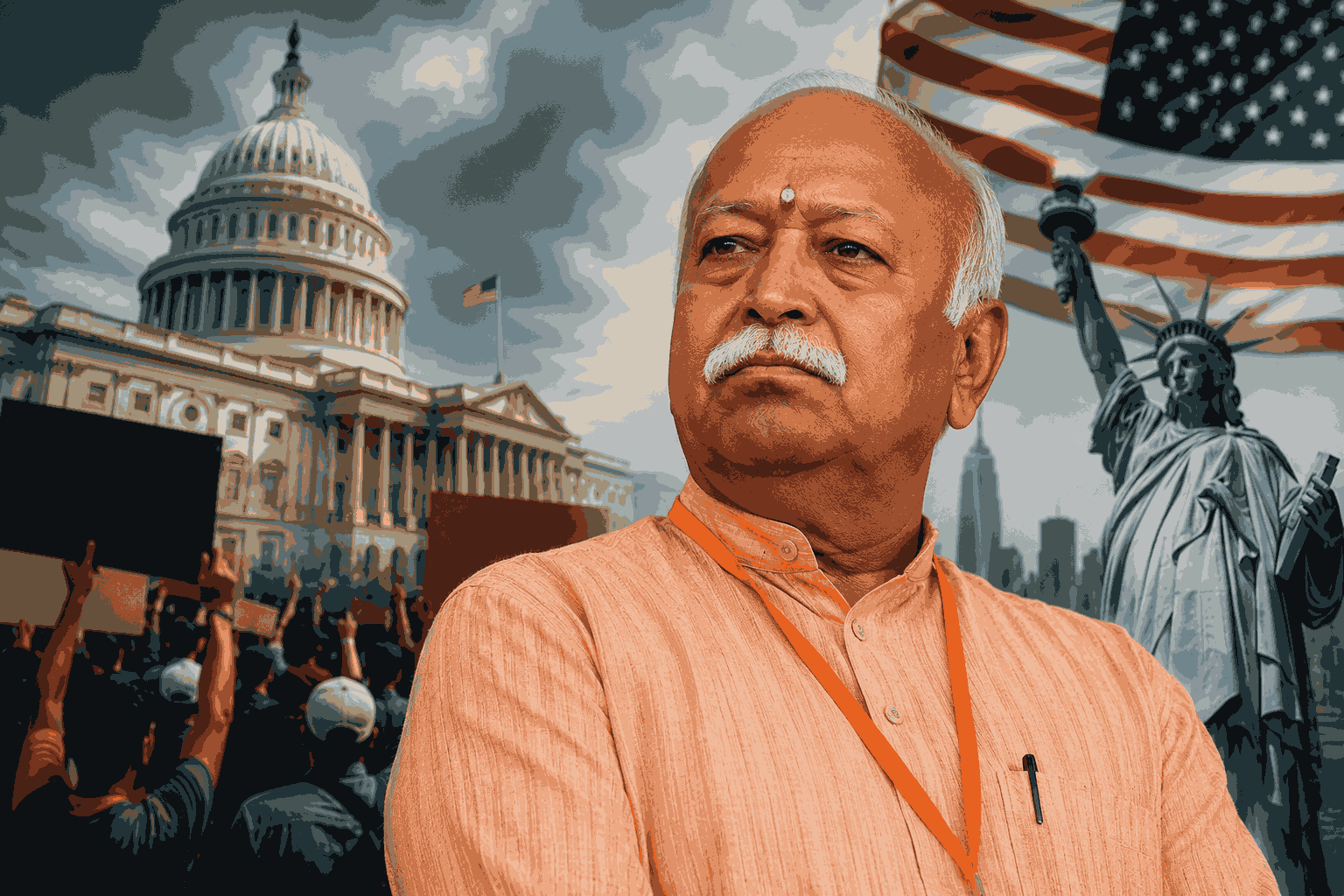
A fresh hate campaign has emerged in the United States ahead of RSS chief Mohan Bhagwat’s scheduled visit, with Chicago-based organisation Justice For All launching an online petition urging the US government to deny him entry. Bhagwat is scheduled to travel to the US, Canada and the UK from August 25 at the invitation of organisations connected with the Indian diaspora. His visit comes during the RSS centenary year and is expected to include meetings with community members and participation in public programmes.
The controversy began after Justice For All called on supporters to pressure US Secretary of State Marco Rubio over Bhagwat’s proposed visit. In its campaign, the organisation accused the RSS of being part of what it described as an extremist movement and argued that Bhagwat’s presence in America would legitimise the organisation. These are allegations made by Justice For All and should be understood as part of an ongoing political and ideological dispute rather than established findings against Bhagwat or the RSS.
The organisation’s intervention has attracted attention because of the sharp language used in its campaign. Justice For All describes itself as an American human-rights organisation advocating for Muslim minorities. Its own website lists campaigns concerning India, Kashmir, Rohingya Muslims and Uyghurs, among other issues. It also says that it works with policymakers and participates in advocacy activities in Washington and at the United Nations.
For Indian observers, the latest hate campaign is significant because Justice For All has previously campaigned on issues involving India and Prime Minister Narendra Modi. According to the organisation’s own website, its “Save India” campaign seeks to raise awareness about what it considers violations affecting Muslims and other minorities in India. It has also stated that a petition opposing an honour for Modi by the Bill & Melinda Gates Foundation collected more than 100,000 signatures.
The organisation was founded in 2001 by Pakistani-born American imam and author Abdul Malik Mujahid. OpIndia’s report highlights Mujahid’s earlier association with Islami Jamiat-e-Talaba, a student organisation affiliated with Jamaat-e-Islami Pakistan. That history has become a major part of the criticism directed at Justice For All by its opponents. However, an individual’s past organisational association does not by itself establish that every position taken by a present-day organisation is directed by Pakistan or represents the views of its members.
The current hate campaign also reflects a wider struggle over how India is portrayed before Western audiences. Justice For All has sought to persuade American policymakers to adopt stronger measures against Indian institutions, while its critics argue that such advocacy presents a one-sided picture of India and disproportionately focuses on allegations involving Hindus, the RSS and the Indian government. The disagreement is therefore not simply about one overseas visit; it is part of a much larger contest over India’s image abroad.
Bhagwat’s proposed programme has added urgency to the dispute. According to the report, he is expected to address the Indian-American community in New York on August 29 at a “Universal Oneness Celebrations” programme, where more than 5,000 people could attend. Justice For All has criticised the event and objected to what it sees as the normalisation of the RSS in the United States.
The latest hate campaign has also drawn attention to the role played by advocacy groups in shaping foreign perceptions of India. American political institutions regularly hear competing representations from diaspora organisations, rights groups and civil-society bodies. Such advocacy is legitimate in a democratic system, but claims about another country can become highly contentious when political campaigning, historical disputes and questions of religious identity overlap.
Justice For All has additionally supported calls associated with the US Commission on International Religious Freedom concerning India. Its website currently features a range of India-focused statements, including criticism of Indian citizenship documentation and campaigns relating to Kashmir and religious minorities. The organisation therefore has a continuing record of public advocacy on Indian affairs rather than making an isolated intervention over Bhagwat’s visit.
At the heart of the hate campaign controversy is a basic question: should political disagreement over India determine whether an Indian social leader is permitted to visit the United States? Justice For All believes Bhagwat’s visit should be opposed. His supporters, naturally, view the campaign as an attempt to stigmatise the RSS and silence a prominent Indian voice overseas.
The coming days are likely to see more debate as Bhagwat’s tour approaches. The episode illustrates how India’s domestic ideological battles increasingly travel across borders, particularly through diaspora networks and American advocacy platforms. For Indian-Americans preparing to attend Bhagwat’s programmes, the dispute may become another highly visible confrontation over identity, politics and competing narratives about India.
The hate campaign surrounding the visit ultimately places the spotlight not only on Bhagwat and the RSS but also on the increasingly influential role of diaspora politics. Whatever one’s political position, allegations of discrimination, extremism or persecution should be examined against evidence, while opposition to political figures should remain within the boundaries of democratic debate. Bhagwat’s visit will now be watched closely, not merely as an overseas engagement by an RSS leader, but as a test of how sharply competing narratives about India can collide on American soil.