
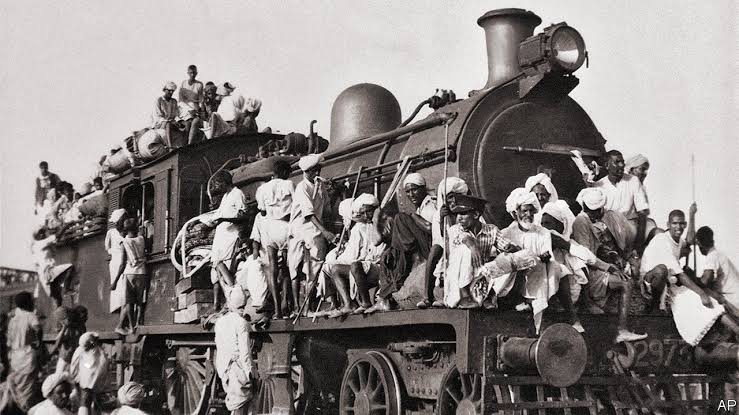
My grandfather used to work for the Railways. He was posted as Station Master at Daya Basti station, Delhi. In those days, one would get salary in cash. He used to get the salary deposited in Old Delhi GPO (General Post Office). Once in the year 1929, while he was there, a man standing beneath him told him not to deposit the salary in his account and buy some land in Delhi, where the Angrez were building Connaught Place and selling the land for 25 paisa a yard. My grandfather’s response was, “Hum Ravi ke kinare rehte hain, yahan tumhari Delhi mein sadne kaun aayega.” (We live on the banks of River Ravi, who will leave that place to live here in scorching heat.)
No one, especially Hindus, ever believed that we would be forced out of our homes from our native place. Our family used to live in Tehsil Shakkargarh on the banks of River Ravi. We had a huge factory manufacturing biscuits and candies by the name of “Punjab Biscuit Factory”. Within a span of 18 years, everything was left behind. The only concern was to stay alive and to begin a new life in this part of Bharat. Shattered, few friends killed, others converted to Islam, women raped, girls kidnapped. The holocaust was massive. Hindus and Sikhs lost their wealth, properties, educational institutions, banks, insurance companies, newspapers and news magazines, even stock exchanges, to start a new life from zilch.
More than 10,00,000 murdered and rough estimate is 1,50,00,000 uprooted. The exchange and rehabilitation of population was poorly planned. The Sarhadis, Sindhis, Punjabis and Sikhs were left at the mercy of Muslims and Muslim League.
The violence of Partition did not happen in one place or in one form. Different towns, villages, and families were attacked, evacuated, killed, and left empty-handed, with no place to call home. Kamoke, Sharaqpur, and D.I. Khan offer glimpses into this violence and act as an eye-opener to the realities of Partition. Through testimonies, statements, and contemporary accounts, they reveal how quickly violence spread and how deeply it affected those who were forced to witness, endure, or flee from it.
The Kamoke Massacre
Statement of Shrimati Laj Wanti, widow of Shri Manak Chand, Age 23 years, caste Khatri, resident of Nurpur Sethi, District Jhelum, to the Chief Liaison Officer, Lahore.
On the 6th of Asuj (beginning of September, 1947), the Hindu employees left Khewra by trucks for evacuation.
Shrimati Laj Wanti travelled with her husband Shri Manak Chand, her one-and-a-half-year-old son, her uncle Ganda Mal, his wife Karma Wali and their small daughter. They left Khewra at about 4 p.m. and reached Pind Dadan Khan at about 4.30 p.m., where a large number of non-Muslims had collected at the railway station.
It was said that the train would be the last train for refugees to leave Pakistan. Approximately 5,000 people had collected to go in the train, including between 600 and 700 women. The train left Pind Dadan Khan at 10 p.m. on the 7th of Asuj. Fifteen men of the Pakistan Army were with the train as guards.
The train reached Kamoke railway station at about 8 p.m. Police came to the railway station and started searching the train. Every article belonging to the passengers was searched and even the women were searched. 97 guns and rifles were taken away, although they were licensed weapons, and even pen-knives were taken from the passengers. After the search, the passengers were asked to get into the train with their luggage.
When everybody had got into the train and the engine was whistling to indicate that it was going to start, “a huge crowd” came from the side of the Mandi and factories. They were armed with rifles, chhuras, axes, barchas and other lethal weapons. They entered the compartments and “started butchering male passengers.” The police and military were present, and passengers trying to escape were shot. Women were taken out and sorted, while the elderly women were later butchered and the younger ones distributed.
The Sharaq Pur Massacre
Sharaqpur is a municipal town and a Sub-Tehsil of District Sheikhupura. It is twenty miles from Lahore, situated on Lahore-Lyallpur Road. Its population was ten thousand, consisting of 10% Hindus and Sikhs. Leading Muslim Leaguers of the city gave us assurance by oath of the Holy Quran for protection. As advised by Mahatma Gandhi and believing the false assurance of Mr. Jinnah, we determined to continue in Pakistan.
Suddenly, on 27th August, 1947, we met with unprecedented brutality. At 9 a.m. on that day, a party consisting of Mr. Fazil Ilahi Kahli, Mr. Mohd. Rafiq s/o Khair Din, Mr. Mohd. Rashid s/o Khair Din, Mohd. Shafi Bhatti, Ibrahim Kasuria and Haji Mohd. Sharif, with four constables, armed with guns, rifles .303 and sten guns, attacked the non-Muslims and began to murder Hindus and Sikhs, with brutality which cannot be expected from a human being.
It is necessary to mention here that there was not a single man from outside among those brutes. They did not even spare the Government employees. Mr. Tek Chand Nanda, Second Master, Government School, Sharaqpur, was thrown off his house and shot dead. L. Moti Ram Gulati was first maimed and later shot dead. L. Labha Ram Sethi, Lumbardar’s eye-balls were removed and later he was thrown alive into Deg Nala. Small children were struck against the walls and some were cut into pieces. Total number of those escaped from those brutes was seventy-one out of one thousand. All were left penniless. Fifteen girls were abducted and whole property of Hindu-Sikh minority was looted.
The Riots in D.I. Khan and West Punjab
The riots spread to the N.W. Frontier Province in June. On the 3rd of June, the Hindus and Sikhs of D.I. Khan who had been living peacefully were suddenly attacked, 1,200 houses were burnt down, 1,600 were looted, 2,000 Hindus and Sikhs were forcibly converted to Islam and the loss of property amounted to ₹10 crores. As many as 1,200 people were killed. The story was repeated in Bahawalpur State. Posters were put on the city walls asking Hindus to quit or they would be murdered and looted. The actual operations for compelling the Hindus to quit were taken in hand in the first week of June when complete demoralisation set in among them.
The disorders had now overtaken the whole of the Frontier Province, Bahawalpur and the West Punjab. Gurgaon district was the only district affected in East Punjab. The despair of the Hindus and Sikhs was mounting. To all intents and purposes, they were being left defenceless and worse than defenceless because a civil war was now waging in West Punjab with a ferocity of which the outsiders could have no conception. There was a disintegration of judiciary and various services: the poison of racial hatred had done its work in the services promptly and stealthily. Millions were doomed to death, and they did not know where to turn for succour. A mob of Muslims had plundered the property of the complainant and his family and also burnt their houses. Nine members of his family were murdered or burnt dead.