
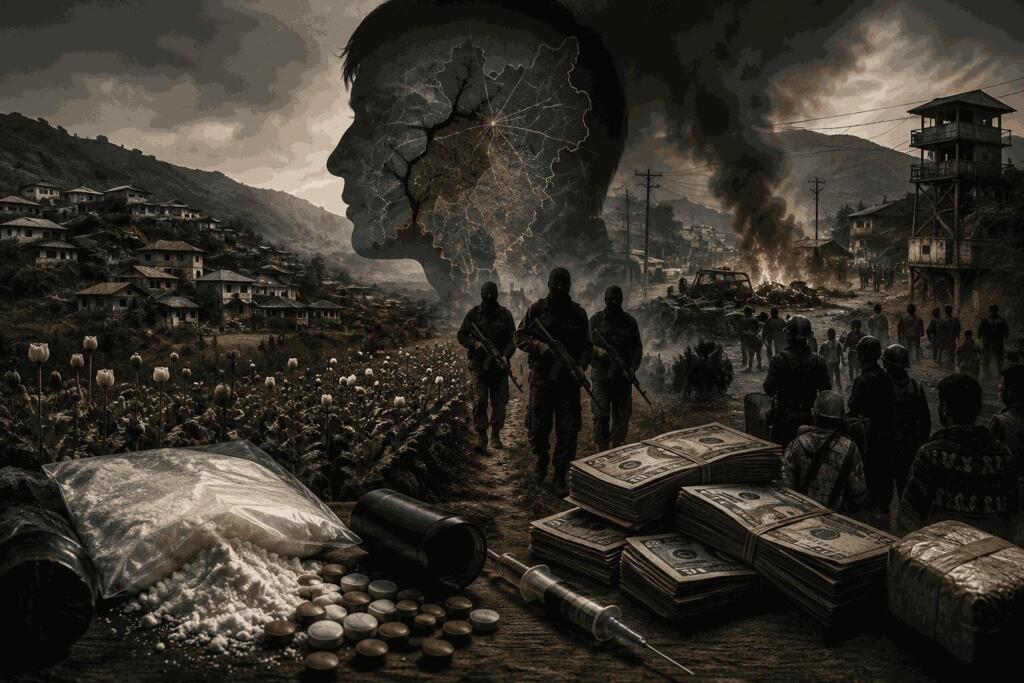
Talk to most people about Manipur’s conflict since May 2023, and you’ll hear about ethnic rivalry, land disputes, political representation. All real factors. But there’s an older story running underneath all of them — one that goes back four decades, not three years. Manipur has a narcotics economy, and it’s been quietly doing damage long before the current crisis broke out: bankrolling insurgents, hollowing out governance, turning whole districts into criminal territory, and feeding conflicts that on the surface look like they’re about something else entirely. You can’t really understand why this state stays so unstable without understanding how the drug trade got woven into it.
Geography as Destiny
Manipur’s problem starts with a map. It shares a 400-km border with Myanmar, right next door to the Golden Triangle — one of the largest opium-producing regions on earth. Back in the late 1970s and early 1980s, when Southeast Asian governments started clamping down harder on trafficking, the smuggling routes simply moved. Manipur was the obvious detour: porous border, difficult terrain, and armed groups already in place who were happy to help things move through. Analysts today put the figure at around 90% — that’s the share of drugs passing through India’s Northeast that trace back to Myanmar.
Wave One: The Addiction Crisis
Being a transit point turned out not to be the whole story. Somewhere along those smuggling routes, heroin started staying behind. Through the late ’80s and into the ’90s, a heroin “spillover” set off one of the worst outbreaks of injecting drug use anywhere in India. By the mid-2010s, health data showed Manipur carrying some of the country’s highest HIV rates — shared needles doing most of the damage. The estimated number of users, across every community in the state, ran to 120,000 or more. That first wave left more than an addiction crisis behind it. It normalized the trade itself, built the distribution networks that would outlast it, and folded narcotics quietly into the state’s informal economy.
When Insurgents Discover the Drug Trade
Manipur already holds the record for the highest density of active insurgent groups anywhere in Northeast India. Over time, a lot of these outfits drifted — from something like a revolutionary project toward something closer to organized crime, with extortion, arms running, and drug trafficking becoming their real bread and butter. The paper trail on this is not subtle. Open-source terrorism databases and government records show valley-based groups like UNLF, PLA, and KYKL, and hill-based outfits too — including some that had actually signed Suspension of Operations agreements with the government — taxing, protecting, or directly running drug shipments. A Manipur police official put it bluntly back in 2019: groups were using poppy cultivation to fund themselves, calling it “a crude form of narco-terror funding system.” None of this was hard to sustain, either — ethnic communities straddle the Indo-Myanmar border, and the Free Movement Regime, which allowed visa-free travel up to 16 km across it, made the whole arrangement easier than it should have been.
Wave Two: From Corridor to Cultivation
Somewhere in the last twenty years, Manipur stopped being just a route the drugs passed through and became a place where they were actually grown. Myanmar’s military had already been letting ethnic militias fund themselves through narcotics, and after the 2021 coup weakened whatever governance existed in the borderlands, poppy fields spread fast on both sides of the line. The UNODC flagged unusually dense cultivation in northern Chin State, just across from Manipur. And when Manipur itself was surveyed by satellite and drone, the numbers were stark: over 15,000 acres of illegal poppy under cultivation, spread across Kangpokpi, Ukhrul, Chandel, Churachandpur, and Tengnoupal. From there, the opium moved into Myanmar for processing into heroin — alongside methamphetamine pills and crystal meth coming out of labs in Shan State.
The War on Drugs, and What Came After
In 2017, the state government launched a formal war on drugs — the first real, sustained attempt to go after this economy rather than just its symptoms. Between 2017 and 2023, security forces tore up more than 18,600 acres of poppy — almost ten times what had been destroyed in the previous stretch, 2013 to 2016, when the figure sat at just 1,889 acres. Over 2,500 people were arrested under the NDPS Act, from every community in the state. In just one year — July 2022 to July 2023 — seizures totaled roughly $193 million. This wasn’t a symbolic gesture; it went straight at the money that kept armed groups and their backers running. And it’s not a coincidence, according to both government assessments and independent civil society analysis, that the violence which erupted in May 2023 followed close on the heels of this disruption — even as the eradication drive itself got tangled up in the broader ethnic conflict.
Where Things Stand Today
Three years in, drugs are still at the center of it all. Manipur Police reported destroying 2,618 acres of poppy between November 2025 and February 2026 alone — which tells you something important: this isn’t a scattering of individual farmers, it’s organized networks that keep replanting no matter how much gets destroyed. More than 19,000 acres have been wiped out since 2017, and still the cultivation returns. Armed groups keep fighting over who controls the growing areas and the trafficking routes, using what they earn to buy weapons and prop up shadow administrations. That the central government is now moving to end the Free Movement Regime, approve a border fence, and revisit Suspension of Operations agreements says a lot — it’s an acknowledgment, finally, that none of this gets resolved without dealing with the drug economy first.
The Bottom Line
Manipur’s Narco-terrorism didn’t grow out of the current conflict — it’s one of the things that caused it. Over more than forty years, the state has moved through every stage: transit corridor, then addiction crisis, then funding engine for insurgents, and now an actual production center for drugs in its own right. Real peace in Manipur is going to require sustained counter-narcotics work — continued eradication, real alternative livelihoods for the farmers currently growing poppy, tighter border management, financial pressure that actually starves armed groups, and genuine cooperation with Myanmar. Until the poppy economy comes down, it’s hard to see how the armed conflict really ends.