
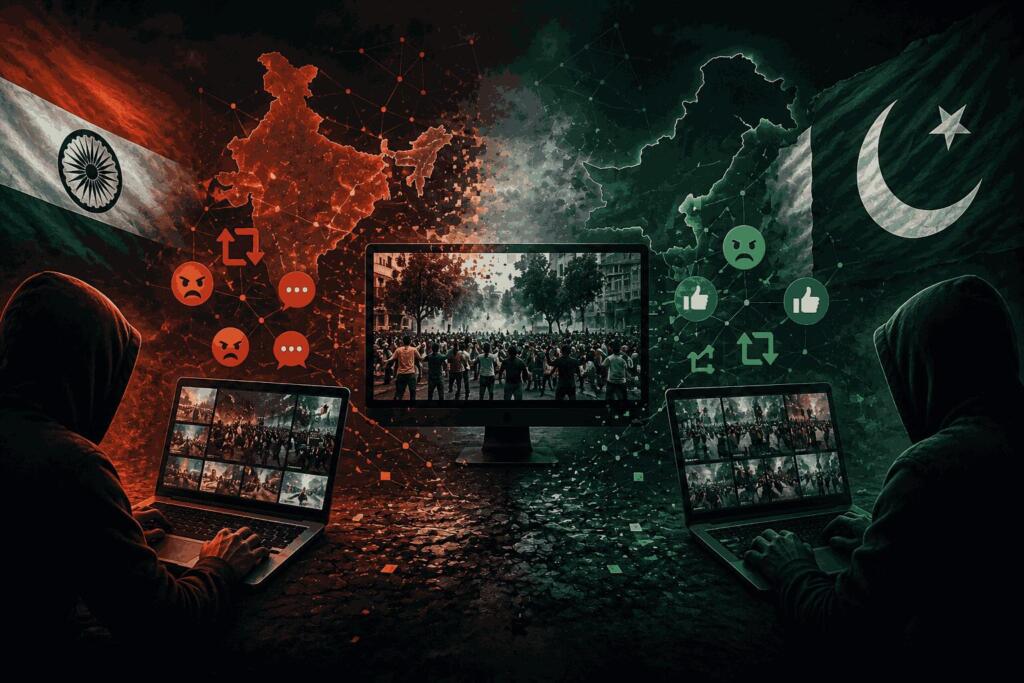
The role of Pakistani influencers in amplifying controversial narratives around the recent CJP protest has come under renewed scrutiny after social media platforms witnessed a surge in misleading claims targeting India’s institutions and government. Reports suggest that several viral posts carried unverified allegations, exaggerated casualty figures, and manipulated visuals that quickly spread across digital platforms before being challenged by fact-checkers and authorities.
The controversy has once again highlighted how social media has become a powerful battlefield for information warfare. During periods of political tension, misleading content can travel across borders within minutes, making it increasingly difficult for ordinary users to distinguish between verified news and coordinated disinformation. Security analysts have repeatedly warned that digital influence campaigns often seek to inflame emotions rather than promote factual debate.
According to reports, several accounts circulated claims alleging large-scale violence, fatalities, and military involvement in handling the demonstrations. Many of these assertions were either unsupported or contradicted by official statements, prompting authorities to advise citizens against sharing unverified content. Delhi Police also announced action against hundreds of Pakistani-linked social media accounts accused of spreading misinformation surrounding the protests.
The conduct of some Pakistani influencers has therefore attracted criticism from observers who argue that sensitive domestic developments in India should not be exploited to circulate sensational or fabricated narratives. Experts caution that misinformation not only distorts public understanding but also risks escalating tensions by provoking emotional reactions before verified facts emerge.
Digital misinformation has become an increasingly complex challenge because coordinated campaigns frequently rely on edited videos, misleading captions, recycled images, and anonymous accounts to maximise online engagement. Once such content goes viral, corrections often fail to achieve the same reach, allowing false narratives to persist long after they have been debunked. Analysts argue that this asymmetry makes online propaganda particularly dangerous during politically charged events.
Several researchers studying information warfare note that hostile online ecosystems often attempt to exploit domestic controversies in rival countries to deepen divisions and weaken public trust. In this context, Pakistani influencers accused of promoting misleading narratives have become part of a broader debate about cross-border digital interference and the responsibilities of influential social media personalities.
The episode has also renewed calls for stronger verification mechanisms across major social media platforms. Critics argue that technology companies must respond more rapidly to coordinated misinformation campaigns, especially when fabricated claims concern public safety or law enforcement actions. Greater transparency regarding coordinated networks and quicker removal of demonstrably false content could help limit the spread of harmful narratives.
Cybersecurity specialists further argue that media literacy is becoming as important as technological safeguards. Citizens are increasingly encouraged to verify information through multiple credible sources before forwarding dramatic claims online. In an era where manipulated content can be produced and distributed within minutes, public vigilance remains one of the strongest defences against organised disinformation campaigns.
The controversy has simultaneously highlighted the geopolitical dimension of online influence operations. Social media has evolved beyond a platform for personal expression into a strategic arena where narratives can shape public opinion, influence international perceptions, and intensify diplomatic tensions. Consequently, activities by Pakistani influencers are likely to remain under close scrutiny whenever sensitive developments in India attract global attention.
For India, the latest controversy underscores the growing need to strengthen cyber resilience while protecting the integrity of public discourse. Authorities, technology companies, and civil society all have important roles in identifying coordinated misinformation without undermining legitimate freedom of expression. At the same time, responsible digital behaviour by users can significantly reduce the impact of fabricated narratives.
As investigations into online activity continue, the broader lesson extends well beyond a single protest. Information warfare has become an integral feature of modern geopolitics, where viral posts can influence perceptions almost instantly. Whether through stronger platform moderation, improved digital awareness, or enhanced international cooperation against coordinated disinformation, addressing these challenges will remain a priority. The debate surrounding Pakistani influencers serves as another reminder that misinformation can travel faster than facts, making verification and responsible journalism more important than ever.