
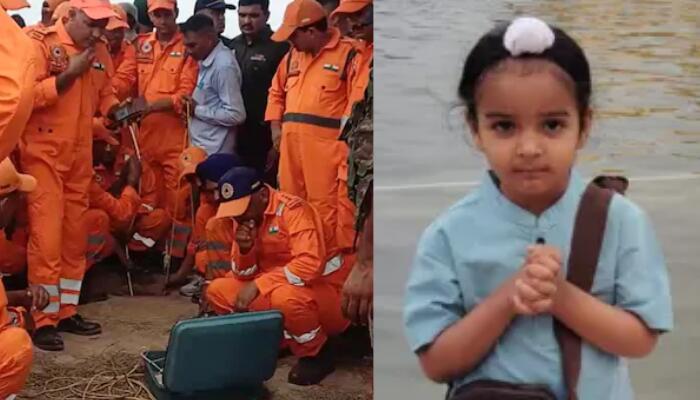
A desperate 21-hour rescue mission to save a four-year-old boy trapped inside a 220-foot-deep open borewell in Haryana’s Ambala district ended in heartbreak early Wednesday, as doctors declared the child dead shortly after he was pulled from the narrow shaft.
The victim, Nirvair Singh, had fallen into the uncovered borewell in Dhaneora village at around 6.30 a.m. on Tuesday, triggering an intensive rescue operation involving the Indian Army, the National Disaster Response Force (NDRF), the State Disaster Response Force (SDRF), district administration and police personnel.
After being retrieved at approximately 3.40 a.m. on Wednesday, the child was rushed by ambulance to the Civil Hospital in Ambala Cantonment. However, medical officers confirmed that he had been brought dead. Doctors said a post-mortem examination would establish the precise cause of death.
A Routine Visit Turned Into an Unimaginable Tragedy
According to the family, Nirvair had accompanied his father, Manjit Singh, to their agricultural fields to deliver breakfast to his grandfather, Karnail Singh, who had begun work early that morning.
While his father attended to farming activities and his grandfather ate, the child wandered away to play. He reportedly noticed an uncovered borewell and began dropping clumps of soil into it. As he leaned over to hear the echo, the damp and unstable soil around the nine-inch-wide opening gave way, causing him to plunge deep inside.
Family members rushed towards the borewell after hearing the sound of the fall and repeatedly called out to him. When their attempts to rescue him failed, they alerted the authorities around 7.30 a.m., prompting an immediate emergency response.
Rescue Teams Battled Water, Rain and Unstable Ground
The rescue operation soon evolved into a complex engineering challenge. Officials said the borewell was approximately 220 feet deep, while rescuers faced relentless obstacles including water seepage, loose soil and persistent rainfall, forcing teams to repeatedly revise their strategy.
NDRF Assistant Commandant Anil Kumar said the child remained trapped inside a water-filled shaft, with rising water levels and continuous sinking making the operation increasingly difficult. Rescue personnel dug parallel shafts and employed specialised equipment in repeated attempts to reach the child safely.
Haryana Cabinet Minister Anil Vij visited the site on Tuesday evening to review the rescue efforts and meet the grieving family.
Negligence Under Scanner
Even before the rescue operation concluded, Ambala Deputy Commissioner Ajay Singh Tomar directed the police to initiate action against those responsible for leaving the borewell uncovered.
Calling the incident entirely preventable, Tomar said even a basic protective covering could have averted the tragedy. He also appealed to farmers across the region to ensure that abandoned or unused borewells are securely sealed to prevent similar accidents.
The incident has once again revived painful memories of India’s recurring borewell tragedies. While Haryana’s widely remembered 2006 rescue of five-year-old Prince ended in celebration after a dramatic 48-hour operation, many subsequent cases across the country have resulted in the loss of young lives despite large-scale rescue efforts.
The death of Nirvair Singh serves as yet another grim reminder that the continued existence of unsecured borewells remains a preventable public safety hazard, demanding not only accountability after tragedy strikes but also rigorous enforcement before another child pays the ultimate price.