
Pakistan’s repeated attempts to raise the Kashmir issue at the United Nations met with a firm and unambiguous response from India at the UN General Assembly, where New Delhi accused Islamabad of misusing global institutions and circulating what it described as misinformed and misleading narratives to advance political objectives.
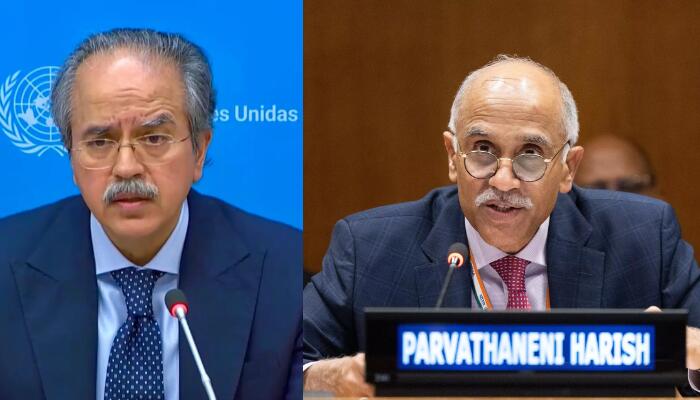
Addressing the plenary session on the Annual Report of the United Nations Security Council, India’s Permanent Representative to the UN, Ambassador Parvathaneni Harish, directly objected to Pakistan’s reference to Jammu and Kashmir, reiterating that the matter remains strictly internal to India.
“The unwarranted reference by Pakistan to a matter strictly internal to India, the Union Territory of Jammu and Kashmir, has compelled me to respond,” Harish said, making India’s position clear on the international stage.
However, India’s response went significantly further than a routine rebuttal. Harish accused Pakistan of abusing its position as a non-permanent member of the Security Council and using even high-level UN platforms to circulate what India termed “misinformed and misleading communications”.
“Pakistan has decided not to spare this forum either from their characteristic misuse of august UN platforms for their divisive political interests,” he said, adding that membership of the Security Council carries “huge responsibility” and is not a platform for “peddling biased and false narratives”.
He further dismissed Pakistan’s assertions on Kashmir in categorical terms, stating that “empty rhetoric and hollow claims would not change this fundamental reality,” reaffirming that Jammu and Kashmir “was, is, and will always remain” an integral and inalienable part of India.
India Draws a Hard Diplomatic Line on Kashmir
Pakistan has long attempted to internationalise the Kashmir issue despite India’s consistent position that it falls entirely within its sovereign jurisdiction. Yet the tone of India’s response this time reflected a sharper and more assertive diplomatic posture.
Rather than merely rejecting Pakistan’s claims, New Delhi questioned Islamabad’s credibility and highlighted what it described as a pattern of misuse of international institutions for political messaging.
The Indian envoy’s remarks underscored New Delhi’s position that the constitutional and legal status of Jammu and Kashmir is settled and not open to external debate or reinterpretation.
India Pushes for Reform of an Outdated Global System
The exchange took place during broader discussions on the functioning of the Security Council, giving India another opportunity to reiterate its long-standing demand for structural reform of the United Nations system.
Harish argued that the Security Council continues to operate within a geopolitical framework shaped in 1945, which no longer reflects present-day realities. According to India, this outdated structure has limited the Council’s effectiveness in addressing contemporary global challenges.
New Delhi reiterated its demand for expansion of both permanent and non-permanent membership categories, arguing that meaningful reform is essential for making the institution more representative and credible.
India also called for the Security Council’s annual report to be more analytical in nature rather than a mere compilation of events. Harish said it must honestly reflect both achievements and shortcomings in maintaining international peace and security. He also urged that the report be submitted earlier in the year to improve its relevance and utility.
During the session, India congratulated Austria, Kyrgyzstan, Portugal, Trinidad and Tobago, and Zimbabwe on their election to the Security Council for the 2027–28 term.
Gilgit-Baltistan Elections Add Fresh Diplomatic Strain
The UN exchange came just a day after the Ministry of External Affairs lodged a strong protest against Pakistan’s decision to hold elections for the so-called Gilgit-Baltistan Assembly on 7 June.
India reiterated that Jammu and Kashmir and Ladakh, including territories currently under Pakistan’s illegal occupation, legally and irrevocably acceded to India in 1947. It categorically rejected any attempt by Pakistan to alter the status of these regions and asserted that such measures cannot legitimise continued occupation.
New Delhi further maintained that Pakistan must vacate the territories it illegally occupies and said that such political exercises cannot obscure issues of political repression, economic exploitation, denial of freedoms, and alleged human rights violations in those areas.
A Clear Diplomatic Signal
India’s interventions at the United Nations and its protest over Gilgit-Baltistan reflect a broader and more assertive diplomatic strategy. New Delhi is no longer restricting itself to rebutting Pakistan’s statements on Kashmir. Instead, it is actively challenging Islamabad’s conduct, questioning its use of global institutions, and pushing back against what it sees as repeated attempts to distort international discourse.
The message from India’s latest intervention was direct and deliberate: if Pakistan continues to use global platforms as political instruments, India is prepared to confront those narratives openly, consistently, and without diplomatic hesitation.