






















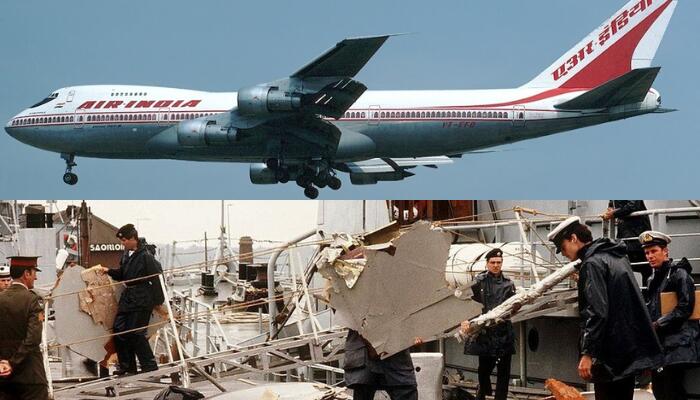
More than forty years after the bombing of Air India Flight 182, Canada has publicly acknowledged what India had asserted from the very beginning. In a landmark shift, the Canadian Security Intelligence Service (CSIS) has officially identified Canada-based Khalistani extremists as the perpetrators of the 1985 Kanishka bombing, ending decades of official reluctance to publicly attribute the country’s deadliest terrorist attack to Khalistani terrorism.
The acknowledgement came on June 23, as Canada observed the National Day of Remembrance for Victims of Terrorism, a day instituted in 2005 to honour those killed in terrorist attacks, particularly the victims of the Kanishka tragedy. Marking the 41st anniversary of the bombing, CSIS paid tribute to the 329 victims through a public social media post, describing the incident as a “heinous terrorist attack” carried out by Canada-based Khalistani extremists. The statement marked the first occasion on which Canada’s premier intelligence agency publicly and unequivocally attributed responsibility for the attack to Khalistani extremists.
Canadian Prime Minister Mark Carney echoed that assessment while paying tribute to the victims. Calling the Kanishka bombing the deadliest terrorist attack in Canada’s history, he reaffirmed Canada’s resolve to combat violent extremism in all its forms and remembered the 329 people who lost their lives, including 268 Canadian citizens, most of them of Indian origin, and 24 Indian nationals.
The Bombing That Changed Aviation History
On June 23, 1985, Air India Flight 182, a Boeing 747 named Kanishka, departed Montreal for New Delhi via London carrying 307 passengers and 22 crew members. Around 45 minutes before its scheduled landing at London’s Heathrow Airport, a powerful explosion ripped through the aircraft over the Atlantic Ocean off the coast of Ireland.
The aircraft disintegrated in mid-air, killing everyone on board. Recovery teams later retrieved wreckage and victims’ remains from the Atlantic in one of the largest search operations following an aviation disaster.
Investigators established that the explosion was caused by a bomb concealed inside checked baggage loaded onto the aircraft. The passenger who had checked in the suitcase never boarded the flight.
Canadian investigators concluded that the bombing had been orchestrated by members of the banned Khalistani organisation Babbar Khalsa in retaliation for Operation Blue Star, the Indian Army’s 1984 operation against heavily armed terrorists inside the Golden Temple complex in Amritsar.
Before the September 11 attacks in 2001, the Kanishka bombing was the world’s deadliest act of aviation terrorism. More than four decades later, it remains Canada’s worst terrorist attack.
Four Decades of Institutional Failure
Canada’s acknowledgement inevitably raises a question: why did it take forty-one years to publicly identify Khalistani extremists as the perpetrators when investigators had long reached that conclusion?
Much of the answer lies in the findings of the 2010 Commission of Inquiry headed by former Supreme Court of Canada Justice John Major, which described the investigation as being undermined by a series of institutional failures.
Among the most damaging mistakes was CSIS’s decision to destroy hundreds of hours of intercepted telephone conversations involving Babbar Khalsa leader Talwinder Singh Parmar, who had been under surveillance before the bombing. The destruction of those recordings deprived investigators of potentially crucial evidence.
The inquiry also exposed poor coordination between CSIS and the Royal Canadian Mounted Police (RCMP), with intelligence-sharing failures weakening the investigation at several critical stages.
Equally troubling was the perception within sections of the Canadian establishment that the bombing was primarily an Indian issue because the aircraft belonged to Air India, despite 268 of those killed being Canadian citizens. The commission concluded that this mindset prevented Canada from treating the attack with the urgency expected of a domestic national security crisis.
The prosecution suffered further setbacks as witnesses faced intimidation and, in some instances, were murdered before they could testify. With crucial evidence weakened, Canadian courts acquitted the principal accused in 2005.
Former Prime Minister Stephen Harper apologised in 2010 for Canada’s failures in investigating the bombing and for the suffering endured by the victims’ families. Yet, even after that apology, successive governments continued referring only to “extremists” or “militants”, carefully avoiding any explicit reference to Khalistani extremists.
Canada’s Security Assessment Begins to Mirror India’s Concerns
The latest acknowledgement is not an isolated development.
In its 2025 Annual Report, CSIS identified Canada-based Khalistani Extremists (CBKE) as a national security threat for the first time. The report warned that some CBKE networks exploit Canadian institutions to promote violent extremist ideology, influence individuals, raise funds and divert financial resources towards violent activities. It concluded that the continued involvement of Canada-based Khalistani extremists in violent extremism poses a direct threat to Canada’s national security and Canadian interests.
That assessment closely mirrors concerns India has repeatedly raised for decades.
Successive Indian governments accused Canada of allowing pro-Khalistan organisations to operate under the protection of freedom of expression and political activity while ignoring allegations that elements linked to these networks were involved in terrorism, organised crime, targeted killings, human trafficking and extremist financing directed against Indian interests.
The Diplomatic Fallout
The Khalistan issue has remained one of the most contentious aspects of India-Canada relations.
Tensions escalated during former Prime Minister Justin Trudeau’s 2018 visit to India after Jaspal Atwal, who had been convicted in connection with the attempted assassination of a Punjab minister, received an invitation to an official event.
Relations deteriorated even further following Trudeau’s allegations linking Indian agents to the killing of Khalistani separatist Hardeep Singh Nijjar in British Columbia, triggering one of the deepest diplomatic crises between the two countries in recent decades. India rejected the allegations and maintained that Canada’s failure to curb extremist organisations operating from its territory had become the central issue.
From India’s Warning to Canada’s Admission
The Khalistan movement emerged during the 1970s and fuelled years of violent insurgency in Punjab. While the movement was eventually dismantled within India through sustained security operations, several extremist leaders and supporters relocated overseas, particularly to Canada, where pro-Khalistan organisations continued political mobilisation and advocacy.
For years, India argued that permitting extremist networks to function unchecked under the cover of democratic freedoms would eventually create wider security consequences. Those warnings were often dismissed as a bilateral disagreement or as an attempt to suppress political dissent.
Canada’s latest acknowledgement suggests that its own security establishment now views the issue differently.
By publicly identifying Canada-based Khalistani extremists as the perpetrators of the Kanishka bombing and classifying some of these networks as an ongoing national security threat, CSIS has effectively aligned Canada’s official security assessment with what India has consistently argued since 1985.
The significance of that admission extends beyond the historical record. It reflects an acceptance that the extremist ecosystem Canada was long accused of underestimating has evolved into a challenge that affects Canadian national security itself. Whether this marks the beginning of a sustained policy shift or simply a long-overdue recognition of reality will shape not only Canada’s counter-terrorism strategy but also the future trajectory of India-Canada relations.
