
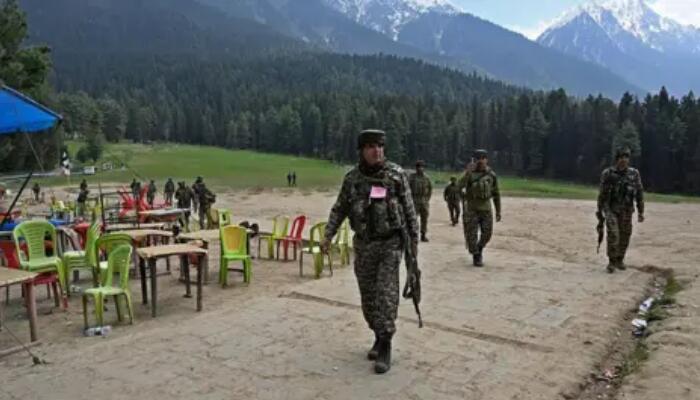
The National Investigation Agency has concluded that the 2025 Pahalgam terror attack, which killed 26 civilians in Jammu and Kashmir’s Baisaran Valley, operated under direct instructions from Pakistan-based handlers linked to Lashkar-e-Taiba and its proxy outfit The Resistance Front (TRF).
The agency’s chargesheet identifies Saifullah alias Sajid Jatt alias “Langda” as the mastermind behind the massacre. Investigators say he operated from Lahore and controlled the attack in real time while the killings unfolded in the valley.
According to the NIA, Saifullah stayed in constant contact with the attackers during the operation. He allegedly shared coordinates, guided their movement and directed escape routes through live communication channels.
The agency identified the three attackers as Faisal Jatt alias Suleiman, Habib Tahir alias Chhotu and Hamza Afghani. Investigators say the trio entered Baisaran Valley on April 15 and 16, 2025, to conduct reconnaissance before carrying out the attack on April 22.
The men reportedly surveyed tourist movement and studied security deployment in the area days before the massacre.
Pakistan links emerge through digital and technical evidence
The chargesheet relies heavily on technical evidence gathered during the investigation. The NIA says IP addresses, phone records and digital communication trails directly connect the attackers to handlers operating from Pakistan.
Security forces later killed the three terrorists during Operation Mahadev. Investigators recovered mobile phones from them and traced the devices back to Pakistan.
One phone reportedly originated from Lahore’s Quaid-e-Azam Industrial Estate. Another came from Karachi’s Shahra locality. The NIA says these findings strengthen the case for Pakistan-based logistical support behind the attack.
TRF propaganda network under scanner
The agency also investigated Telegram channels linked to TRF. According to the chargesheet, channels such as ‘Kashmir Fight’ and ‘TheResistanceFront_Official’ operated from Pakistan’s Khyber Pakhtunkhwa region and Rawalpindi.
TRF initially claimed responsibility for the attack through these channels. However, the group later denied involvement and claimed hackers had compromised the accounts after international outrage intensified.
The NIA rejects that explanation. Investigators believe the organisation attempted to push a false narrative after global criticism and condemnation from the international community.
Local support network helped attackers
The chargesheet also names two local residents, Parvez and Bashir Ahmed, as facilitators who allegedly helped the attackers during the operation.
Investigators further claim that Saifullah built a strong overground network in South Kashmir over the years. The NIA links him to cross-border arms smuggling and narcotics trafficking through drones after the abrogation of Article 370 in 2019.
The agency also states that Saifullah infiltrated Jammu and Kashmir in 2005 and stayed in Kulgam for nearly two years. During that period, he married a local woman named Shabbira and later returned to Pakistan. His son, however, continued living in Kashmir.
Pakistan’s denial versus NIA findings
Pakistan has denied involvement in the Pahalgam massacre and accused India of making politically motivated allegations. The NIA, however, says its investigation establishes a clear cross-border conspiracy backed by technical and human intelligence evidence.
The attack later triggered India’s military response under Operation Sindoor. Indian forces targeted terror infrastructure and launchpads across the border during the operation.
Through its chargesheet, the NIA has portrayed the Pahalgam massacre as a fully coordinated terror operation directed from Pakistan, supported by digital communication networks and executed with local logistical assistance inside Kashmir.