
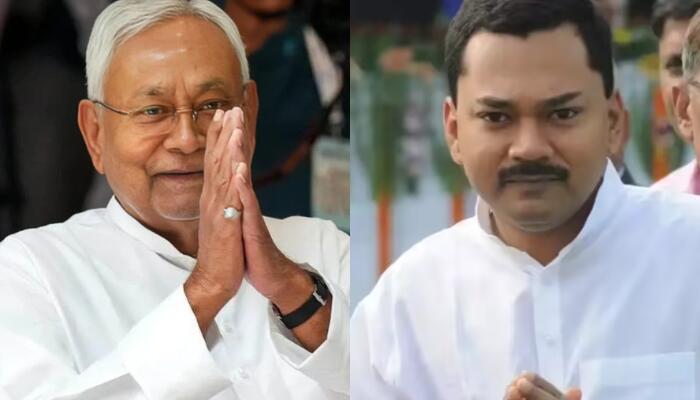
The NDA turned Bihar’s cabinet expansion into a major political statement as 32 ministers, including Nishant Kumar, took oath in Patna before the top leadership of the Bharatiya Janata Party and its allies. Far from being a routine administrative exercise, the event showcased how the BJP is steadily shaping Bihar’s future political structure while keeping allies firmly within the NDA fold.
The ceremony at Gandhi Maidan carried unusual political weight. Prime Minister Narendra Modi, Union Home Minister Amit Shah, Defence Minister Rajnath Singh, and BJP national president Nitin Nabin attended the event alongside senior NDA leaders. Their presence underlined Bihar’s growing importance in the BJP’s national strategy.
At the centre of the political conversation stood Nishant Kumar, son of former Chief Minister Nitish Kumar. His induction into the Bihar government marks the formal beginning of a carefully managed political transition inside the JD(U).
Nishant Kumar’s Entry Signals A Controlled Transition
For years, Nitish Kumar projected himself as a leader different from regional parties dominated by family politics. However, political survival often changes ideological positions. With Nitish Kumar shifting to the Rajya Sabha after stepping down as Chief Minister, the JD(U) needed both continuity and a recognisable political face.
Nishant Kumar’s entry appears to be the party’s answer.
Unlike many political heirs who receive instant promotions, Nishant’s rise was gradual. Party leaders maintained that he initially resisted joining the government despite pressure from JD(U) workers.
There was speculation that he could even become Deputy Chief Minister after Nitish Kumar vacated the top post. However, Nishant reportedly declined the proposal. Instead, he focused on understanding the party organisation and building public outreach.
In recent weeks, Nishant intensified his visibility through the “Sadbhav Yatra” across Bihar. During the outreach, he met residents and discussed issues linked to education, governance, and development. The exercise signalled that the JD(U) was preparing him as a long-term political face within the NDA framework.
Before taking the oath, Nishant met Nitish Kumar and senior JD(U) leaders in Patna. The moment carried symbolic significance for party workers witnessing the beginning of a generational shift.
BJP’s Larger Bihar Strategy Becomes Visible
The cabinet expansion reflected a carefully balanced social and political strategy. Of the 32 ministers sworn in, 15 belonged to the BJP and 13 to the JD(U). Alliance partners, including the Lok Janshakti Party (Ram Vilas), Hindustani Awam Morcha (Secular), and Rashtriya Lok Morcha, also received representation.
Several experienced leaders retained influential positions. These included Vijay Kumar Sinha, Ashok Choudhary, Shravan Kumar, Leshi Singh, and Ram Kripal Yadav. At the same time, the NDA inducted newer faces such as Nitish Mishra, Mithilesh Tiwari, Sheila Mandal, Ratnesh Sada, and Sweta Gupta.
The BJP’s broader strategy was clearly visible in the expansion. Despite emerging stronger after the 2025 Assembly elections, the party avoided politically weakening its allies. Instead, it continued with a coalition model where regional parties remain relevant but operate within a BJP-led framework.
The NDA’s landslide victory in the 2025 elections strengthened that approach. The alliance secured 202 seats in the 243-member Assembly. The BJP won 89 seats while the JD(U) secured 85.
Prime Minister Modi’s roadshow in Patna before and after the swearing-in further reinforced the message that Bihar remains central to the BJP’s future plans. The visuals from Gandhi Maidan projected an NDA that appears politically confident, electorally stable, and organisationally disciplined.
More importantly, the cabinet expansion showed how the BJP now handles coalition politics differently from older alliance-era parties. Rather than allowing allies to become competing power centres, the BJP appears focused on integrating them into a larger national political structure.
In that sense, Nishant Kumar’s rise is not merely the story of a political successor entering government. It is also the story of how the BJP is redesigning Bihar’s political balance while ensuring that future transitions remain aligned with the NDA’s larger national vision.