
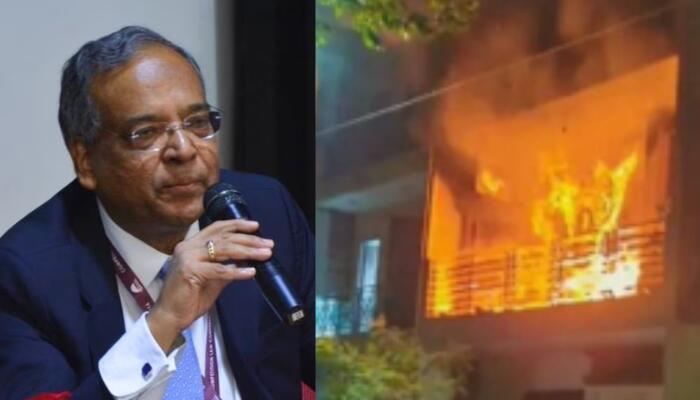
The death of retired IAS officer Dhanendra Kumar in a fire at his Hauz Khas residence has triggered concern over the growing dangers linked to air-conditioning systems during Delhi’s punishing summer. Investigators and safety experts now warn that electrical overload, poor maintenance and careless servicing are turning ordinary cooling appliances into major fire hazards.
Kumar, 80, served in several senior administrative positions during his career, including as India’s Executive Director at the World Bank board in Washington DC. He died after a late-night blaze erupted inside his south Delhi home on May 27. Preliminary findings suggest that a malfunction in the air-conditioning unit installed in his bedroom may have sparked the fire.
South Delhi Deputy Commissioner of Police Anant Mittal said Hauz Khas Police Station received a distress call at around 11:18 pm. Police teams rushed to the spot and found that two injured individuals had already been shifted to hospital in a PCR vehicle. Officers and residents tried to contain the flames before the Delhi Fire Service arrived.
Investigators believe smoke spread rapidly through Kumar’s room after the AC unit malfunctioned. The retired officer reportedly collapsed due to severe smoke inhalation before flames engulfed sections of the ground floor. Family members and domestic staff managed to pull him out of the room, but he remained unconscious while being taken to AIIMS Trauma Centre, where he later died.
Family Faced Thick Smoke During Rescue Effort
The incident unfolded while several family members were present at the residence for a gathering. Police said one of Kumar’s sons, who lives abroad, and his wife first noticed a strange burning smell inside the house before panic spread through the property.
The family immediately moved Kumar’s wheelchair-bound wife to safety. They then attempted to rescue him from the smoke-filled room. By then, thick smoke had covered the floor and visibility had dropped sharply, making access difficult.
Neighbours and PCR personnel later joined the rescue effort before firefighters arrived with two fire tenders under station officer Mukul Bharadwaj. Officials brought the blaze under control shortly after midnight. Cooling operations continued for nearly another half hour.
Police teams and electrical inspectors later examined the damaged AC unit, internal wiring and electrical systems inside the house. Investigators also recorded statements from eyewitnesses, family members and domestic staff.
Authorities have registered an FIR under provisions related to culpable homicide not amounting to murder. Officials continue to examine the exact technical failure that may have caused the explosion and fire. Police said no foul play has emerged so far.
Delhi Heatwave Raises Fear Over AC-Linked Fires
The Hauz Khas tragedy has intensified concerns over the growing number of AC-related fires during Delhi’s ongoing heatwave. Experts warn that prolonged usage, ageing wiring and poor servicing practices are creating dangerous conditions inside homes and commercial buildings.
Following the incident, the Chamber of Trade and Industry (CTI) issued a citywide safety advisory to nearly 20 lakh traders across Delhi. The organisation urged immediate inspection of air-conditioning systems operating in shops, offices, factories and warehouses.
CTI Chairman Brijesh Goyal said the body circulated advisories to 768 market associations and 56 industrial groups after the Hauz Khas fire triggered widespread concern.
According to CTI, refrigerant gas leaks, compressor overheating, faulty wiring, voltage fluctuations and improper servicing remain among the leading causes behind AC-related fires and explosions. The organisation also warned against the growing use of untrained mechanics and low-quality spare parts during peak summer months.
CTI noted that gases such as R32 and R290, commonly used in modern AC systems, are mildly flammable. If these gases leak near electrical sparks caused by damaged wiring or short circuits, they can ignite quickly. The organisation also warned that some mechanics illegally use unsuitable gases such as LPG to reduce servicing costs, creating dangerous pressure conditions inside cooling systems.
Experts have advised residents to remain alert to warning signs such as burning smells, overheating, repeated tripping, unusual noises, sparks near sockets and reduced cooling efficiency. They have also recommended regular servicing, voltage stabilisers and professional inspections during extreme summer conditions.
Kumar’s death has now become more than an isolated household tragedy. The Hauz Khas fire has exposed the hidden risks inside India’s rapidly overheating cities, where rising temperatures and overworked cooling systems are increasingly colliding with weak maintenance standards and ageing electrical infrastructure.