



















In an era where political battles are increasingly fought on social media, a recent post by Nishikant Dubey has once again ignited a sharp ideological confrontation. The BJP leader has been consistently vocal in his criticism of what he terms the legacy of the Nehru Congress, and his latest remarks—shared via X (formerly Twitter)—fit squarely into that pattern of sustained political messaging.
Dubey has, in recent months, announced a broader campaign to highlight what he sees as historical and policy failures of the Congress party. He declared that he would post regularly, outlining both the “good and bad” decisions of Congress governments and their long-term impact on India’s development trajectory. This initiative reflects a deliberate attempt to frame contemporary political discourse through a historical lens, often invoking the Nehru Congress as a central reference point.
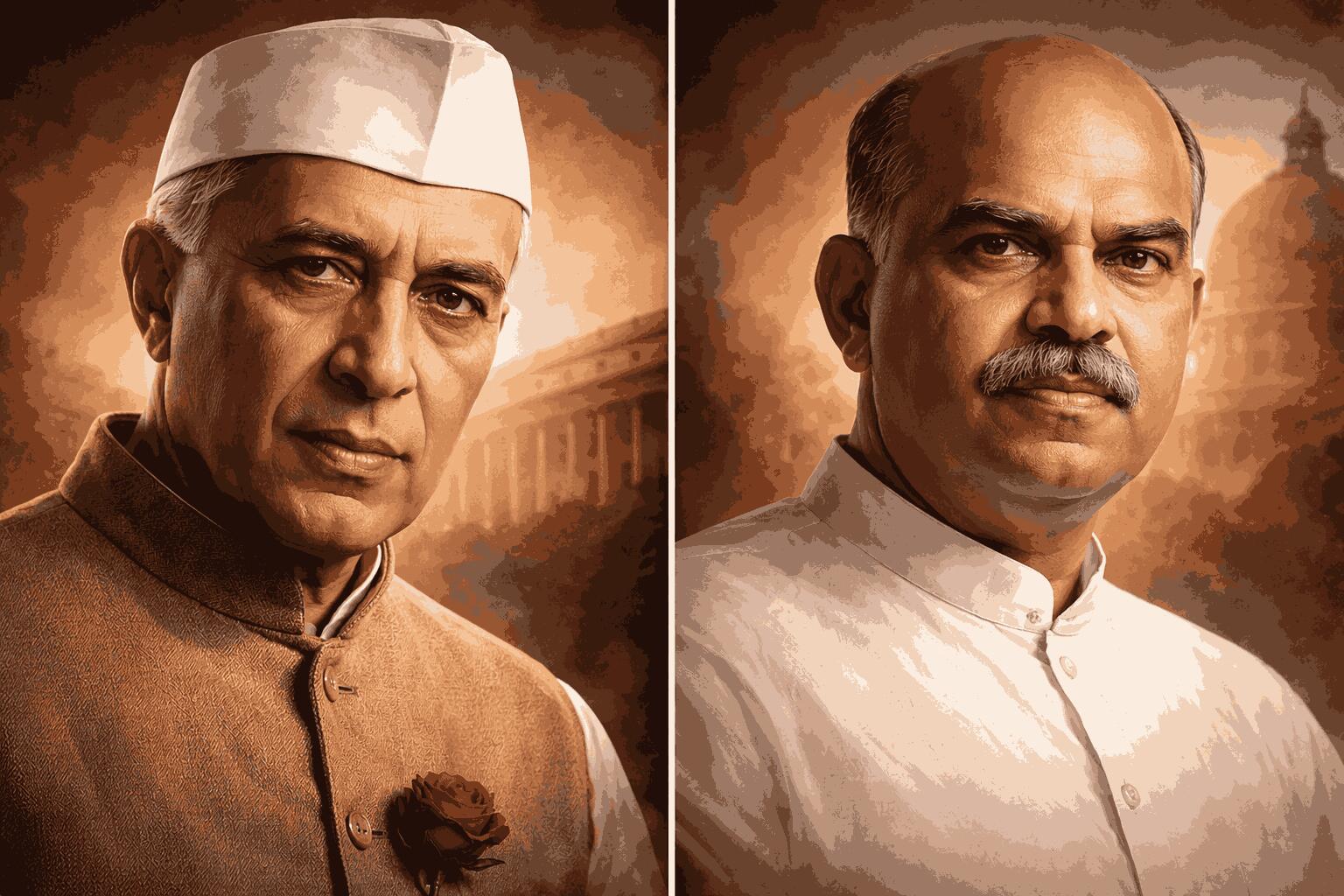
At the heart of Dubey’s argument lies the assertion that the policies and decisions taken during the early decades of independent India—particularly under Jawaharlal Nehru—have had lasting consequences. His critique of the Nehru Congress is not merely rhetorical; it is positioned as a systematic effort to revisit historical narratives and question the foundations of post-independence governance.
In contrast to Nehru’s leadership and vision, figures like Dr. Syama Prasad Mookerjee are often brought into the discussion as ideological counterpoints. Mookerjee, who later founded the Bharatiya Jana Sangh, articulated an alternative political vision rooted in strong nationalism and opposition to certain policies of the Nehru government. His resignation from Nehru’s cabinet and later political trajectory are frequently cited by critics of the Nehru Congress to highlight internal disagreements within the early Indian leadership.
The Nehru Congress, as invoked in such debates, often becomes shorthand for a broader ideological critique. Dubey and others argue that this period was marked by missed opportunities in economic development, strategic miscalculations in foreign policy, and an overreliance on centralized planning. These claims, however, are fiercely contested by Congress leaders and historians who emphasize the challenges of nation-building in a newly independent state and credit Nehru-era policies with laying the groundwork for democratic institutions and industrial growth.
Social media platforms have amplified these competing narratives. Dubey’s use of X allows him to bypass traditional media filters and communicate directly with a large audience. This strategy has proven effective in shaping public discourse, especially among politically engaged users. By repeatedly referencing the Nehru Congress, he reinforces a particular framing of history that aligns with his party’s ideological stance.
Critics, however, argue that such campaigns risk oversimplifying complex historical realities. They contend that reducing decades of governance to a series of social media posts may distort nuanced debates into polarizing soundbites. Furthermore, the personalization of historical critique—often targeting figures like Nehru or invoking leaders such as Mookerjee—can shift focus away from substantive policy discussions.
Nevertheless, the persistence of the Nehru Congress as a political motif underscores its enduring relevance in Indian politics. Even decades after independence, the legacy of early leadership continues to influence contemporary debates. For the ruling party and its supporters, revisiting this legacy serves as both a critique of past governance and a justification for current policy directions.
Dubey’s campaign also highlights a broader trend: the increasing use of historical narratives as tools of political mobilization. By invoking the Nehru Congress repeatedly, he seeks to create a continuity between past decisions and present challenges, thereby framing current governance as a corrective effort. This approach not only energizes supporters but also compels opponents to defend or reinterpret historical records.
The reaction to such messaging has been mixed. Supporters applaud the effort to bring historical accountability into public discourse, arguing that it encourages informed debate. Opponents, on the other hand, view it as selective interpretation aimed at political gain. The resulting exchanges often reflect deeper ideological divides rather than converging toward consensus.
Ultimately, the debate surrounding the Nehru Congress is unlikely to fade anytime soon. As long as political actors continue to draw upon history to legitimize their positions, figures like Dubey—and the contrasting legacies of leaders such as Jawaharlal Nehru and Dr. Syama Prasad Mookerjee—will remain central to shaping how that history is discussed and understood.
In this evolving landscape, the interplay between history, politics, and digital communication will continue to shape narratives. Whether one agrees with Dubey’s critique or not, his focus on the Nehru Congress underscores a key reality: in India, the past is never truly past—it is constantly being reinterpreted, debated, and deployed in the service of contemporary political goals.