




















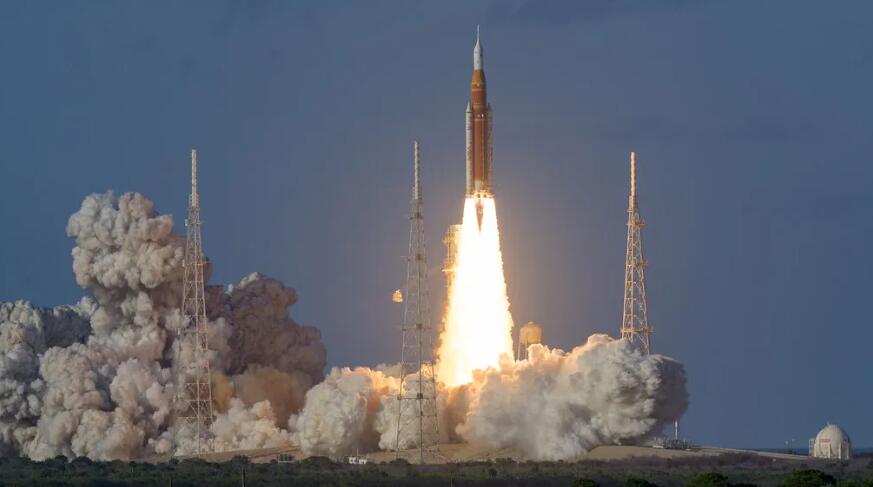
The Artemis II crew, comprising four astronauts, blasted off aboard a powerful NASA rocket, embarking on a long-awaited journey around the Moon, the first crewed lunar flyby in more than five decades.
Spurred by American ingenuity, the enormous orange-and-white rocket carrying three Americans and one Canadian took off from the Kennedy Space Centre in Florida around 22.35 GMT.
https://x.com/NASA/status/2039473910987534599?s=20
Just before liftoff, launch director Charlie Blackwell-Thompson delivered an inspiring message to the Artemis II crew, reminding them that they carry with them the collective effort, pride, and hopes of people around the world on this historic mission.
“On this historic mission, you take with you the heart of this Artemis team, the daring spirit of the American people and our partners across the globe, and the hopes and dreams of a new generation. Good luck, Godspeed Artemis II. Let’s go,” said Thompson reportedly.
Historic 10-Day Lunar Mission
The Artemis II team embarked on a 10-day journey around the Moon, marking a major step in human space exploration. Although the astronauts will not land on the lunar surface, the mission will include key experiments and preparations for a planned Moon landing in 2028.
The four astronauts launched aboard NASA’s powerful Space Launch System (SLS) rocket from Launch Pad 39B at the Kennedy Space Center at 6:35 p.m. EDT on Wednesday. They are traveling in the Orion spacecraft on a test flight designed to take them around the Moon and safely back to Earth.
“Today’s launch marks a defining moment for our nation and for all who believe in exploration. Artemis II builds on the vision set by President Donald J. Trump, returning humanity to the Moon for the first time in more than 50 years and opening the next chapter of lunar exploration beyond Apollo. Aboard Orion are four remarkable explorers preparing for the first crewed flight of this rocket and spacecraft, a true test mission that will carry them farther and faster than any humans in a generation,” said NASA Administrator Jared Isaacman as per reports.
“Artemis II is the start of something bigger than any one mission. It marks our return to the Moon, not just to visit, but to eventually stay on our Moon Base, and lays the foundation for the next giant leaps ahead,” he added.
Mission Goals and Crew Operations
The mission marks the first crewed flight under NASA’s Artemis program and includes astronauts Reid Wiseman, Victor Glover, Christina Koch, and Jeremy Hansen from the Canadian Space Agency.
One of the key objectives is to test life support systems with a human crew for the first time and prepare for a sustained human presence on the Moon, with future missions eventually targeting Mars.
Shortly after reaching space, Orion deployed its solar array wings to draw energy from the Sun. The crew and ground engineers then began transitioning the spacecraft from launch mode to full flight operations while checking essential systems.
“Artemis II is a test flight, and the test has just begun. The team that built this vehicle, repaired it, and prepared it for flight has given our crew the machine they need to go prove what it can do,” said NASA Associate Administrator Amit Kshatriya reportedly.
“Over the next 10 days, Reid, Victor, Christina, and Jeremy will put Orion through its paces so the crews who follow them can go to the Moon’s surface with confidence. We are one mission into a long campaign, and the work ahead of us is greater than the work behind us,” he added.
Journey Path, Experiments, and Return
About 49 minutes after launch, the SLS rocket’s upper stage fired to place Orion into an elliptical orbit around Earth. A second burn will push the spacecraft into a high Earth orbit extending about 46,000 miles beyond the planet. After this, Orion, named “Integrity” by the crew will separate and continue independently.
Several hours later, the rocket’s upper stage will deploy four CubeSats built by international partners, including Argentina, Germany, South Korea, and Saudi Arabia, for scientific research and technology demonstrations.
The spacecraft will remain in high Earth orbit for about a day, during which the crew will perform a manual piloting test and continue system checks with teams at Johnson Space Center.
If all systems function properly, mission controllers will command Orion’s European-built service module to perform a translunar injection burn on Thursday, April 2. This six-minute maneuver will send the spacecraft toward the Moon and use its gravity to guide the crew back to Earth.
During a planned lunar flyby on Monday, April 6, the astronauts will photograph and observe the Moon’s surface, including parts of the far side rarely seen by humans. The lighting conditions are expected to highlight surface features such as ridges, slopes, and craters. Scientific investigations, including studies like AVATAR, will also be conducted to support future missions.
After completing the flyby, the crew will return to Earth and splash down in the Pacific Ocean. As part of a broader era of innovation and exploration, NASA plans to send Artemis astronauts on increasingly complex missions to explore more of the Moon, support scientific discovery, create economic opportunities, and lay the groundwork for future human missions to Mars.