


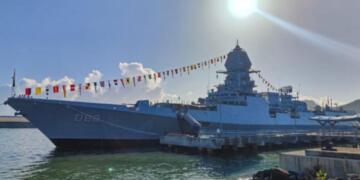














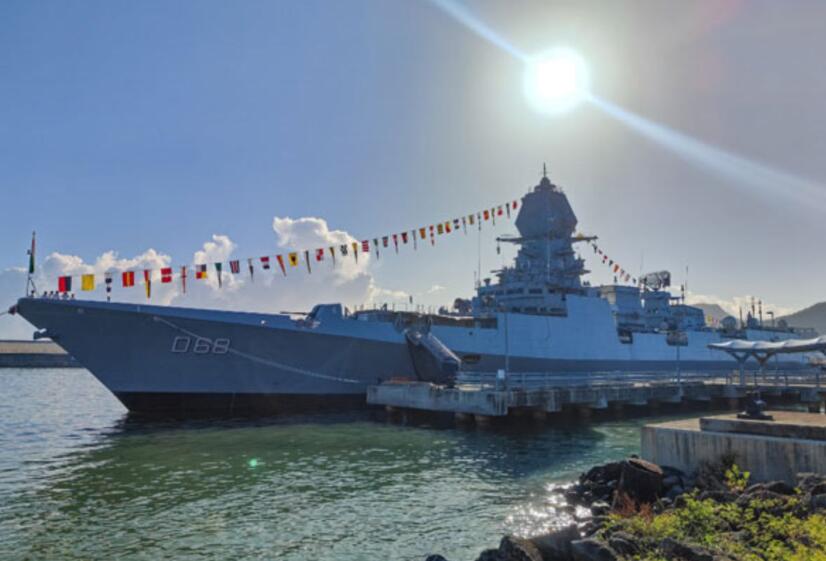
India’s growing maritime engagement in the Indian Ocean was visible during INS Trikand’s recent visit to Mauritius, but the effort goes beyond ship deployments.
A key part of this strategy is training and capacity building, which helps create lasting partnerships. Over the last nine years, the Indian Navy has trained 516 Mauritius’s National Coast Guard officers, demonstrating how India is combining on-ground presence with long-term skill development to strengthen regional cooperation.
The visit coincided with Mauritius marking its 58th Independence Day and 34th year as a republic on March 12, an occasion that carried additional weight given the long arc of India-Mauritius relations since the island nation gained independence from British rule in 1968.
Indian naval personnel participated in the National Day parade, with a contingent of sailors, the ship’s band, and a naval helicopter forming part of the proceedings.
Such participation has gradually become a fixture in the bilateral calendar, though those familiar with the relationship are quick to point out that the operational substance of these visits matters far more than the ceremonial elements.
After departing Port Louis on March 13, INS Trikand conducted a passage exercise with the Mauritian patrol vessel CGS Valiant and participated in joint surveillance of Mauritius’ Exclusive Economic Zone.
The scale of what Mauritius must monitor puts the significance of such assistance in perspective. The island nation’s EEZ spans approximately 2.3 million square kilometres, a maritime expanse vastly disproportionate to its land territory and one that poses persistent challenges for a coast guard with limited resources.
The navy has invested considerably in building such relationships through training. Over the past nine years, Indian institutions have trained 516 Mauritius National Coast Guard officers alone, illustrating the breadth of New Delhi’s engagement beyond its immediate neighbourhood.
The economic stakes of maintaining order in these waters are considerable. Mauritius draws more than ten per cent of its GDP from its blue economy, which sustains roughly 10,000 jobs outside the tourism sector alone.
Protecting marine resources and keeping shipping lanes secure is not merely a strategic concern but an economic necessity for the country.
India’s material contributions to Mauritian maritime capacity reflect a recognition of this reality. These include a leased interceptor boat, Dornier maritime patrol aircraft, and coastal surveillance radar systems. Hydrographic surveys, the meticulous mapping of the seabed essential for safe navigation, port development and resource assessment have been another area of Indian technical assistance.
Infrastructure built with Indian support has added a longer-term dimension to this partnership. The airstrip and jetty at Agaléga Island, inaugurated in early 2024, have substantially improved Mauritius’ ability to respond to piracy threats and drug trafficking operations across its maritime domain.
The facilities allow the movement of personnel and equipment at a speed that was previously impossible from the remote northern atoll. Both countries also share maritime domain awareness through the Information Fusion Centre for the Indian Ocean Region, a multilateral platform that tracks vessel movements and supports early identification of potential threats across some of the world’s busiest sea lanes.
The relationship has also been tested and, arguably, reinforced during crises. When Cyclone Chido struck the region in December 2024, India moved quickly to provide relief supplies and technical support, a response that fits a broader pattern of India positioning itself as a first responder among its Indian Ocean neighbours under what it calls its Neighbourhood First policy.
For the Indian Navy, the visit of INS Trikand fits within a wider framework of maritime engagement across the Indian Ocean. India has described this approach through the MAHASAGAR vision, Maritime Security and Growth for All in the Region which frames the ocean not as a theatre of strategic competition but as a shared commons whose safety depends on collective effort and sustained practical cooperation.





