









Fresh political controversy has erupted in Tamil Nadu after Udhayanidhi Stalin made remarks comparing Dravidianism with major religions, triggering sharp reactions across the political spectrum.
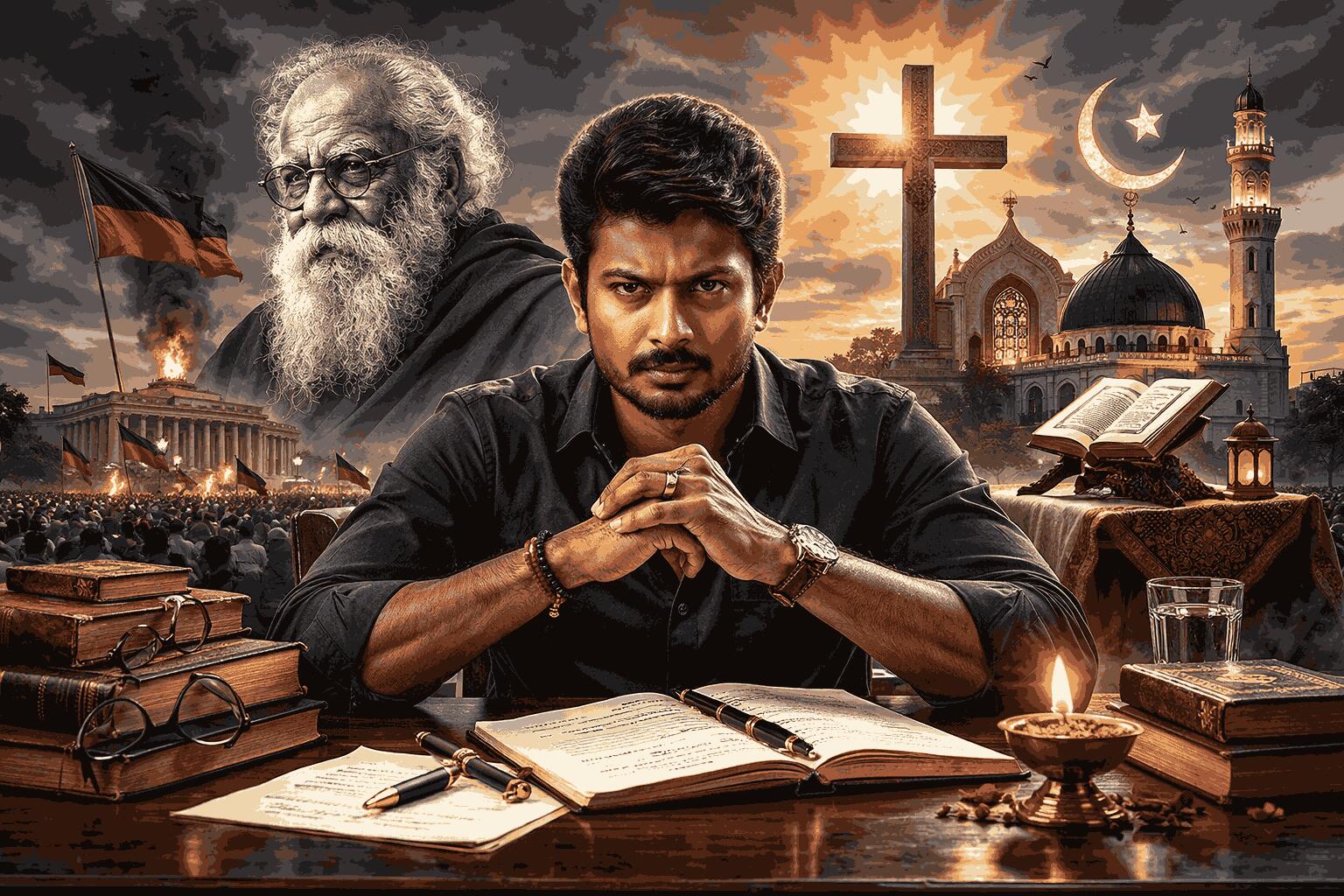
Speaking at a recent public event, the DMK leader stated that the principles of Dravidianism and Islam are “fundamentally the same,” emphasizing values such as equality, brotherhood, and social justice. The remarks were made during an Iftar gathering, where he praised Islam for promoting compassion and inclusivity, and reiterated his party’s long-standing relationship with minority communities.
The statement quickly gained traction because it followed an earlier controversy in which Udhayanidhi had reportedly drawn parallels between Dravidian ideology and Christianity at a separate event. Taken together, these remarks have intensified debates about the ideological positioning of the ruling Dravida Munnetra Kazhagam and its approach to religion and secularism.
At the core of the issue lies the interpretation of Dravidianism itself. Rooted in the ideas of social reformers like Periyar, the movement has historically championed rationalism, anti-caste politics, and social equality. Udhayanidhi’s comparison appears to frame these principles as compatible with religious teachings that emphasize equality and human dignity.
Supporters of the DMK argue that the statement was meant to highlight shared ethical values rather than equate political ideology with any particular faith. They point out that the Dravidian movement has long advocated inclusivity and social justice, which resonate with the moral teachings found in multiple religions.
However, critics have strongly objected to the remarks, accusing the leader of blurring the line between political ideology and religion. Opposition voices have framed the comments as an attempt at minority appeasement, arguing that equating a political doctrine with religious principles risks distorting both. The controversy has also revived earlier debates around statements made by Udhayanidhi on religion and ideology, which had already drawn legal and political scrutiny.
The timing of the controversy is also significant, coming ahead of crucial political developments in Tamil Nadu. With electoral battles looming, ideological positioning and identity politics are expected to play a central role in shaping narratives. The DMK, under Chief Minister M.K. Stalin, has consistently projected itself as a protector of minority rights, while its critics accuse it of leveraging identity-based politics for electoral gain.
Beyond immediate political reactions, the episode raises broader questions about the evolving nature of Dravidian politics. Historically associated with atheism and rationalism, the movement is now being interpreted in ways that seek alignment with religious values of equality and compassion. This shift, whether strategic or philosophical, is likely to remain a subject of debate among scholars and political observers.
The controversy also underscores the sensitive intersection of politics and religion in India. Statements that draw parallels between ideological and religious frameworks often provoke strong responses, given the country’s diverse social fabric and deeply held beliefs. In such a context, even attempts to emphasize common values can be perceived as controversial.
As reactions continue to pour in, the debate over Udhayanidhi Stalin’s remarks shows no sign of subsiding. Whether seen as an attempt to build bridges or as a politically charged statement, the episode has once again brought Dravidian ideology into the national spotlight.
In conclusion, the controversy highlights how political rhetoric like Dravidianism can shape—and sometimes complicate—public understanding of ideology and identity. As Tamil Nadu moves toward future electoral contests, such debates are likely to play a defining role in the state’s political discourse.