
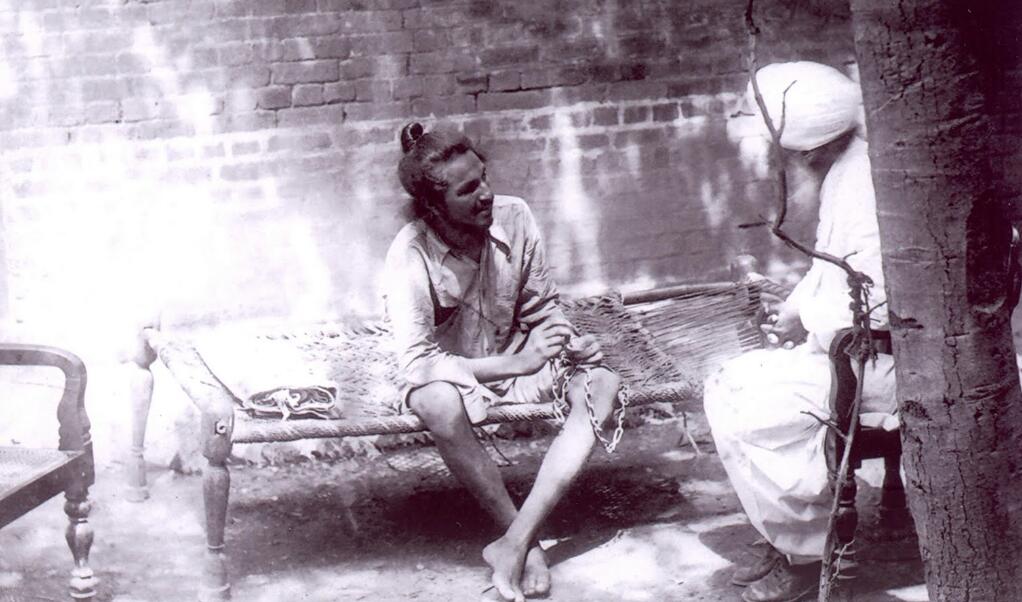
Bhagat Singh’s early engagement with literature and philosophy and his deep curiosity for knowledge form only one aspect of his multidimensional personality. The question of which ideology he aligned with often appears insignificant when viewed against his thunder-like courage, unparalleled bravery, and selfless devotion to the nation.
Indeed, it is true that Bhagat Singh possessed an insatiable thirst for learning. Even just minutes before facing the gallows, he was reading a book written by Lenin. During his brief 23 years of life, he remained in constant search of an ideology that could not only justify his ultimate goal, freedom but also actively support and strengthen it.
Influence of Arya Samaj and Early Awakening
Bhagat Singh was not an accidental revolutionary, he was shaped by a rich cultural and intellectual environment deeply influenced by the ideas of the Arya Samaj, which held a strong presence in Punjab during his formative years.
His family, too, was profoundly inspired by the teachings of Swami Dayanand Saraswati, where nationalism was intrinsically linked with civilizational pride, moral discipline, and a sense of duty toward society.
His education at Dayanand Anglo-Vedic (DAV) institutions further strengthened these values. These were not merely academic centers but spaces where young minds were nurtured to embody courage, selflessness, and respect for India’s ancient heritage.
For Bhagat Singh, nationalism was not a reactionary sentiment born solely out of colonial oppression, it was rooted in a deeper, long-standing conviction that the nation is a living entity, deserving of complete devotion and sacrifice.
A defining moment in his early life came in the aftermath of the Jallianwala Bagh massacre. The young Bhagat Singh visited the site and collected soil soaked with the blood of the bravehearts, preserving it as a sacred memory. This act, often seen as symbolic, revealed something far more profound, his early acceptance of sacrifice as a sacred duty.
In many ways, the Arya Samaj’s concept of “yajna,” understood as self-offering for the welfare of society, found its living expression in Bhagat Singh. His life would go on to reflect this very principle, where personal sacrifice became inseparable from the larger cause of the nation.
Encounter with Revolutionary Thought
At a crucial stage in his life, Bhagat Singh came into contact with Marxist and communist ideology. He was deeply influenced by the Russian Revolution of 1917, which led him to study the works of Marx and Lenin. As a result, his ideological leanings naturally inclined toward communism.
A passionate young man who had witnessed the oppression of the poor under British rule, he was deeply disturbed by the prevailing caste system and the resulting exploitation in society. He was also disillusioned by the hollow structure of imperialism and critical of the political neglect of the poor by contemporary leadership, including the Congress party. In such a context, Marxism appeared to him as a reflection of his own thoughts and ideals, a framework that resonated with his vision of justice and equality.
Faith, Atheism, and the Complexity of Belief
It is also true that, as a Marxist, Bhagat Singh naturally identified as an atheist. He expressed this clearly in his famous essay “Why I Am an Atheist.” This article was written in response to an accusation made by a fellow prisoner that “you have created a wall between yourself and God due to your pride arising from fame.”
In this essay, Bhagat Singh wrote, “अब और क्या सांत्वना है मेरे पास। अपनी कुर्बानी और यातनाओं के ऐवज में एक आस्तिक हिन्दू पुनर्जन्म में एक राजा बनने का सपना देख सकता है, एक मुस्लिम या इसाई स्वर्ग के आनंद की आस लगा सकता है। मैं क्या आशा रखूं? मुझे पता है की जब फांसी का फंदा मेरे गले में कस जाएगा और मेरे पैरों के नीचे से कड़ी हट जाएगी, तब वही मेरा अंत हो जाएगा।”
This statement clearly reflects his rejection of belief in rebirth, aligning with his atheistic worldview. However, a contrasting perspective emerges when his family visited him shortly before his execution. During this emotional meeting, Bhagat Singh reportedly told his father, “काश कि मैं एक बार फिर से भारतवर्ष में पैदा हो जाऊं, ताकि मुझे अंग्रेजो से लड़ने का एक और मौका मिले।”
At first glance, this appears contradictory, yet, this duality reveals a deeper dimension of his personality, one that goes beyond rigid definitions of belief and disbelief. An atheist who does not believe in rebirth could still express such a sentiment as a symbolic desire for continued struggle, rather than a literal belief in reincarnation. Similarly, his unwavering resolve and the mental image of a chained Bharat Mata remained ever-present in his consciousness.
Beyond Ideological Boundaries
The truth is that Bhagat Singh cannot be confined within the boundaries of any single “ism” or ideology—be it communism, capitalism, left-wing, or right-wing thought. He was a complex and layered individual whose thoughts transcend conventional classifications.
Modern interpretations often attempt to place him within narrow ideological frameworks, but such efforts fail to capture the depth of his personality. Today’s political labels, whether left or right, cannot fully encompass his vision or legacy.
Misinterpreting or simplifying Bhagat Singh’s philosophy to fit contemporary ideologies is both limiting and misleading. A martyr does not belong to any political or religious faction; he belongs to the nation for which he sacrificed his life.
Legacy Beyond Death
When a dictator dies, his empire comes to an end, but when a patriot and braveheart lays down his life, his legacy begins. Bhagat Singh’s legacy lives on in the hearts of every Indian youth, inspiring courage, patriotism, and a sense of purpose. “जब भी सुनते है तेरा नाम, है देशप्रेम दिल में जगता, कुछ लोगों ने डाला है तेरी सोंच को विवादों में भगता।”
It means, today, it is a misfortune to compare such an immortal figure with a misguided or misinterpreted generation. It is an even greater misfortune to attempt to confine his multifaceted personality within narrow ideological labels.