


















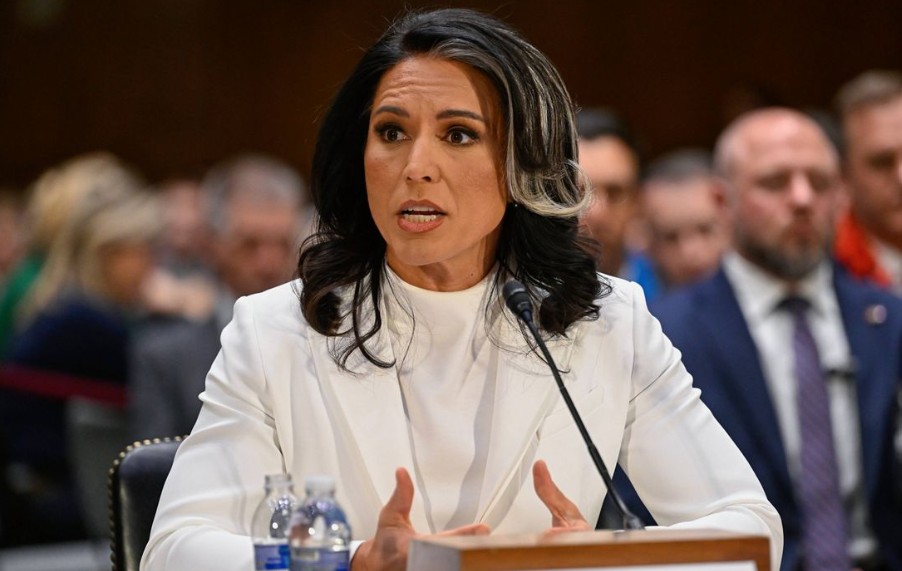
Pakistan’s evolving missile capabilities could potentially pose a threat to the United States, Director of National Intelligence Tulsi Gabbard warned as she highlighted growing global concerns over the expansion of advanced weapons systems.
As per media reports, while speaking before the US Senate Intelligence Committee on Wednesday, Gabbard included Pakistan among a group of nations developing increasingly sophisticated missile technologies, as outlined in the 2026 Annual Threat Assessment Report.
“Russia, China, North Korea, Iran, and Pakistan have been researching and developing an array of novel, advanced, or traditional missile delivery systems with nuclear and conventional payloads, that put our homeland within range,” she told lawmakers.
Adding further, she said, “Pakistan’s long-range ballistic missile development potentially could include ICBMs with the range capable of striking the homeland.”
Gabbard further cautioned that the overall missile threat facing the United States is expected to grow significantly in the coming years, noting that she anticipates the number of such systems increasing from over 3,000 to more than 16,000 by 2035.
Commenting on the development, Washington-based scholar Shuja Nawaz told Dawn News that the assessment reflects continuity in US policy. “This continues the analysis of the Biden administration that placed sanctions on Pakistani entities and tried to curb acquisition of new technologies,” he said.
Relations between Washington and Islamabad have historically been marked by cooperation as well as friction. During the Cold War, Pakistan aligned closely with the United States and became part of US-led alliances such as the Southeast Asian Treaty Organization (SEATO) and the Central Treaty Organization (CENTO).
In 2004, the US designated Pakistan a major non-NATO ally, however, ties later deteriorated as Washington accused Islamabad of supporting the Taliban in Afghanistan and undermining US objectives in the region until the American withdrawal in 2021.
Despite tensions, recent developments suggest continued engagement. Earlier this year, Islamabad joined an initiative led by US President Donald Trump, the Board of Peace, aimed at overseeing postwar reconstruction efforts in Gaza.
At the same time, Pakistan maintains strong ties with China and is a participant in President Xi Jinping’s Belt and Road Initiative. It is also a full member of the Shanghai Cooperation Organization (SCO), underscoring its strategic positioning in regional and global geopolitics.
The latest warning underscores growing international attention on missile proliferation and the evolving security dynamics involving major and emerging powers.
US–Pakistan Relations and Emerging Missile Concerns
Relations between the United States and Pakistan have evolved through cycles of close strategic cooperation and deep mistrust. During the Cold War, Pakistan aligned with Washington by joining alliances such as SEATO and CENTO, positioning itself as a key partner against Soviet influence.
Ties strengthened again after 2001 when Pakistan became a frontline ally in the US-led “war on terror,” though relations later deteriorated amid American accusations that Islamabad supported the Taliban in Afghanistan.
In recent years, the relationship has remained pragmatic but limited, shaped by shifting geopolitical priorities and Pakistan’s growing ties with China. Against this backdrop, concerns have intensified over Pakistan’s advancing missile programme.
According to the 2026 Annual Threat Assessment presented by US Director of National Intelligence Tulsi Gabbard to the Senate Intelligence Committee, Pakistan is among countries developing advanced missile systems that could potentially place the US homeland within range.
Analysts at institutions such as the Center for Strategic and International Studies have also documented Pakistan’s steady progress in long-range ballistic missile technology, warning that continued advancements, particularly toward intercontinental ballistic missiles (ICBMs) could expand its strategic reach beyond South Asia, raising long-term security concerns for the United States, said media reports.