





















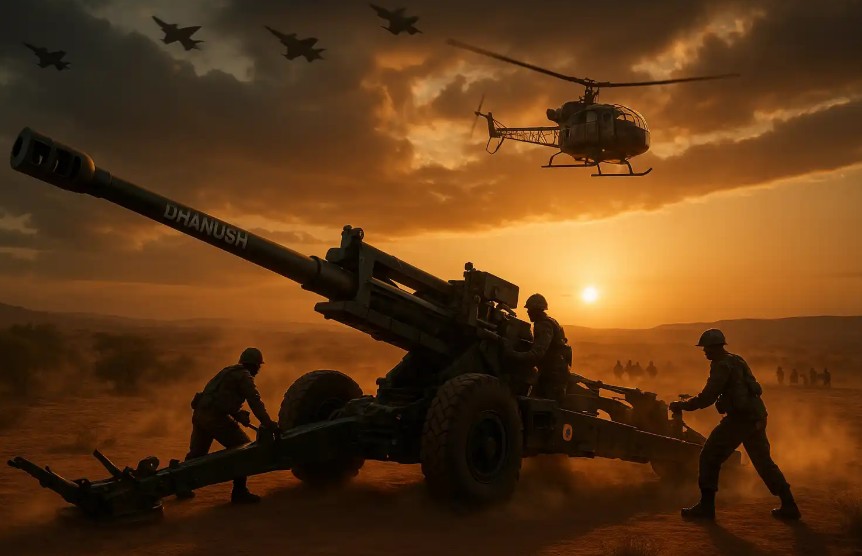
India’s push for indigenous defence manufacturing is set to reach an important milestone as the Indian Army prepares to receive the final batch of its initial order of Dhanush artillery guns by the end of 2026.
According to reports, the 2019 contract for 114 units of the 155mm/45-calibre Dhanush howitzer is indigenously developed by Advanced Weapons and Equipment India Limited (AWEIL), a state-owned defence manufacturer at Gun Carriage Factory Jabalpur, previously a part of the Ordnance Factory Board.
The delivery of the remaining 30 guns will complete the first phase of induction of this domestically developed artillery system, marking a major step in India’s drive for defence self-reliance.
Production Challenges Overcome
The development and manufacturing of the Dhanush system faced early challenges, including supply chain issues and quality control concerns. However, AWEIL has since addressed these hurdles and stabilised production.
According to reports, the manufacturing process now maintains an indigenous content level of around 80%. Each unit is produced at an estimated cost of about ₹14 crore, making it a relatively economical artillery platform for the Army.
The Dhanush artillery gun is based on the design of the Swedish Bofors FH-77B howitzer, which gained prominence during the Kargil War in 1999.
Indian engineers have significantly upgraded the system, converting it into a more capable 45-calibre platform. The improved gun offers a firing range of up to 38 kilometres and incorporates modern technologies such as an inertial navigation system, GPS-based auto-laying capability, and an auxiliary power unit that enhances mobility across difficult terrain, said reports.
Deployment in Army Regiments
The Indian Army has already inducted the Dhanush into operational service, with four artillery regiments currently equipped with the system.
After the remaining guns from the initial order are delivered, two additional regiments are expected to be raised by the end of the year.
These units will receive the latest production versions of the artillery system, which incorporate mechanical and electronic improvements made during the manufacturing process.
Plans for Major Expansion
Looking ahead, the Army is planning a significant expansion of its indigenous artillery capabilities. Defence authorities are preparing to procure around 300 additional Dhanush guns in the coming years.
This expansion could equip up to 15 more artillery regiments and help replace the ageing inventory of Bofors guns introduced in the 1980s. Of the roughly 400 Bofors guns originally imported, fewer than half remain operational today due to age and the shortage of spare parts.
By increasing investment in the Dhanush system, the Army aims to ensure strong and accurate artillery support across different operational environments.
The guns are particularly valuable for high-altitude and border deployments, where reliable and precise long-range firepower remains essential for maintaining operational readiness.





