














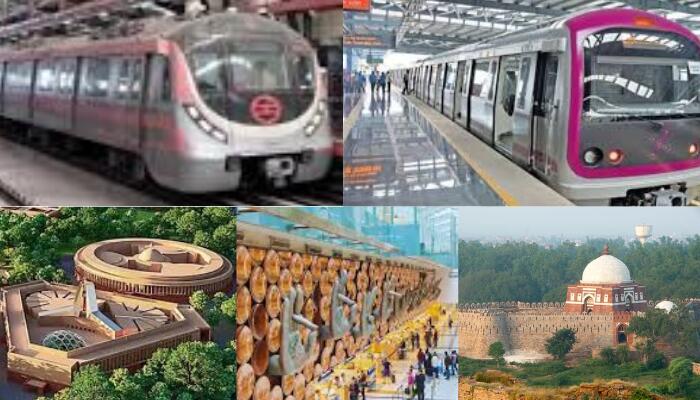
New Delhi is set to witness a significant expansion of its public transport system as Prime Minister Narendra Modi prepares to inaugurate two new metro corridors and lay the foundation stone for three additional routes under the growing network of the Delhi Metro Rail Corporation (DMRC) . The projects, together valued at more than ₹18,300 crore, are aimed at strengthening connectivity across the capital, easing daily travel for commuters and reducing pressure on the city’s road network.
The inauguration ceremony is scheduled to take place on March 8 at DDA Utsav Sthal, where the Prime Minister will formally open the Majlis Park–Maujpur-Babarpur section of the Pink Line and the Deepali Chowk–Majlis Park extension of the Magenta Line.
Pink Line Forms India’s First Fully Operational Ring Metro
The most significant development in the expansion is the opening of the 12.3-kilometre Majlis Park–Maujpur-Babarpur corridor of the Pink Line. With the addition of this stretch, the Pink Line will extend to around 71.56 kilometers and become India’s first fully operational Ring Metro, running along a loop that connects multiple parts of the city.
The corridor includes eight elevated stations at Majlis Park, Burari, Jharoda Majra, Jagatpur-Wazirabad, Soorghat, Nanaksar-Sonia Vihar, Khajuri Khas, Bhajanpura, Yamuna Vihar and Maujpur-Babarpur. These stations are expected to provide long-awaited metro access to several densely populated residential areas along the Yamuna, including Burari, Sonia Vihar, Khajuri Khas and Bhajanpura, which have largely depended on road transport until now.
The new stretch also features significant engineering additions, including a bridge across the Yamuna and a double-decker viaduct designed to carry both a metro line and a road flyover. This structure marks the fifth metro bridge constructed across the river in Delhi.
By completing the Pink Line loop, the network is expected to make cross-city travel quicker and more convenient, linking neighborhoods in North, Northeast and East Delhi more efficiently with the rest of the capital.
Magenta Line Extension Expands Connectivity in Northwest Delhi
The second corridor set to open is the 9.92-kilometre Deepali Chowk–Majlis Park extension of the Magenta Line. This elevated stretch will add seven stations to the network: Deepali Chowk, Madhuban Chowk, Uttar Pitampura-Prashant Vihar, Haiderpur Village, Haiderpur Badli Mor, Bhalswa and Majlis Park.
Once operational, the extension will increase the Magenta Line’s total length to approximately 49 kilometres. The corridor is expected to improve connectivity for residents of outer areas such as Bhalswa and Haiderpur, linking them to the wider metro network and providing easier access to South Delhi and Noida.
Part of this corridor reaches a height of around 28.36 metres, making it one of the highest elevated sections in the Delhi Metro system.
Phase V Expansion to Add Three New Strategic Corridors
Alongside the inauguration of the two corridors, the Prime Minister will also lay the foundation stone for three new metro lines under Phase V (A) of the expansion plan.
One of the key projects is the 9.913-kilometre Central Vista corridor, which will run underground from Ramakrishna Ashram Marg to Indraprastha. The corridor will include stations at Shivaji Stadium, Central Secretariat, India Gate, War Memorial-High Court, Baroda House, Bharat Mandapam and Indraprastha. The route is expected to strengthen connectivity to major government institutions and cultural landmarks located in central Delhi.
Two additional extensions will expand the Golden Line. The first is a 2.263-kilometre underground stretch from Aerocity to Indira Gandhi Domestic Airport Terminal-1 with a new station. The second is a 3.9-kilometre elevated corridor from Tughlakabad to Kalindi Kunj, with stations planned at Sarita Vihar Depot, Madanpur Khadar and Kalindi Kunj.
Officials say the expansion will also benefit commuters travelling from neighbouring cities such as Faridabad and Ballabhgarh, who will be able to reach the airport through Tughlakabad via the Violet Line. Passengers from Noida are also expected to gain improved access through Kalindi Kunj with onward connectivity to South Delhi and the airport.
With these developments, Delhi’s metro network is poised to deepen its reach across the capital and surrounding regions. The new corridors are expected to improve mobility for thousands of daily commuters while helping reduce vehicular congestion and supporting broader efforts to curb pollution in the city.
| Corridor / Project | Line | Length | Type | Stations | Key Details |
|---|---|---|---|---|---|
| Majlis Park – Maujpur-Babarpur | Pink Line | 12.3 km | Elevated | Majlis Park, Burari, Jharoda Majra, Jagatpur-Wazirabad, Soorghat, Nanaksar-Sonia Vihar, Khajuri Khas, Bhajanpura, Yamuna Vihar, Maujpur-Babarpur | Completes India’s first fully operational Ring Metro; includes Yamuna bridge and double-decker viaduct |
| Deepali Chowk – Majlis Park | Magenta Line | 9.92 km | Elevated | Deepali Chowk, Madhuban Chowk, Uttar Pitampura-Prashant Vihar, Haiderpur Village, Haiderpur Badli Mor, Bhalswa, Majlis Park | One of the highest elevated sections of Delhi Metro at about 28.36 metres |
| Ramakrishna Ashram Marg – Indraprastha | Central Vista Corridor | 9.913 km | Underground | Shivaji Stadium, Central Secretariat, India Gate, War Memorial–High Court, Baroda House, Bharat Mandapam, Indraprastha | Will improve access to major government and cultural institutions |
| Aerocity – Indira Gandhi Domestic Airport Terminal-1 | Golden Line Extension | 2.263 km | Underground | One new station | Will connect Aerocity directly to the domestic airport terminal |
| Tughlakabad – Kalindi Kunj | Golden Line Extension | 3.9 km | Elevated | Sarita Vihar Depot, Madanpur Khadar, Kalindi Kunj | Will improve connectivity towards Faridabad and airport routes |