
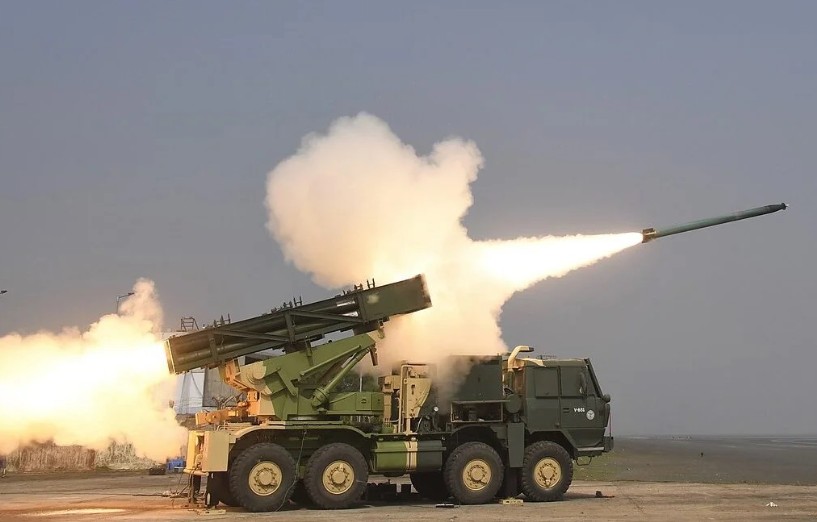
In a significant boost to Indo-French defence cooperation, France is reportedly considering the purchase of India’s indigenously developed Pinaka rocket system.
As India-France defence ties enter a new era as Paris eyes the purchase of India’s homegrown Pinaka rocket system, signaling a shift toward reciprocal arms procurement between the two countries, traditionally marked by one-way defence trade.
The development comes as India moves ahead with its $36 billion order for 114 Rafale fighter jets from Dassault Aviation. In a balancing step, Paris is exploring the acquisition of Indian-made weapon systems, marking a new phase in bilateral defence ties.
France is currently facing urgent gaps in its artillery capabilities due to sustained military aid to Ukraine. Reports indicate that France’s LRU rocket systems, based on the M270 platform, have been significantly depleted.
Only nine systems reportedly remain after four were donated to Ukraine, and the fleet is expected to retire by 2027. With stockpiles shrinking because of continued support to Kyiv, France is seeking fast and mobile rocket replacements.
India’s indigenously built Pinaka rocket system has emerged as a frontrunner. Apart from Pinaka, French buyers are also closely monitoring India’s artillery platforms, missile programmes and electronic warfare systems. Paris is said to be keen on building resilient and diversified supply chains.
India’s Pinaka: A Budget-Friendly Yet Powerful Rocket System
Pinaka is viewed as a cost-effective alternative to Western systems such as the United States’ HIMARS. The system can strike targets at a range of 90–130 km and fire 12 rockets in just 44 seconds. It has proven its operational effectiveness in Indian military strikes on Pakistani positions, reinforcing its reputation as a reliable and powerful platform.
Reportedly, Brigadier General Stéphane Richou tested the system during his 2024 visit to India. He praised its speed, mobility and compatibility with NATO equipment, describing it as a potential quick solution until France’s own FLP-T rocket trials begin in mid-2026.
Developed by India’s Defence Research and Development Organisation (DRDO), Pinaka is a fully home-grown rocket launcher system. Often described as a wheeled “rocket shotgun,” it can unleash 12 rockets in 44 seconds, targeting an area up to 1 km wide at distances ranging from 45 to 120 km.
The system is easy to deploy, suitable for all weather conditions, and highly mobile. A battery of six Pinaka units can fire 72 rockets in rapid succession, capable of destroying enemy troops, vehicles and camps.
India has deployed it in real combat situations and has also drawn international interest, including a recent export deal with Armenia. Its affordability and rapid strike capability have attracted global buyers, including France.
Indo-France Defence Ties Enter a New Phase
The reported interest in Pinaka reflects the deepening strategic partnership between India and France. Defence cooperation between the two nations is increasingly focused on joint production, technology sharing and reciprocal procurement, moving beyond a traditional buyer-seller relationship toward a more balanced partnership.
During French President Emmanuel Macron’s recent three-day visit to India for the India AI Impact Summit, the two countries elevated their relationship to ‘Special Global Strategic Partners’ under the Horizon 2047 Roadmap. The upgraded partnership aims to strengthen cooperation in defence, technology and the Indo-Pacific region.
Prime Minister Narendra Modi described the visit as taking bilateral ties to new heights, highlighting Rafale co-production, innovation and shared security priorities. Macron, in turn, said relations were at their “highest point,” underscoring deeper collaboration in technology and strategic affairs.
If France proceeds with the purchase of Pinaka, it would mark a major milestone for India’s indigenous defence industry and signal a new chapter in Indo-French strategic cooperation.
How Pinaka Strengthens India’s Defence Ecosystem and Battlefield Value?
India’s Pinaka multi-barrel rocket launcher has significantly boosted the country’s indigenous defence ecosystem by reducing reliance on imports and strengthening domestic manufacturing.
Developed by the Defence Research and Development Organisation (DRDO) and produced with strong private-sector participation, the system reflects India’s push for self-reliance under its defence indigenisation drive.
Pinaka has been inducted in large numbers by the Indian Army and is now a key component of its long-range artillery capability. Over the years, upgraded versions including the enhanced Pinaka Mk-I and guided variants have expanded its strike range and precision, strengthening India’s deterrence posture.
Pinaka has been deployed in Kargil sector (post-1999 conflict induction phase): The system was fast-tracked after the Kargil War to strengthen high-altitude firepower capabilities.
It has been deployed in Western borders with Pakistan, where it was used for counter-force positioning and deterrence along sensitive sectors.
It was used in Northern borders during the India-China standoff (post-2020). Pinaka regiments were deployed in high-altitude areas to enhance rapid-response firepower.
Additionally, Indian forces have used it in calibrated strikes on hostile positions, demonstrating its reliability and rapid saturation capability.
Beyond domestic deployment, Pinaka has also entered the export market. Armenia signed a deal to procure the system, marking one of India’s most significant defence exports in the rocket artillery segment. This has enhanced India’s credibility as a global arms supplier.
By combining indigenous research, private manufacturing partnerships, export success and battlefield validation, Pinaka has emerged as both a strategic military asset and a symbol of India’s growing defence-industrial strength.