




















The Holocaust was a systematic, state-sponsored genocide carried out by Nazi Germany under Adolf Hitler between 1933 and 1945, rooted in extreme antisemitism, racism, and Nazi ideology that falsely portrayed Jews as enemies responsible for Germany’s economic hardship, social unrest, and defeat in World War I.
The Nazis believed in creating a so-called “racially pure” Aryan state, which led them to target Jews primarily, along with Romani people, disabled individuals, Slavs, LGBTQ+ people, political opponents, and others deemed “undesirable.”
As Nazi power expanded across Europe during World War II, Jews were stripped of rights, forced into ghettos, deported, and ultimately subjected to industrialized mass murder through extermination camps such as Auschwitz, Treblinka, and Sobibor.
The atrocities included mass shootings, gas chambers, forced labor, medical experiments, starvation, and brutal dehumanization, resulting in the murder of approximately six million Jews and millions of other victims.
The Holocaust stands as one of history’s most horrific examples of how hatred, propaganda, and authoritarian power can lead to unimaginable human suffering and genocide.
In remembrance of the Holocaust, cinema has played a vital role in preserving memory, bearing witness, and confronting the horrors of this dark chapter in human history. The following ten films stand as some of the most powerful portrayals of the Holocaust era, capturing its causes, brutal realities, and lasting emotional impact through deeply human stories.
From historically grounded narratives of survival and resistance to intimate depictions of loss, trauma, innocence, and moral courage, these films illuminate the systematic persecution and genocide of millions under Nazi rule.
Together, they serve not only as works of art but as acts of remembrance—ensuring that the suffering of the victims is neither forgotten nor reduced to history, and reminding future generations of the consequences of hatred, silence, and indifference.
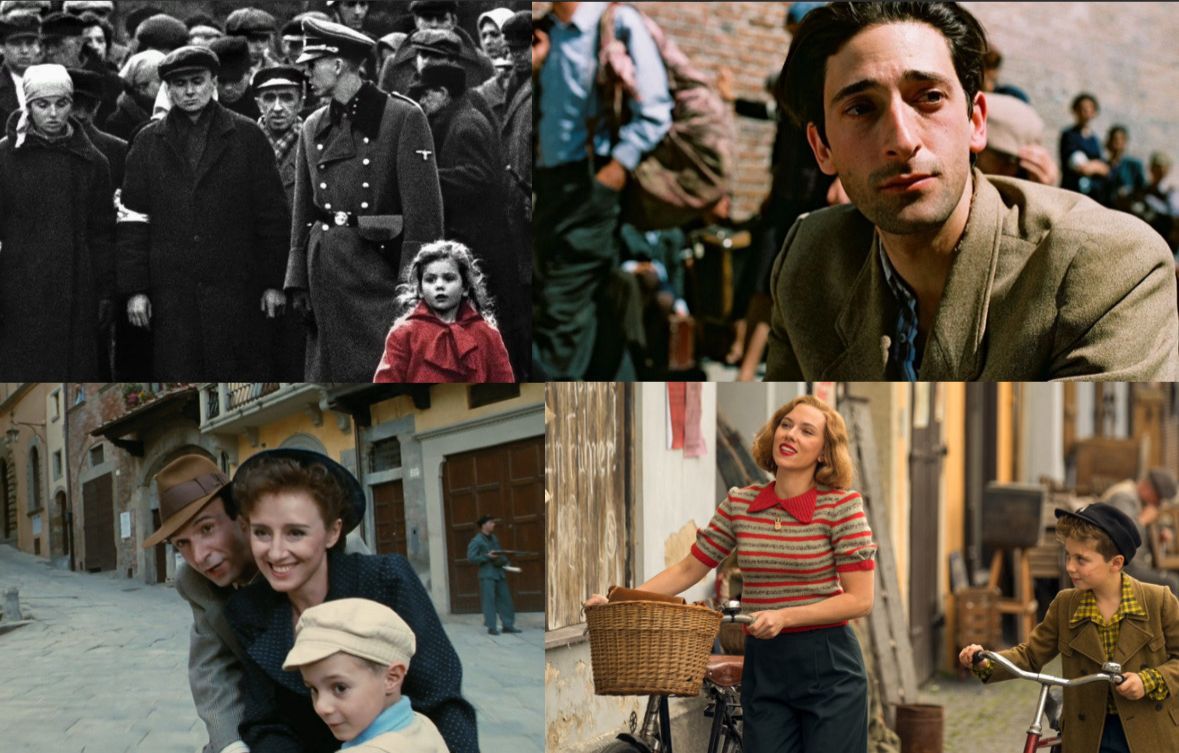
Schindler’s List (1993) – Directed by Steven Spielberg
The film tells the true story of Oskar Schindler, a German industrialist who saved over 1,000 Jews by employing them in his factories during the Holocaust. The focus is on the historical accuracy, horror of concentration camps, moral courage, human compassion amidst atrocity.
The impact of the movie shows the industrialized nature of genocide, the cruelty of Nazis, and the possibility of individual heroism. The black-and-white cinematography heightens realism and emotional weight.
The Pianist (2002) – Directed by Roman Polanski
This movie portrays the life of Polish-Jewish pianist Władysław Szpilman, who survives the Warsaw Ghetto and Nazi occupation through hiding, luck, and resilience. The focus is on the realistic depiction of survival under extreme conditions, the starvation, destruction, and random cruelty of the Nazis.
It is a deeply personal, humanized view of the Holocaust; that emphasizes despair, isolation, and the struggle to maintain dignity and humanity.
Life Is Beautiful (1997) – Directed by Roberto Benigni
The movie portrays a father, Guido, uses humor and imagination to shield his young son from the horrors of a concentration camp, turning a death camp into a “game.”
The focus is on the emotional resilience, parental love, the human ability to preserve hope even in unimaginable circumstances. It combines tragedy with optimism, showing the psychological strength of victims, while also depicting the brutal reality of the camps.
The Boy in the Striped Pyjamas (2008) – Directed by Mark Herman
Told through the eyes of an 8-year-old German boy, Bruno, who befriends a Jewish boy in a concentration camp, its focus is on the innocence and naivety of children versus the horrors of the Holocaust; highlights the incomprehensible cruelty of the Nazis through a child’s perspective.
It has an emotional and heartbreaking impact, and demonstrates how the Holocaust’s effects reach beyond direct victims, affecting families and communities.
Son of Saul (2015) – Directed by László Nemes
The movie shows a Jewish prisoner forced to assist in the disposal of bodies in Auschwitz tries to bury a boy he believes is his son. It focuses on the claustrophobic, first-person perspective of life inside Auschwitz; intense, immersive realism.
It shows the mechanized horror of the camps without sensationalism; emphasizes dehumanization, moral dilemmas, and despair.
Sophie’s Choice (1982) – Directed by Alan J. Pakula
Sophie, a Polish Holocaust survivor, struggles with guilt and trauma from the impossible choices forced on her in Auschwitz. It focuses on the psychological trauma, long-term effects of the Holocaust, human suffering beyond the camps.
The movie explores moral dilemmas, survivor guilt, and emotional scars, showing that the Holocaust’s effects last a lifetime.
Au Revoir les Enfants (1987) – Directed by Louis Malle
A French boarding school hides Jewish boys during Nazi occupation; a friendship forms, ending in tragedy when Nazis discover them. It highlights childhood innocence, betrayal, and loss during wartime; personal stories in occupied Europe.
It brings out the quiet, poignant depiction of Nazi oppression; emphasizes the moral complexities of everyday life under occupation.
The Diary of Anne Frank (1959) – Directed by George Stevens
The movie is an adaptation of Anne Frank’s diary, following a Jewish family hiding in Amsterdam during Nazi occupation. It depicts the daily life in hiding, fear of discovery, hope, and coming-of-age under extreme danger.
It humanizes the Holocaust through personal perspective; emphasizes hope, resilience, and tragedy of lost lives.
Europa Europa (1990) – Directed by Agnieszka Holland
A Jewish boy survives the Holocaust by pretending to be a Nazi, navigating identity and survival. It focuses on the survival through deception, identity crises, moral compromise, and absurdity of war.
The movie explores the lengths people go to survive; examines irony and tragedy in war.
Jojo Rabbit (2019) – Directed by Taika Waititi
The movie portrays a young German boy, member of the Hitler Youth, discovers that his mother is hiding a Jewish girl; his imaginary friend is a satirical Hitler.
The focus is satirical, dark humor to explore indoctrination, prejudice, and moral awakening. It uses comedy to highlight the absurdity of Nazi ideology while showing human compassion and resistance.
Inglourious Basterds (2009) – Directed by Quentin Tarantino
This movie is a fictional revenge story in Nazi-occupied France, where Jewish-American soldiers hunt Nazis. The focus is revisionist history, stylized violence, revenge fantasy. The movie captures Nazi terror and Jewish suffering in a fictional, cathartic way; emphasizes justice and resistance through hyper-stylized storytelling.