
























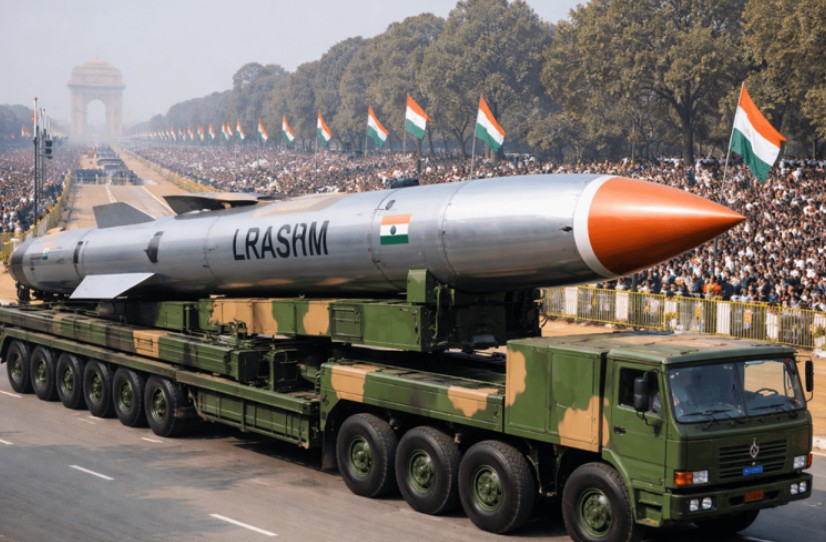
India is set to showcase a significant defence breakthrough at the 77th Republic Day parade on January 26, as DRDO is set to display the long-range anti-ship hypersonic glide missile, LRAShM.
Capable of striking naval targets from considerable distances, the missile’s public debut on Kartavyapath highlights India’s advancing defence self-reliance and a strengthened maritime deterrence posture.
The unveiling of the LRAShM at Kartavyapath is particularly significant, as it places India among a small group of nations capable of developing hypersonic weapons. This is a clear signal that the country is advancing rapidly in defence technology and self-reliance under initiatives like Aatmanirbhar Bharat.
India is one of the world’s most prosperous and vibrant democracies, and every year the grandeur and strength of the country are showcased on Kartavya Path during the Republic Day parade.
Now imagine the moment, this weapon rolling down Kartavya Path in the presence of European Commission President Ursula von der Leyen. The signal it sends will reverberate far beyond India’s borders, especially at a time when Donald Trump is openly pressuring Europe and several EU nations over Greenland.
What Is LRAShM and How Will It Transform India’s Capabilities?
LRAShM, or Long Range Anti-Ship Missile, has been specifically designed to neutralize large enemy naval platforms such as aircraft carriers and destroyers.
While India already operates highly capable and proven anti-ship missiles like BrahMos, there is a fundamental difference.
BrahMos is a supersonic cruise missile, whereas LRAShM is a hypersonic missile built around a Hypersonic Glide Vehicle (HGV).
Unlike conventional ballistic missiles—which exit the atmosphere before re-entering toward their target—LRAShM accelerates using a booster and then glides at extremely high speeds within the atmosphere itself. In this sense, it represents a hybrid of ballistic and cruise missile trajectories.
Traditional ballistic missiles can achieve speeds of Mach 15 to Mach 20, but their trajectories are fixed and predictable, allowing early detection and interception.
Hypersonic glide vehicles, by contrast, operate at speeds between Mach 5 and Mach 10 at comparatively low altitudes of roughly 40–100 kilometers, making radar detection exceptionally difficult.
Why Are Hypersonic Glide Vehicles So Dangerous?
The most critical advantage of such weapons is the dramatically reduced reaction time they offer to defenders. Because these missiles fly much closer to the Earth’s surface, long-range radar systems detect them significantly later.
At hypersonic speeds, a plasma layer forms around the missile, absorbing electromagnetic waves emitted by radar systems. This phenomenon effectively grants the missile an inherent stealth capability.
Moreover, these missiles are capable of maneuvering mid-flight and changing direction—something ballistic missiles cannot do. This makes their trajectories unpredictable and renders interception by existing air defense systems nearly impossible. For this reason, hypersonic weapons—particularly hypersonic cruise missiles—are widely regarded as true game-changers in modern warfare.
Which Hypersonic Projects Is India Working On?
A common question is whether India is developing only a single hypersonic missile. The answer is no, India is currently pursuing multiple hypersonic weapon systems and enabling technologies across different categories.
Hypersonic Cruise Missile
DRDO has made substantial progress through the HSTDV (Hypersonic Technology Demonstrator Vehicle) program, including the successful testing of its scramjet engine. Scramjet technology is considered the backbone of hypersonic cruise missiles, as it enables sustained hypersonic flight. India is also working on multiple design variants related to missile shape and structural configuration.
BrahMos-II
While the existing BrahMos missile already travels at speeds exceeding Mach 3, development is underway on its next iteration, BrahMos-II, which is expected to achieve speeds of around Mach 7.
Boost-Glide Hypersonic Weapon (HGV)
LRAShM falls into this category. These weapons are designed for long-range precision strikes and are capable of engaging maneuvering targets such as aircraft carriers at ranges exceeding 2,000 kilometers.
Where Does India Stand in the Hypersonic Race?
Russia currently leads the hypersonic race, having already employed such weapons in Ukraine. China is also believed to possess operational hypersonic systems. The United States trails slightly behind but remains heavily invested in large-scale testing and development.
India is not far behind. DRDO’s progress in scramjet testing, boost-glide trials, and reports of limited-series production suggest that hypersonic technology in India has moved beyond pure research and experimentation and is now approaching the initial operational phase.
What Does This Mean Strategically?
Weapons such as LRAShM provide India with a significant strategic advantage, particularly in the maritime domain. In regions like the Indian Ocean, the ability to strike enemy warships within minutes—while evading advanced air defense systems—has the potential to fundamentally transform India’s naval deterrence posture.
In strategic terms, hypersonic capability represents not merely technological maturity, but a decisive shift in India’s ability to dominate critical maritime spaces.