
















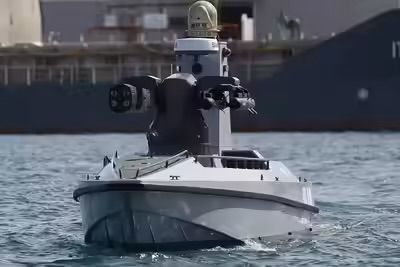
The Indian Navy is set to receive the first batch of the country’s first-of-its-kind autonomous weaponised unmanned fast interceptor crafts (FICs) from Pune-based defence firm Sagar Defence Engineering, a major step towards strengthening maritime security and enhancing special mission capabilities along India’s coastline.
As per reports, India will enter the exclusive group of nations possessing the capability to develop weaponised swarm vessel technology with the induction of these unmanned weaponised vessels.
The first batch of two FICs was dispatched from Sagar Defence’s Pune facility on January 30 and will be deployed “somewhere in the west coast”, sources told Times of India.
The Navy had placed an order for 12 such weaponised boat swarms after signing a contract with Sagar Defence on January 5, 2022.
Designed, developed and manufactured entirely in India, the FIC programme reflects the country’s push for self-reliance in defence technologies under the iDEX-DIO framework.
Until now, the Navy has relied on Israel-made unmanned surface vessels, primarily for mine counter-measure operations.
The unmanned interceptor craft is armed with a 12.7-mm gun for close-range engagements and is also capable of deploying short-range missiles and loitering ammunition.
Multiple FICs can be operated from a single control station, significantly enhancing force projection while minimising risk to human operators.
A key capability of the craft is its ability to function effectively in a GPS-denied environment. Advanced navigation systems enable reliable operations even under electronic warfare conditions, ensuring mission continuity where conventional platforms may struggle.
With an endurance of over two days at sea, the vessel provides sustained operational presence and improved maritime domain awareness.
Despite being unmanned, the interceptor craft can carry more than 14 personnel when required, offering flexibility for special missions such as coastal operations, rapid insertion or evacuation.
Its layered weapon architecture allows it to counter a broad spectrum of threats, ranging from asymmetric maritime challenges to high-intensity combat scenarios.
With an operational range exceeding 400 nautical miles (around 800 km), the craft is well-suited for extended patrols and rapid response missions.
The induction of this technology aligns with global trends towards network-centric and autonomous warfare, placing India at the forefront of innovation in naval combat systems.