






















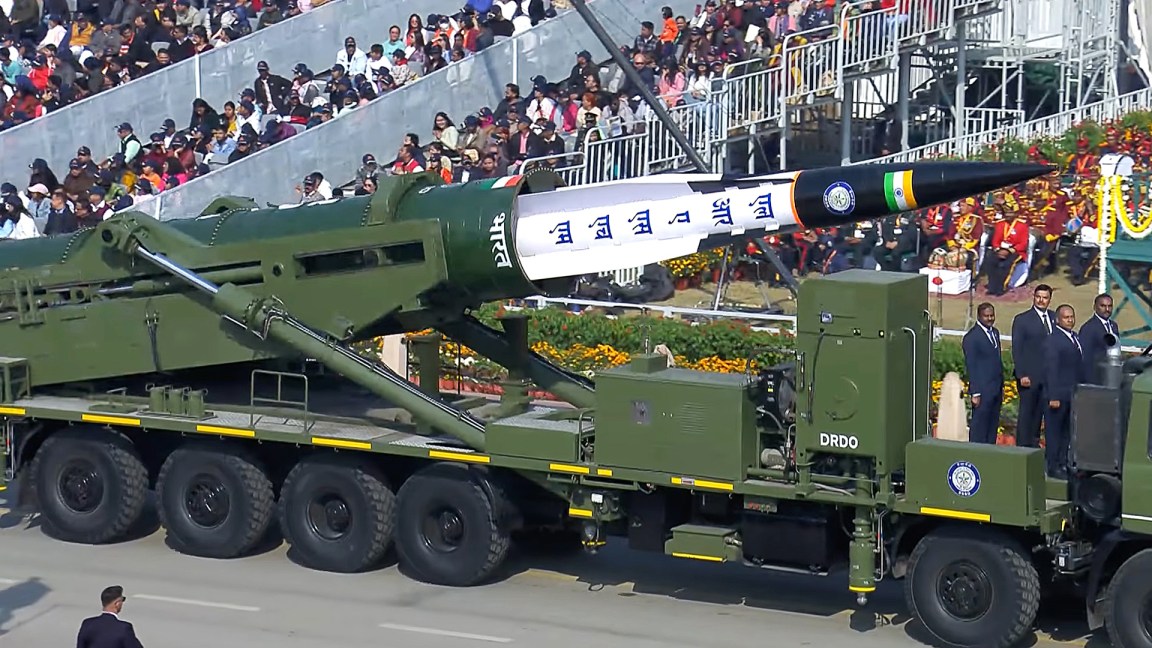
On January 26, 2026, India unveiled one of its most advanced indigenous military technologies during the 77th Republic Day Parade in New Delhi — the Long-Range Anti-Ship Hypersonic Missile (LR-AShM) developed by the Defence Research and Development Organisation (DRDO).
The majestic parade along Kartavya Path served not just as a celebration of India’s constitution and culture but also as a platform to showcase strides in defence self-reliance, reinforcing the nation’s growing technological prowess.
A Milestone in Hypersonic Technology
The LR-AShM represents a significant leap in India’s defence capabilities, placing it among a select group of nations working with hypersonic weapon systems. These missiles travel at speeds above Mach 5, making them extremely difficult to detect and counter.
Designed primarily for maritime strike roles, the LR-AShM is intended to enhance the Indian Navy’s coastal defence. It can engage both stationary and moving surface targets, including warships, at ranges of up to 1,500 kilometres.
Mounted on a land-based mobile launcher, the system was paraded mounted on a high-mobility wheeled vehicle — a typical arrangement for coastal battery deployment.
Flight Profile and Capabilities
The missile’s flight profile combines elements of hypersonic speed and manoeuvrability. It is propelled by a two-stage solid rocket motor, reaching initial velocities as high as Mach 10 and sustaining average speeds around Mach 5 during flight, assisted by skip-glide manoeuvres that help it evade radar detection and interception.
This trajectory — referred to as quasi-ballistic or skip-glide — enables the missile to perform unpredictable changes in altitude and direction, complicating tracking for enemy defence systems.
India’s Ministry of Defence notes that the LR-AShM is capable of carrying a variety of payloads, adding flexibility in mission planning and execution.
Although widely described as a hypersonic glide missile, some analysts believe the configuration features elements of both traditional hypersonic boosters and enhanced glide dynamics.
Strategic Significance
The unveiling of the LR-AShM carries both symbolic and strategic weight. It demonstrates India’s commitment to developing indigenous advanced weapons systems, a central goal of the government’s “Atmanirbhar Bharat” (self-reliant India) initiative.
In the maritime domain, long-range hypersonic missiles are seen as force multipliers — capable of projecting power deep into contested waters and deterring hostile naval operations. By expanding its strike envelope far beyond traditional naval weapons, India improves its ability to protect its extensive maritime borders and interests in the Indian Ocean Region.
The missile was showcased alongside other defence platforms, including the Arjun Main Battle Tank, Nag anti-tank missile, and the BrahMos supersonic cruise missile, underscoring the breadth of India’s defence technology landscape.
Challenges and Future Prospects
Despite the high-profile display, the LR-AShM’s operational readiness remains under development. Officials acknowledge that further trials, refinements, and testing are necessary before the system can be fielded in active service
Experts suggest that integrating such advanced weapons into combat units will require enhancements in command and control, target acquisition systems, and secure communication networks — especially if used to coordinate against moving naval assets at sea.
Nevertheless, the public debut of the LR-AShM signals India’s determination to compete in the realm of hypersonic weapons, joining other major powers such as the United States, Russia, and China in exploring next-generation strike technologies.
India’s display of the Long-Range Anti-Ship Hypersonic Missile at the Republic Day Parade was both a national statement and a strategic message to the world: that India is steadily advancing toward cutting-edge military capabilities, reducing dependence on foreign technologies, and strengthening its deterrent posture in an increasingly complex security environment.