























At the helm of the project is Dr Anna Zeiter, ex-Chief Privacy Officer and VP for AI and Data Responsibility at eBay, who departed the company last month.
Zeiter formally announced her appointment as CEO of W this week at the World Economic Forum in Davos, presenting the platform’s “anti-disinformation” mission to a high-profile audience.
In a post on LinkedIn, Zeiter formally announced her position as the CEO of the platform.
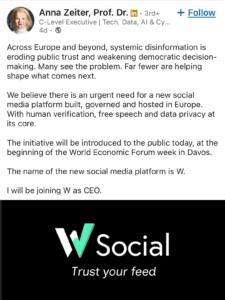
“Across Europe and beyond, systemic disinformation is eroding public trust and weakening democratic decision-making. Many see the problem. Far fewer are helping shape what comes next. We believe there is an urgent need for a new social media platform built, governed and hosted in Europe. With human verification, free speech and data privacy at its core. The initiative will be introduced to the public today, at the beginning of the World Economic Forum week in Davos. The name of the new social media platform is W. I will be joining W as CEO,” her post read.
According to a Danish news media outlet, Politiken.dk, the soon-to-be-launched digital platform, W, will require user identity verification to prevent bots, which have been a driving force of disinformation in Europe.
The social media platform W is being developed with the support of an advisory board, along with former ministers and business leaders, primarily from Sweden.
American journalist and foreign affairs columnist for The Washington Post, also took posted on his handle on X, announcing about the launch of the platform ‘W.’
https://x.com/ishaantharoor/status/2013347866840912106?s=46
“In Davos, there’s a launch of a new social media platform called “W” to counter the misinformation on other social media platforms. Here’s part of their introductory video at the debut event. They tout actual verification and no bots, and being hosted on European servers,” he posted, while sharing a video.
Who is the CEO of W, Anna Zeiter?
Anna Zeiter, CEO of W, is a Swiss privacy expert with extensive experience in the tech industry.
According to her LinkedIn profile, she spent over a decade at eBay, where she led initiatives in data protection and artificial intelligence (AI).
She holds a PhD in law from the University of Hamburg and has also pursued studies at Stanford University.
Legally, W will operate as a subsidiary of “We Don’t Have Time,” a media platform focused on climate action. The team is spread across Europe, with plans to open offices in Berlin and Paris, according to Bilanz.
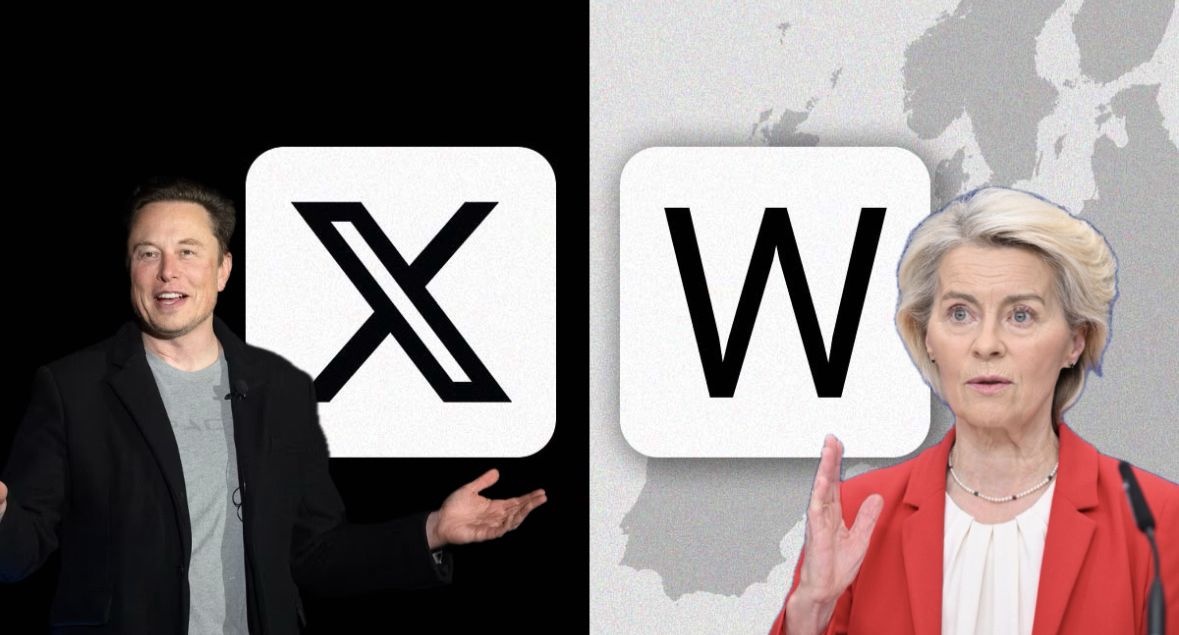
The announcement of the platform ‘W’comes amid growing tensions between the United States and European nations.
President Donald Trump recently unveiled a new round of tariffs on several European countries in response to their resistance to his proposals to purchase or annex Greenland, which is part of the Kingdom of Denmark.
Meanwhile, US social media companies have long criticized European regulators for what they claim is unfair targeting and censorship.
The European Union, on the other hand, maintains that its stringent rules are designed to protect users and ensure greater accountability from online platforms.
At the center of the dispute is Elon Musk’s X. Following a €120 million ($140 million) fine for violating transparency requirements under the European Digital Services Act, Musk publicly called for the dismantling of the EU.
Will users provide IDs?
Few details about W have been confirmed, but it is understood that the platform may require users to submit an ID for verification.
While this could be an effective measure against bots, some users may resist sharing personal identification with a digital platform.
A 2025 survey from Australia found that 10% of social media users said they would abandon every platform that requires age verification, which involves providing a government ID.
Gen Z users were the most resistant, with 45% willing to quit rather than verify. Europeans, however, appear more accepting– nearly half (47%) agree that social networks should only be used with real names and proof of identity, according to the same 2025 survey.
Commonly cited concerns about such requirements include intrusion into anonymity and risks to data protection and privacy. Leaked IDs could have serious consequences for users, including identity theft, financial loss, and damage to credit scores.
LinkedIn, the Microsoft-owned professional platform, introduced an optional user verification system requiring a government-issued ID in 2023. Over 100 million users have opted into the feature, representing roughly one in ten users.
So far, no ID leaks affecting LinkedIn or the third-party verification company Persona have been reported, suggesting that platforms may be able to implement verification safely.