





















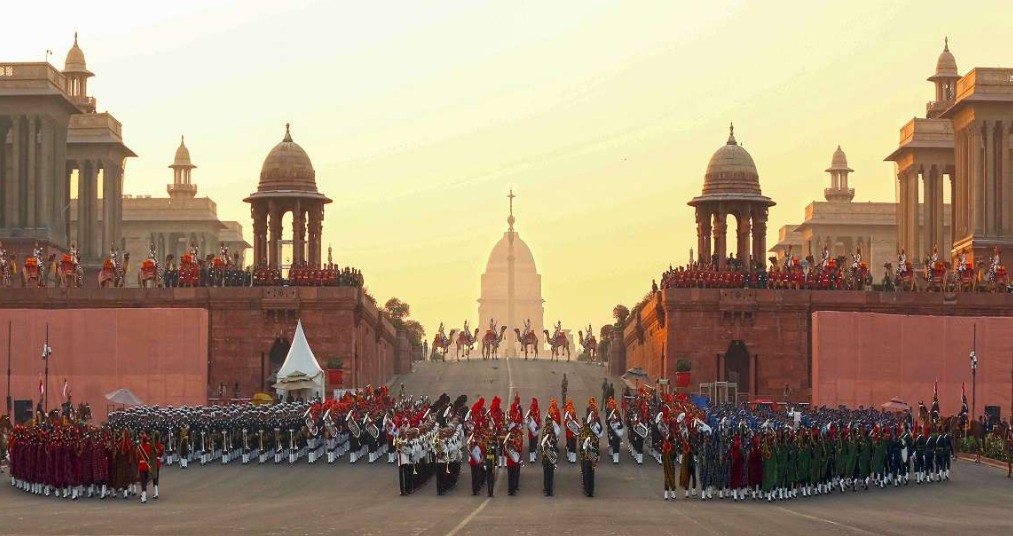
The air at Vijay Chowk will come alive with patriotic fervour as the bands of the Indian armed forces and paramilitary forces perform a dazzling array of lilting tunes and foot-tapping melodies at Thursday’s Beating Retreat ceremony at Vijay Chowk in New Delhi.
The central focus of this year’s ceremonial parade at Kartavya Path, along with the associated celebrations, is the 150th anniversary of the national song, ‘Vande Mataram.’
As part of the 77th Republic Day celebrations, the ceremony at Vijay Chowk will honour India’s cultural heritage through a specially curated musical programme and thematic emphasis on Indian compositions.
The celebration of the national song Vande Mataram, which will be reflected in the choice of tunes played by the armed forces and CAPF bands will be a central highlight.
The repertoire for this year emphasises patriotic and martial compositions such as Vande Mataram, Kadam Kadam Badhaye Ja, Vijay Bharat, Sitare Hind, and Brave Warrior, an array designed to blend traditional patriotic fervour with the spirit of the Republic’s heritage.
Seating enclosures at Vijay Chowk have been named after Indian musical instruments such as the bansuri, tabla, sitar, shehnai, and sarod, thereby embedding the nation’s artistic legacy into the very fabric of the ceremony.
This culturally infused framing underscores an effort to connect military tradition with broader Indian artistic identity.
What Is the Beating the Retreat Ceremony
The Beating the Retreat ceremony is a historic military tradition that dates back several centuries. In India, it has been organised annually on January 29, three days after Republic Day, and is usually held at Vijay Chowk in New Delhi.
Renowned for its grand musical performances and disciplined formations, the Beating the Retreat ceremony showcases the professionalism, coordination, and dedication of India’s armed forces.
The repertoire includes traditional Indian compositions as well as military tunes, reflecting the country’s cultural diversity and martial pride.
The ceremony also highlights the enduring values of service, sacrifice, and unity that define India’s defence forces.
As the Beating the Retreat ceremony brings the Republic Day celebrations to a close, it stands as a powerful reminder of the courage, discipline, and unity that continue to strengthen the nation.
The massed bands are expected to present an extended set of around 30 musical performances that begin with traditional marches and progress into a rich array of patriotic and rhythm-driven pieces, showcasing both Western military oeuvre and Indian martial music.
The ceremony features a grand musical performance by the bands of the Indian Army, Navy, Air Force, Delhi Police, and the Central Armed Police Force (CAPF). Bringing together all three wings of the armed forces, the event stands as a striking display of music, precision, and India’s rich military heritage.
Presided over by the President of India, the Supreme Commander of the Armed Forces, the ceremony reflects military discipline and tradition.
Ahead of the ceremony, Prime Minister Narendra Modi shared a message underscoring the importance of the Beating the Retreat and described the event as a symbol of India’s strong military legacy and expressed deep pride in the country’s armed forces.
https://x.com/narendramodi/status/2016714755436925145
In a post on X, the Prime Minister stated, “Beating Retreat will be held this evening. It symbolizes the end of the Republic Day celebrations. It will showcase the power of India’s rich military heritage. We are extremely proud of our armed forces dedicated to defending the country.”
The Prime Minister also posted a Sanskrit verse एको बहूनामसि मन्य ईडिता विशं विशं युद्धाय सं शिशाधि।अकृत्तरुक्त्वया युजा वयं द्युमन्तं घोषं विजयाय कृण्मसि॥, which is a Vedic mantra that that speaks of unity, courage, and collective strength in times of war.
How the Ceremony Began in India
While the broader tradition of Beating the Retreat has ancient and European roots, its practice in modern India was adapted after independence and became an integral part of the nation’s Republic Day observances in the 1950s.
The first officially recognised Beating the Retreat in India was organised in 1955 during the state visit of Queen Elizabeth II and Prince Philip. This early ceremony was conceived by Brigadier Bewoor and Major GA Roberts of the Ceremonial and Welfare Directorate of the Indian Army, who brought together military bands in a coordinated performance that combined martial music with ceremonial discipline.
Since then, the event has been held every year to close the Republic Day festivities, symbolising the unity, discipline, and cultural heritage of the Indian Armed Forces.
Over the decades, the massed bands evolved in their repertoire and composition. Originally heavy on Western marches and bugle calls, the performances gradually incorporated Indian martial tunes and patriotic songs that resonate deeply with the spirit of the Republic, blending indigenous melodies with the precision of military band traditions.
Cultural and Symbolic Significance
The Beating the Retreat ceremony has a reflective tone, as the bugles sound, the national flag is lowered with respect, and music such as martial marches and patriotic tunes honour both the legacy of the armed forces and the citizens of the Republic.
The ceremony is equally striking visually, as twilight deepens, the buildings of Raisina Hills are illuminated, creating a tableau that merges architectural grandeur with the rhythms of the band performances and the emotional cadence of national music, all of which reinforce a sense of collective pride and remembrance.
From its early military origins to its present role as the ceremonial finale of India’s Republic Day, the Beating the Retreat ceremony has evolved into a richly symbolic and deeply emotional event.
Its historical roots, fusion of martial music with patriotic themes, and annual staging at Vijay Chowk reflect India’s journey as a sovereign republic.