



















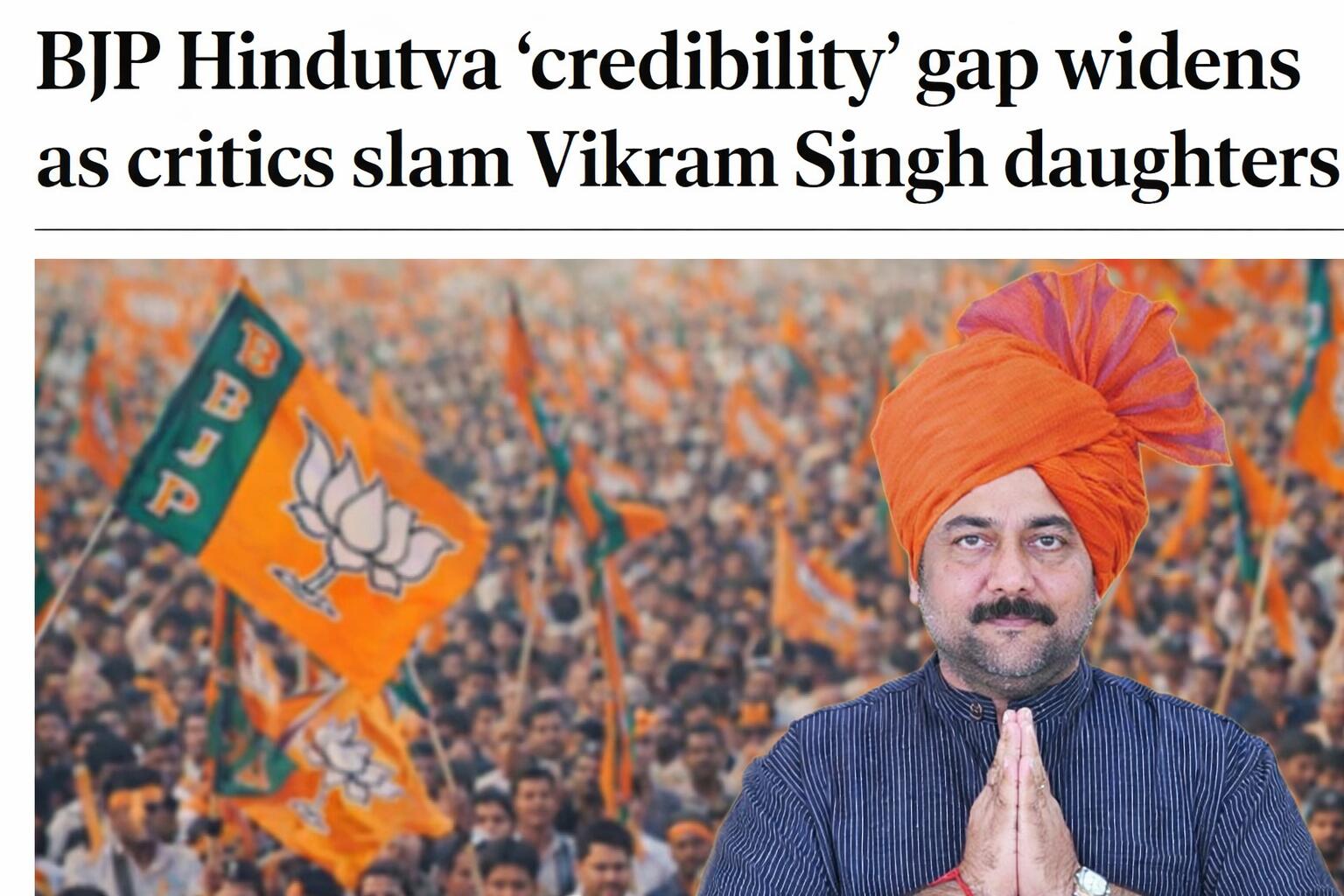
The intersection of personal lives and public politics once again became a flashpoint on Indian social media after a series of sharp posts targeted Vikram Singh, questioning the consistency between ideological preaching and private conduct. The controversy did not emerge from an official statement or a verified report but from aggressive online commentary that accused several political leaders of failing to practice at home what they advocate in public life.
At the heart of the debate was the broader charge that many leaders who loudly champion Hindutva and nationalism expect ideological conformity from society while being unable or unwilling to enforce similar values within their own families. In this case, critics framed their argument around Vikram Singh as a symbol of what they described as a growing credibility gap between public sermons and personal realities.
Social media posts circulating widely alleged that family members of certain leaders were endorsing political causes that run contrary to the nationalist positions their parents defend. These claims were presented as proof that moral lectures delivered from political platforms often ring hollow. While none of these allegations have been independently verified, they gained traction because they tapped into an existing public frustration with perceived double standards in politics.
The commentary aimed at Vikram Singh was particularly harsh, using confrontational language to argue that charity and ideological discipline must begin at home before being imposed on the wider society. According to the critics, preaching nationalism loses moral authority if immediate family members are seen supporting narratives that question India’s territorial integrity or align with causes viewed as hostile to Indian interests.
A recurring theme in the online criticism was the idea that political leaders cannot disown the public actions of their adult children while simultaneously demanding ideological loyalty from ordinary citizens. Supporters of this argument claimed that when leaders speak on issues of religion, nationalism and civilizational values, their own households inevitably become part of the public conversation. This reasoning was repeatedly invoked in posts directed at Vikram Singh, though it remains a deeply contested premise.
Defenders of political leaders, however, pushed back strongly against what they described as intrusive and irresponsible attacks on family members who do not hold public office. They argued that dragging relatives into political battles crosses ethical boundaries and amounts to character assassination. From this perspective, holding Vikram Singh accountable for the online activities or opinions of his children is neither fair nor democratic, especially when such claims circulate without evidence.
The episode also reopened a larger debate within Indian politics about generational differences. Many observers noted that younger family members of politicians often grow up in globalized environments, study abroad and engage with international causes through social media. These experiences can shape political views that diverge sharply from the ideological positions of their parents. Critics of the online attacks stressed that such differences are not unique to any one party or leader, including Vikram Singh, but are visible across the political spectrum.
At the same time, supporters of the criticism insisted that public figures voluntarily place themselves under greater scrutiny. In their view, when leaders repeatedly position themselves as guardians of culture and nationalism, they implicitly invite questions about how those values are lived in their personal spheres. This line of reasoning was central to the posts targeting Vikram Singh, portraying him not merely as an individual but as a representative of a broader political culture.
The controversy also highlighted the dangers of social media trials. Unverified claims, personal insinuations and provocative language can spread faster than facts, causing reputational damage that is difficult to reverse. Legal experts and political analysts warned that normalizing such attacks lowers the quality of public discourse and distracts from substantive policy debates. They cautioned that if allegations replace arguments, democratic conversation itself suffers.
In the final analysis, the uproar surrounding Vikram Singh says as much about India’s polarized political climate as it does about any single leader. The incident underscores how quickly ideological disagreements can morph into personal assaults, and how social media amplifies outrage without due process. Whether one believes leaders should be judged by their family members’ views or not, the episode is a reminder that politics driven by accusation rather than accountability ultimately weakens public trust.