



















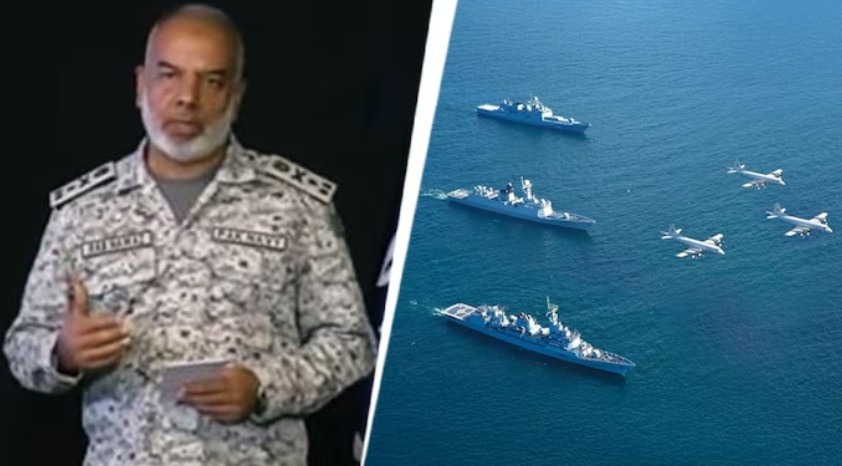
In recent months, Pakistan has attempted to present an image of strong naval readiness through press briefings, social media posts and official visuals.
But behind these dramatic displays lies a troubling pattern. Many of the images used to show rapid deployments of submarines, warships and maritime aircraft were not real.
They were digitally altered, AI-enhanced or lifted from earlier exercises. Instead of documenting actual operations, they created the illusion of a powerful naval response at a time when the real fleet was largely inactive.
This strategy became especially visible during and after India’s Operation Sindoor. While India’s Navy was deployed across the Arabian Sea, Pakistan’s vessels remained close to Karachi, avoiding major movements.
With few real deployments to show, Pakistan turned to something else–imagery manipulation.
Digitally Altered Images Presented as Real Deployments
During ISPR briefings, Pakistan Navy officials displayed visuals showing a flurry of activity—submarines supposedly dispersing across the North Arabian Sea, frigates launching into patrols, and maritime aircraft taking off in quick succession.
On the surface, these images suggested the navy was fully prepared and mobilised. But forensic checks by defence analysts and open-source researchers told a different story. Much of the imagery had been altered. Warships were duplicated or digitally inserted into scenes.
Submarines appeared in locations where they could not have been based on satellite data. Maritime patrol aircraft were shown operating during times when air traffic logs indicated no such flights took place.
Some of the visuals even contained small inconsistencies: shadows that didn’t match the sun’s angle, reflections that looked artificial, or vessels that appeared sharper than the rest of the image—common signs of digital editing.
What was presented as fresh operational footage was, in many cases, heavily modified content designed to tell a story rather than show the truth.
Old 2023 Drill Footage Passed Off as New
Forensic analysis revealed something even more significant. Several of the showcased images were traced back to a 2023 joint naval exercise between China and Pakistan.
In those original photographs, only a small number of ships were present. But in the updated, Pakistan Navy–branded versions, additional submarines, frigates and support vessels had been digitally inserted.
The original drill footage showed a routine formation—a handful of ships sailing together for a bilateral exercise. However, the doctored versions expanded the formation, adding multiple submarines and surface vessels that were not part of the drill.
Some ships were repeated from the same photograph, simply edited to appear as additional vessels.
These manipulated visuals were then circulated with captions highlighting “full-spectrum readiness” and “rapid mobilisation of naval assets.”
Viewers who did not know the origin of the images were left with the impression that Pakistan had surged a large fleet to sea. In reality, most of those ships never left port.
A Digital Fleet to Cover Real-World Absence
Satellite imagery during Operation Sindoor showed a stark contrast to the official narrative. Pakistan’s major surface combatants remained berthed at Karachi Naval Dockyard or in protected waters nearby.
Submarine movements were minimal. The wide dispersal of ships shown in AI-enhanced visuals did not match the real deployment picture.
This left Pakistan in a difficult position. Its navy did not generate the operational footage that normally accompanies a major mobilisation.
Instead, the response played out online, where edited images could provide the appearance of strength even when ships stayed stationary.
In effect, the “virtual navy” became a stand-in for the real one. By using AI-generated imagery and digital alteration, Pakistan created a version of its naval power that existed only on screens.
The goal was not to deceive adversaries—they rely on real intelligence, not edited photos—but to influence public perception and present a confident image at home.
However, the gap between the virtual and real fleets was too large to ignore. Defence analysts quickly noted the mismatch, pointing out that a navy that truly deploys does not need to digitally exaggerate its presence.
Why the Fabrication Matters
Some may wonder whether these manipulated visuals are harmless propaganda. But they carry real risks.
First, they give the public a sense of false security. Citizens believe the navy is active and capable when many ships are actually undergoing maintenance, constrained by readiness issues or simply staying close to port.
Second, they create unrealistic expectations. When a future crisis arises, the public may expect Pakistan to show the same kind of fleet massing seen in edited images—something the real navy may not be able to achieve.
Third, they undermine credibility. When militaries rely on altered imagery, analysts and foreign governments become sceptical of all future announcements. Trust, once lost, is hard to regain.
Fourth, they reveal strategic anxiety. Nations confident in their forces show real operations. Nations uncertain of their readiness often rely on digital illusions.
A Navy Built Online, Not at Sea
Pakistan’s reliance on AI-generated imagery fits into a broader trend in its information strategy. When real capability is limited or untested, the digital space becomes the preferred arena.
Just as deepfakes targeted Indian officers and fake battle clips appeared online, AI-edited visuals of naval deployments served to fill the operational silence at sea.
The story is straightforward: Pakistan’s strongest naval pictures came from a computer, not from the Arabian Sea.
Its virtual fleet sailed farther than its real one.
The SMASH missile videos, the exaggerated naval claims and the AI-generated images of fleet deployments all point to a pattern.
Pakistan’s information machinery is working overtime to project an image of strength that its navy is not currently demonstrating.
The “virtual navy”—built from edited photographs and AI-enhanced scenes—has become a tool to mask limited deployments and operational constraints. But no amount of digital editing can change the real balance at sea.
When the real navy cannot dominate the Arabian Sea, the virtual navy tries to dominate the narrative.