














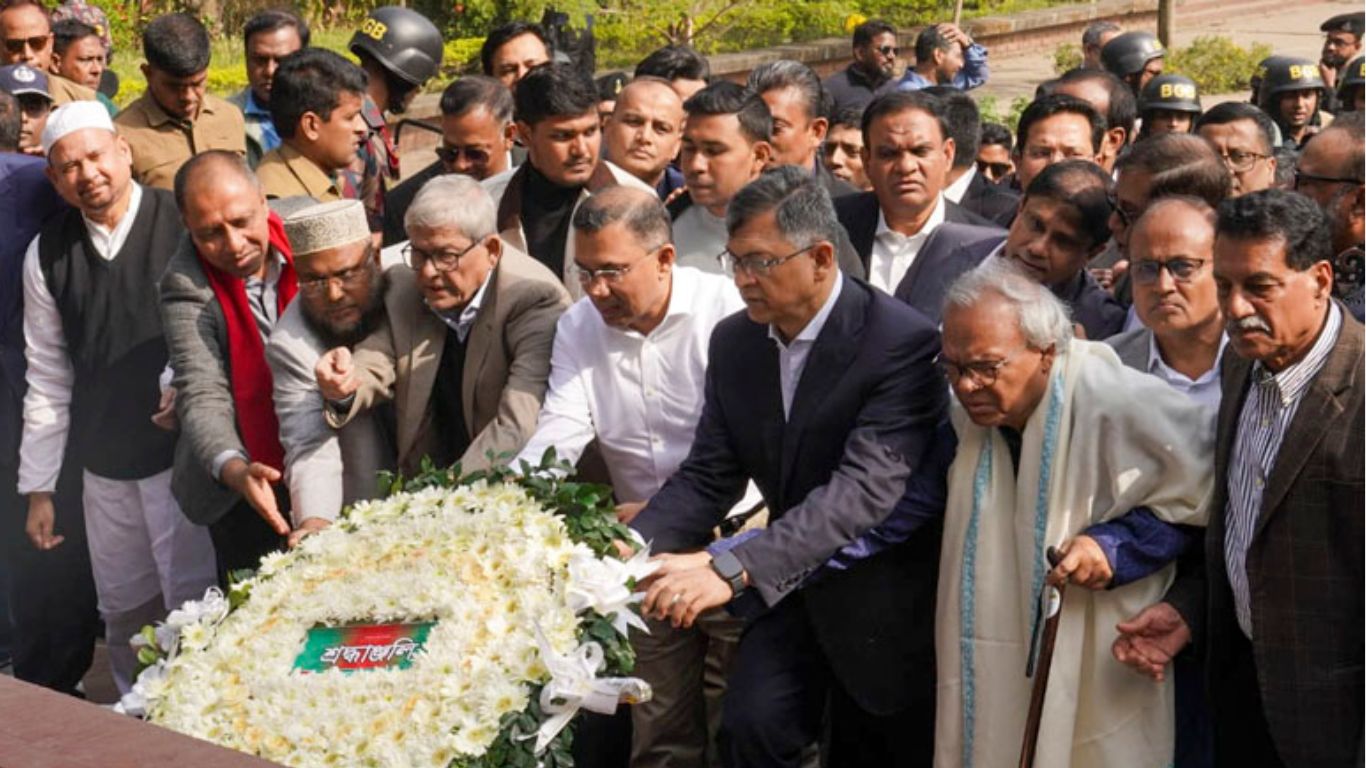
On Saturday (December 27), in one of his public appearances since coming back to Bangladesh, Bangladesh Nationalist Party (BNP) acting chairman Tarique Rahman visited the grave of Sharif Osman Hadi. Hadi was a young political activist whose killing recently triggered large-scale protests across the country.
As The Daily Star reported, later, Rahman also offered prayers at the grave of Bangladesh’s national poet Kazi Nazrul Islam, which is located next to the Dhaka University Central Mosque. Notably, Hadi was laid to rest beside Nazrul Islam’s grave on December 20.
Tight Security During Visit
Meanwhile, traffic for both vehicles and pedestrians was completely stopped on both sides of the road from Shahbagh to Dhaka University during Rahman’s visit. At the same time, heavy security arrangements were put in place, with personnel from the Rapid Action Battalion (RAB), Border Guard Bangladesh (BGB), and the police deployed along the route, local media reported.
Hadi, who served as a spokesperson for Inqilab Moncho, was shot dead earlier this month in an attack that has further raised political tensions ahead of the national elections scheduled for February. Importantly, he was also a key figure in the July 2024 uprising, which eventually led to the fall of the Sheikh Hasina-led Awami League government last year.
After paying his respects at Hadi’s grave, Rahman was scheduled to visit the Election Commission office in Agargaon. There, he was expected to complete the registration process for his national identity card and formally enroll himself as a voter.
Tarique Rahman’s Return Marks Political Shift
Rahman’s return to Dhaka after more than 17 years in exile is being seen as a major turning point in Bangladesh’s political landscape. The 60-year-old BNP leader, widely regarded as the political heir to a powerful family, arrived from London, where he had been living since 2008. He had left Bangladesh following what he has repeatedly described as politically motivated persecution.
Also Read: Bangladesh at a Crossroads: Why a New Elected Government Is Key to Resetting India Ties
Addressing supporters for the first time after his return, Rahman said Bangladesh had been “liberated twice”—first in 1971 and again during the July 2024 uprising. Additionally, he called for building an inclusive nation, stressing the importance of participation from all communities and ethnic groups. According to him, unity and equal representation would guide the BNP’s future political agenda.
As acting chairman, Rahman is expected to soon take over full leadership of the party from his mother, former Prime Minister Khaleda Zia, who is currently 80 and unwell. He returned to the country along with his wife, Dr Zubaida Rahman, and their daughter, Zaima Rahman.
Earlier, Rahman was arrested during the 2007 caretaker government and spent nearly 18 months in jail. Subsequently, he left for the United Kingdom in 2008 for medical treatment. Now, following the removal of Sheikh Hasina from power, he has emerged as a strong contender for the post of prime minister in the upcoming February general elections.