
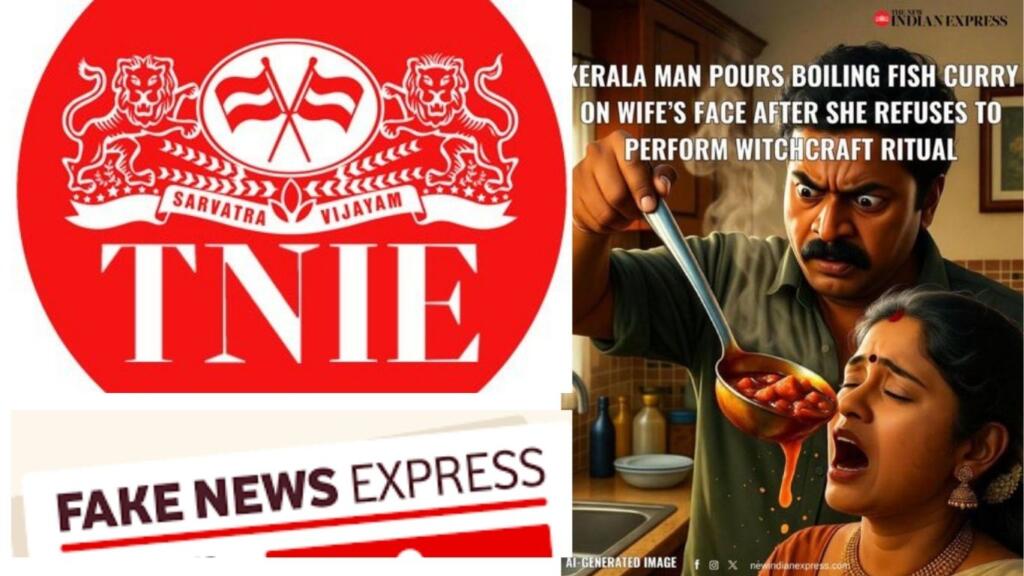
The New Indian Express has courted controversy this time, not for its reporting but for the image it chose to represent a sensitive crime story. In a case involving a Muslim man assaulting his wife in Kerala, the outlet published an AI-generated image depicting a Hindu woman with a visible tilak on her forehead. After outrage now it has silently deleted that image and placed another image. But the question remains, When a newsroom knows that such visual cues can deeply offend the sentiments of millions, the question arises: why was it used at all? Is it ignorance or arrogance born from the assumption that Hindus will never react violently or call for accountability? Would the same New Indian Express dare to publish an image showing a burqa-clad or skullcap-wearing figure in a story involving a Muslim perpetrator? The answer is self-evident and deeply troubling.
A Kerala Crime Misrepresented by AI Imagery
The shocking case from Kerala’s Kollam district involves a man named Mohd Sajeer, who allegedly poured boiling fish curry on his wife, Rejila Gafoor, after she refused to take part in a black magic ritual prescribed by an Usthad a local occult practitioner. According to the FIR, the incident took place at around 10 a.m. on a Wednesday in the couple’s rented home near Chadayamangalam. Sajeer, police said, believed his wife was “possessed” and had repeatedly assaulted her in the past.
When Rejila resisted his demand to participate in the ritual, he hurled the hot curry at her face, leaving her with severe burns. Neighbours rushed her to a private hospital in Anchal, where she is still recovering. Police have booked the accused under Section 118(1) of the Bharatiya Nyaya Sanhita and are on the lookout for him as he remains absconding.
However, while the brutality of the crime itself shocked readers, what triggered outrage online was how The New Indian Express represented the incident using an AI-generated image of a woman with visible Hindu identifiers. The woman in the image wore a tilak and bindi, symbols of faith and identity, when the actual victim, by all accounts, was a Muslim woman.
This seemingly minor “mistake” is not just a technical lapse. It’s a distortion of truth that can easily change the communal perception of a story and subtly transfer guilt to the wrong community.
Deliberate Misrepresentation or Convenient Bias?
The outlet later claimed the image was “AI-generated,” but that defence falls apart under scrutiny. Artificial intelligence doesn’t generate content in isolation it responds to human prompts. The imagery, tone, and aesthetic of any AI picture come from the directions given by editors or reporters themselves. Thus, blaming the technology is merely an attempt to escape responsibility.
What is at stake here is not just factual accuracy but the integrity of journalistic intent. If editors are feeding prompts that yield Hindu religious symbols for crimes committed by non-Hindus, it shows either carelessness or deliberate communal deflection. And this isn’t an isolated lapse it fits into a pattern.
A Pattern of Targeting Hindu Symbols and Whitewashing Others by Media Outlets
The Indian Express and Times of India also has a long and questionable history of editorial framing that minimises Islamist crimes while magnifying Hindu identity in unrelated contexts.
- The Times of India on the 23rd July, 2018 published an article titled “ ‘Godman’ held for forcing men into ‘unnatural sex’”. The article posted on Facebook at about 11 am (approximately) had the representational image of a Sadhu with long hair (tied in a bun/juda) meditating and donning a rudraksh and a prominent tilak/teeka on the forehead. Upon further reading, it becomes evident that the name of the accused in this case is Asif Noori who is a self proclaimed maulana who claimed to have magical powers. The Muslim godman (we are deliberately writing Muslim here to contradict the title of the article, we do not intend to spread any communal hatred) allegedly had sex with men who came to him with their problems.
-
March 28, 2025: In its story The Indian Express said “As competing Jagannath temple emerges in Digha, Odisha pulls out all stops for Rath Yatra in Puri,” the paper subtly pitted two Hindu regions against each other. The headline falsely implied competition between the historic Jagannath Dham of Puri and a newly built temple in Bengal a classic case of sowing intra-Hindu division.
-
Similarly In January 28, 2022: Reporting a communal murder in Gujarat, the Indian express headline read, “Communal tension after 27-year-old’s death: VHP bandh uneventful in Dhandhuka; two murder suspects held.” No mention of the victim’s Hindu identity, nor the perpetrators’ Muslim background. A casual reader would never know it was a communal killing of a Hindu youth by Islamist assailants.
This editorial pattern has one consistent outcome Hindu imagery and identities are used freely, while others are protected behind vague, sanitized terms like “people of another religion.”
The Double Standards of ‘Secular Journalism’
When stories involve Hindu individuals, these newspapers often has no hesitation in using religious names, temples, and symbols prominently. Yet, when the accused or the context is Islamic, terms like “Usthad,” “black magic,” or “religious ritual” are carefully buried under linguistic neutrality.
If a Hindu spiritual practice were involved in such violence, the coverage would likely feature words like “superstition,” “ritual crime,” or “patriarchal Hindu belief.” But in this case, where the accused is a Muslim man, the focus quietly shifted to the act itself stripped of any religious marker while the AI-generated Hindu imagery filled the visual gap, subconsciously redirecting blame.
This is how narrative manipulation works: subtle enough to pass editorial scrutiny, yet potent enough to distort public understanding.
Media houses cannot hide behind technology. Every AI-generated image originates from a prompt typed by a human editor. Thus, every such misrepresentation reflects editorial intent or negligence, not machine error.
If editors know that depicting a Hindu woman in a crime involving a Muslim perpetrator could inflame or offend, then doing it anyway is a sign of selective audacity a confidence that no backlash will follow because Hindus are known to remain peaceful and law-abiding.
This emboldens the cycle of bias without consequence, where media outlets exploit the tolerance of one community to appease or protect another.
The New Indian Express’s misrepresentation of Hindu symbols and silence on Islamist perpetrators is no coincidence. It reflects an entrenched editorial bias where facts are twisted, faith is trivialised, and sensitivity is one-sided.
AI cannot be blamed prompts come from people. Editors decide which image to generate, which headline to write, and which community to name or hide. If truth were the goal, such distortions would not exist.
The question now is simple, when will these so-called liberal media houses stop insulting Hindu identity under the guise of ‘representation’? Journalism must inform, not inflame; report, not manipulate. Until that standard returns, public trust will remain fractured and the integrity of Indian media will continue to erode under the weight of its own double standards.