






















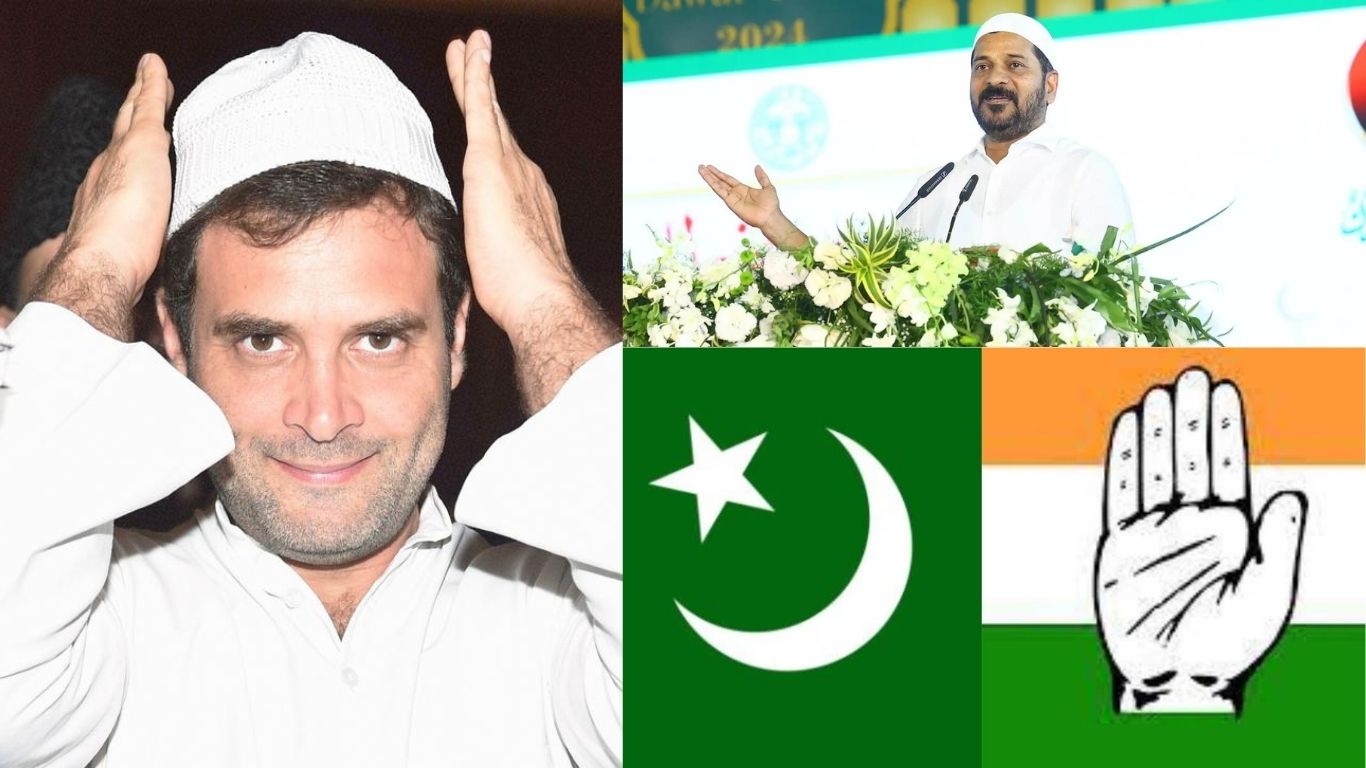
Telangana Chief Minister Revanth Reddy’s remark during his campaign for the Jubilee Hills bypoll “Congress means Muslims, and Muslims mean Congress” has set off a political storm that goes beyond a mere election speech. The statement, made in front of a large public gathering, openly equated Congress’s political identity with none other than the Muslim league.
In doing so, Reddy not only revealed the Congress’s long-standing dependence on minority appeasement but also confirmed what many critics have long argued that the Congress party has reduced itself to the political mirror image of the pre-Independence Muslim League.
If a BJP leader had ever said, “Hindus mean BJP and BJP means Hindus,” the same Congress ecosystem would have erupted in outrage, labelling it as communal and divisive. But when a sitting Congress Chief Minister makes an equally sectarian declaration, the same commentators who preach secularism remain conveniently silent. This selective outrage exposes the hypocrisy at the heart of Congress’s so-called secular politics.
The timing of Revanth Reddy’s comment is telling. With the November 11 Jubilee Hills bypoll approaching, Reddy’s words appear less like a slip of the tongue and more like a calculated pitch to consolidate Muslim votes. His statement that “Congress gave minorities big posts and opportunities” directly appeals to religious identity, not merit or governance. Telangana BJP President N. Ramchander Rao called out this desperation, saying, “The maximum communal riots took place under Congress rule. The Chief Minister is frustrated because he knows he’s going to lose this election.”
This pattern is not new. Congress has repeatedly resorted to such divisive rhetoric whenever it faces electoral uncertainty. Instead of offering development-based politics, it falls back on appeasement, attempting to secure one community’s loyalty while alienating the majority.
For decades, Congress’s approach to governance has revolved around viewing the Muslim community as a consolidated vote bank. Instead of pursuing inclusive growth or national integration, the party has indulged in targeted sops and religiously motivated policy decisions. Former Prime Minister Manmohan Singh once remarked that Muslims must have the “first claim on national resources,” a statement that symbolized Congress’s ideological drift from nationalism to minority-ism.
Such politics has long-term consequences. It discourages decisive action against Islamist radicalism and fosters a culture of entitlement rather than empowerment. More importantly, it alienates other communities who begin to perceive the Congress as a party of selective justice one that sees citizens not as Indians, but as members of competing religious blocs.
Interestingly, it is not just the BJP but even Congress’s allies who have exposed this pattern. In 2020, Kerala Chief Minister and CPI(M) leader Pinarayi Vijayan accused the Congress of being controlled by the Indian Union Muslim League (IUML). Vijayan wrote on his social media that “the League is taking decisions for the Congress” and that the grand old party’s “shamelessness for a few votes” had reached new depths.
Vijayan’s outburst came after the Congress-led United Democratic Front (UDF) appeared to allow the IUML to dictate candidate selections and strategic decisions. When even the Left, which shares stage with the Congress in the INDIA bloc, accuses it of surrendering to communal control, it underscores how deeply identity politics has eroded Congress’s ideological backbone.
The story repeatead itself in West Bengal. Just ahead Assembly polls in 2021, the state Congress unit, led by Adhir Ranjan Chowdhury, joined hands with the Indian Secular Front (ISF) a party founded by Pirzada Abbas Siddiqui, a cleric with openly sectarian leanings. The ISF was part of the Left-Congress alliance, but the move triggered fierce criticism from senior Congress leaders at the national level.
Kapil Sibal, Anand Sharma, and others from the party’s G-23 faction warned that such alliances betrayed Congress’s foundational principles. Sharma even said the tie-up with ISF was against the “core ideology of the Congress” and that the decision was taken without the central leadership’s consent. Yet, despite these objections, the state leadership went ahead, confirming that vote-bank politics outweighed ideology or consistency.
From Revanth Reddy’s Telangana speech to the IUML’s control in Kerala and the ISF alliance in Bengal, a clear pattern emerges Congress is no longer a secular party. It is a coalition of regional appeasement strategies masquerading as inclusivity. The party’s leaders no longer shy away from declaring their allegiance to one community if it promises electoral dividends.
This degeneration has created a political vacuum where Congress no longer appeals to aspirational India the youth, the middle class but relies instead on emotional and religious manipulation. The more it loses ground nationally, the more it doubles down on the same failed politics of the past.
When Revanth Reddy declared “Congress means Muslims,” he might not have realized how perfectly his words capture the party’s transformation. The Congress that once stood for national unity under leaders like Sardar Patel has now reduced itself to a narrow vote-bank vehicle.
Today’s Congress resembles the pre-1947 Muslim League in both spirit and strategy appealing to religious sentiment, exploiting fears, and dividing citizens for political survival. In its desperate attempt to remain relevant, Congress has abandoned the idea of a united India built on merit, equality, and nationalism.