

















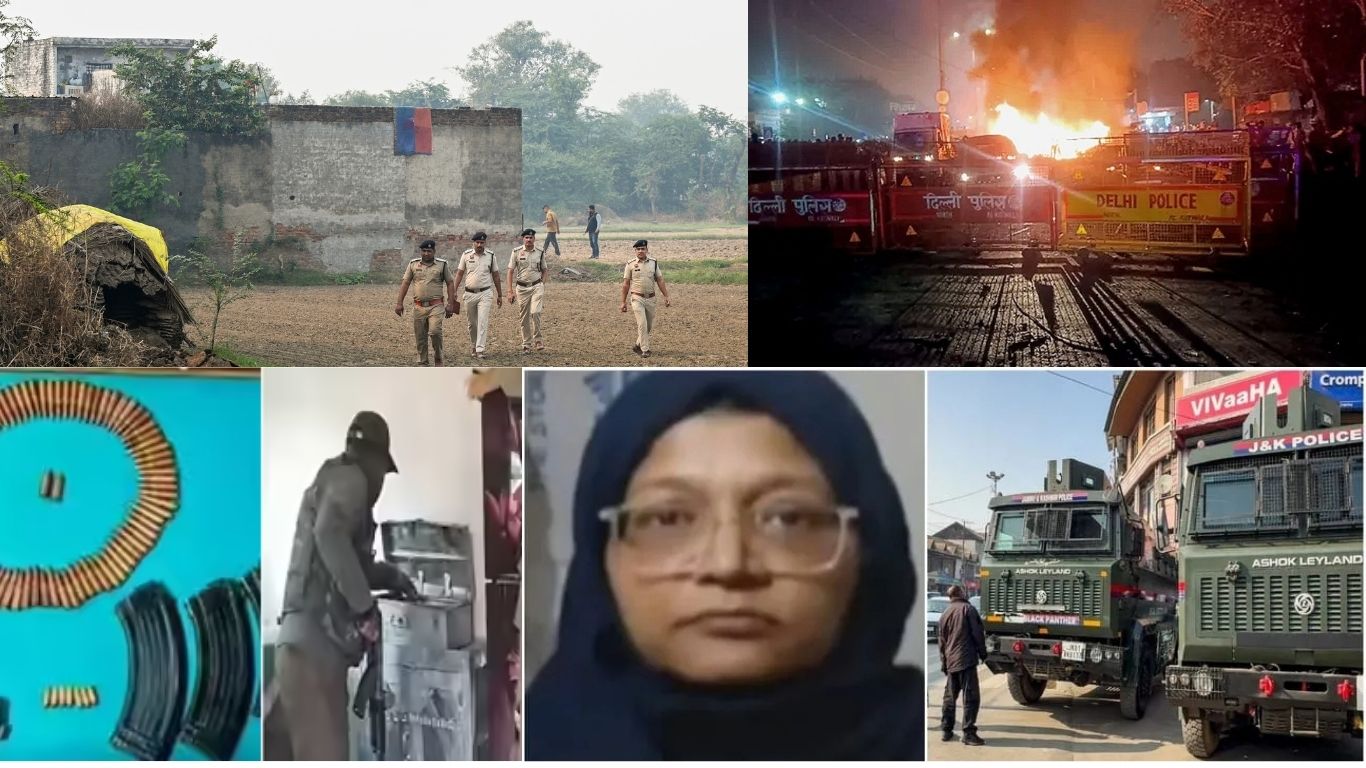
Authorities investigating the November 10 blast near Delhi’s Red Fort have found that the explosives used in the attack were identical to those recovered from the Faridabad hideouts of a recently dismantled Jaish-e-Mohammed (JeM) terror module. The module, described by officials as a “white-collar network,” involved several doctors and professionals who were allegedly radicalised and recruited to build a covert operational base in India.
The blast, which occurred just hours after multiple raids on the group’s suspected facilities in Faridabad and other regions, killed 12 people and injured several others. Investigators believe the explosion was triggered by panic and desperation among module members after coordinated police operations disrupted their plans and exposed their safe houses across Jammu and Kashmir, Haryana, and Uttar Pradesh.
A senior intelligence official told The Times of India that raids carried out in Delhi-NCR and Pulwama led to the recovery of nearly 3,000 kilograms of explosives, primarily ammonium nitrate. “These raids are believed to have forced one of the module’s operatives to act hastily under mounting pressure,” the officer said, suggesting that the blast was not part of a fully executed plan.
Investigators later discovered that the explosive device used in the Red Fort incident was crudely assembled and incomplete, which limited its destructive impact. According to forensic reports cited by TOI, the device did not create a crater, nor were any bullets or metallic fragments found at the site signs that it was not a fully functional improvised explosive device (IED).
An officer involved in the probe stated, “Dr Umar, a member of the Faridabad module, changed his location from the Al-Falah Medical College campus following the crackdown on other members. He is believed to be the one driving the car used in the blast, as confirmed by CCTV footage. The explosives used were the same as those found in the Faridabad hideouts.”
The official added that whether the explosion was intentional or accidental remains under investigation. The vehicle was moving in regular traffic and did not appear to target a specific location, which investigators see as evidence that the explosion may have occurred while the explosives were being transported.
Officials described the Delhi blast as an unfortunate incident that nonetheless reflected the success of India’s counterterrorism efforts. “The destruction of the JeM-linked terror module caused the hasty explosion in Delhi, which shows how alert our agencies have become,” one senior officer said. “This is a success for our intelligence and law enforcement systems.”
The origins of the case trace back to Srinagar, where the appearance of a few offensive posters in October triggered an investigation. On October 19, a formal complaint was registered, leading to an extensive probe that uncovered the involvement of multiple individuals across several states.
During the raids, authorities arrested several doctors associated with the module, including Dr Muzammil Shakeel (also known as Musaib or Dr Muzammil Ganaie), Dr Adil Ahmed Rather, and Dr Shaheena Shahid from Lucknow. Nearly 2,900 kilograms of explosive material were recovered from various sites linked to the group.
Investigators allege that Dr Shaheena was recruited by Saadia Azhar, sister of JeM chief Maulana Masood Azhar, to establish the women’s wing of the organisation Jamaat-ul-Mominat in India. Her role reportedly involved recruiting women from professional and academic backgrounds, particularly from the medical community, to support JeM’s ideological and logistical operations.
The Faridabad-based Al-Falah University came under scrutiny after raids revealed a cache of explosives and weapons stored in its vicinity. Several of the arrested doctors were either employed at or connected to the university, which investigators suspect was being used as a base for meetings and recruitment.
Fresh details have emerged in the Red Fort car blast investigation, linking the event directly to the Faridabad module. Police sources said that one of the arrested accused, Dr Shaheen Shahid (referred to as Shaheena in earlier reports), confessed during interrogation that she and other module members had been collecting explosives for nearly two years in preparation for coordinated attacks across India.
According to investigators, the Hyundai i20 car used in the explosion travelled through several parts of Delhi before the incident. CCTV footage showed the vehicle passing Connaught Place around 2:30 p.m. before moving toward the Red Fort area, where the explosion occurred near Gate No. 1 of Red Fort Metro Station around 6:52 p.m.
Sources said Dr Umar Nabi, an assistant professor at Al-Falah University, was driving the car. Nabi, a key member of the terror module, reportedly fled Faridabad in a hurry after learning of the raids. Investigators suspect that he was carrying an incomplete IED, which detonated accidentally while in transit. This explains why the explosion’s impact remained relatively small, leaving no crater or shrapnel at the scene.
Police confirmed that the blast was not a suicide bombing. The vehicle did not ram into any structure or target civilians deliberately. Umar Nabi died in the explosion, and his identity is being verified through DNA testing using samples taken from his mother.
Forensic experts have confirmed that the chemical composition of the explosives used in the Red Fort blast matches the material seized earlier in Faridabad. Investigators believe the network is connected to Jaish-e-Mohammed and Ansar Ghazwat-ul-Hind, both active in Jammu and Kashmir and the northern states of India.
Further interrogation revealed that Dr Shaheen maintained direct communication with Saadia Azhar, who founded Jamaat-ul-Mominat in October 2025. Intelligence agencies say the women’s wing was formed in retaliation for the death of Saadia’s husband during Operation Sindoor, an Indian anti-terror offensive in Kashmir.
The Jammu and Kashmir Police arrested Dr Shaheen from Al-Falah University in Faridabad and later transferred her to Srinagar for further interrogation. Officials are now analyzing her digital communications, including emails and messaging app records, to trace her network of contacts and potential funders.
Dr Shaheen’s academic background adds to the case’s complexity. She completed her MBBS from Allahabad Medical College (1996–2001 batch) and later obtained an MD in Pharmacology. Between 2006 and 2013, she worked as an assistant professor at Kanpur Medical College, having been appointed through the UP Public Service Commission (UPPSC).
After 2013, she reportedly disappeared from public life and stopped responding to college notices. She was formally dismissed in 2021. Sometime later, she joined Al-Falah University in Faridabad, where she came into contact with Dr Muzammil, another key member of the terror module.
Security agencies continue to piece together how this group of educated professionals became part of a terror network. Investigators say the Faridabad module’s exposure, and the resulting panic that may have caused the Red Fort blast, highlight both the reach of radicalisation and the growing effectiveness of India’s