






















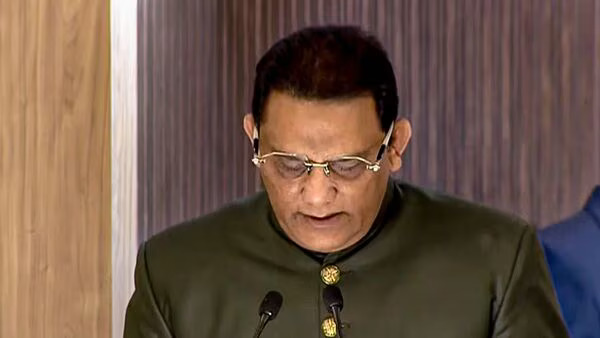
A political tempest has struck Telangana — and for good reason. The Congress government’s decision to induct former Indian cricket captain Mohammad Azharuddin, a man whose name is still synonymous with one of cricket’s darkest scandals, into the state cabinet is nothing short of a disgrace. That the oath-taking was conducted with the pomp of official ceremony at Raj Bhavan on October 31 only adds insult to injury.
For a party that prides itself on “moral politics” and “ethical governance,” the move reeks of opportunism, desperation, and political amnesia. Without a shred of doubt, past of Azharuddin is not one shrouded in mere controversy — it is marked by infamy. His fall from grace in 2000, following the explosive match-fixing scandal that shook Indian cricket to its core, remains one of the most shameful chapters in the nation’s sporting history. Though the Andhra Pradesh High Court later lifted his life ban in 2012, the cloud of suspicion never truly dispersed. His reputation remains tarnished, his integrity permanently in question.
Yet, the Congress party, led by Chief Minister A. Revanth Reddy, appears to have decided that history — and morality — no longer matter. Reports suggest that Azharuddin may be handed portfolios as sensitive and significant as Home Affairs or Minorities Welfare and Sports. The irony could not be more stark: a man once banned for betraying his sport now potentially holding the reins of state security and ethics-related portfolios.
Even within the Congress, dissent is simmering. Telangana Pradesh Congress Committee (TPCC) president Mahesh Kumar Goud admitted to being blindsided by the appointment, a stunning revelation that exposes the lack of consultation and creeping authoritarianism within the party’s ranks. Senior leaders, according to sources, are privately fuming — not only over the decision but also over the timing. With the Jubilee Hills by-election barely days away, the move is widely seen as a calculated ploy to curry favour with Muslim voters.
This kind of identity-based tokenism is not just cynical; it is dangerous. Congress’s justification — that Azharuddin’s induction is meant to ensure minority representation — rings hollow. There is no shortage of capable, respected Muslim leaders in Telangana. Choosing a figure dogged by allegations of corruption and deceit sends precisely the wrong message: that representation can be bought with notoriety.
The opposition has wasted no time in tearing into the decision. Both the Bharatiya Janata Party (BJP) and the Bharat Rashtra Samithi (BRS) have accused the Congress of exploiting Azharuddin’s religious identity for electoral gain. The BJP has even filed a complaint with the state Election Commission, alleging a violation of the Model Code of Conduct. While political outrage from rivals is expected, in this case, it is entirely justified.
Congress leaders have scrambled to defend the move. Deputy Chief Minister Mallu Bhatti Vikramarka labelled the criticism a “BJP-BRS nexus.” Goud, in a complete about-face, parroted the same line, insisting that the appointment merely “corrects a long-overdue imbalance.” But no amount of spin can disguise the rot: Congress has chosen expedience over ethics.
Let’s be clear — Azharuddin may have once been a cricketing hero, but heroism fades when integrity collapses. His later years have been spent in political obscurity, punctuated by failed electoral bids and lacklustre leadership stints. Now, resurrected at the convenience of Congress’s vote-bank arithmetic, he stands as a symbol of everything wrong with India’s political opportunism.
It is telling that even now, Azharuddin is not an elected representative. He must be inducted into the Legislative Council within six months to hold onto his post — another procedural sleight of hand that underlines how hastily and cynically this decision was made.
In a state that deserves better governance and cleaner politics, Telangana’s Congress government has chosen instead to rehabilitate the discredited. One must ask: when did the party of Nehru and Patel lose its moral compass so completely that it sees no contradiction in rewarding scandal with power?
The answer, sadly, is written in Azharuddin’s oath of office — and in the silence of a party that once claimed to stand for integrity.