


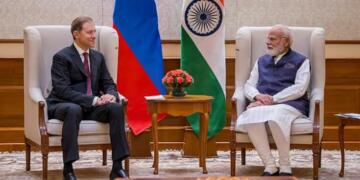












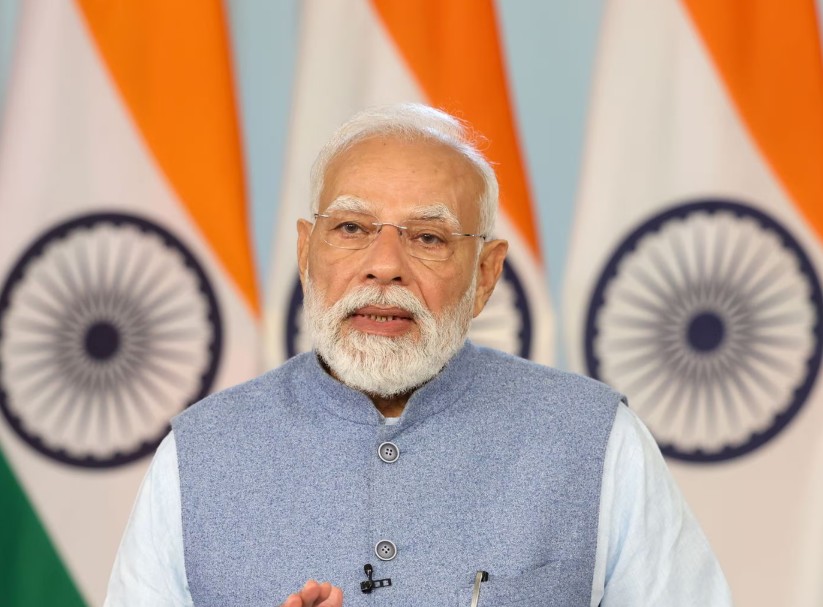
Prime Minister Narendra Modi on Wednesday virtually inaugurated the Safran Aircraft Engine Services India (SAESI) facility located at the GMR Aerospace and Industrial Park, SEZ, Rajiv Gandhi International Airport in Hyderabad through video conferencing.
Addressing the occasion, the Prime Minister highlighted, “From today India’s aviation sector is taking a new flight. Safran’s new facility will help establish India as a Global Maintenance, Repair, and Overhaul (MRO) Hub.”
Boost to Youth Employment and Indigenous Aviation Capabilities
The Prime Minister underlined that this MRO facility will also create new opportunities for youth in the high-tech aerospace sector and recalled that he had met the Safran Board and Management on November 24, and noted that in every discussion with them earlier too, he witnessed their confidence and hope regarding India.
He expressed his expectation that Safran’s investment in India will continue at the same pace. Extending his best wishes, the Prime Minister conveyed congratulations to Team Safran for this new facility.
India’s Aviation Market Among the Fastest Growing
Highlighting that in recent years India’s aviation sector has advanced at an unprecedented pace, PM Modi said that today India is among the fastest growing domestic aviation markets in the world.
Safran Aircraft Engine Services India (SAESI) is Safran’s dedicated Maintenance, Repair, and Overhaul (MRO) facility for LEAP (Leading Edge Aviation Propulsion) engines, which power the Airbus A320neo and Boeing 737 MAX aircraft.
A Major Milestone: First Global Engine OEM MRO in India
The establishment of this facility marks a significant milestone, as it is not only one of the largest global aircraft engine MRO facilities but also the first time, a global engine OEM (original equipment manufacturer) has set up an MRO operation in India.
Spread across 45,000 sqm within the GMR Aerospace and Industrial Park – SEZ, the state-of-the-art facility developed with an initial investment of around Rs 1,300 crore.
Designed to service up to 300 LEAP engines annually, SAESI facility will employ over 1,000 highly skilled Indian technicians and engineers upon achieving full operational capacity by 2035.
The facility will feature advanced process equipment to deliver world-class engine maintenance and repair services. The MRO facility will be a huge step towards the goal of Aatmanirbharta in the aviation sector.
Policy Reforms Strengthening India’s MRO Ecosystem
Developing indigenous capabilities in MRO will reduce foreign exchange outflows, create high-value employment, strengthen supply-chain resilience and position India as a global aviation hub. The Government of India is actively working to build a robust MRO ecosystem to support the sector’s rapid growth.
Key policy initiatives of the government, including GST reforms in 2024, MRO Guidelines 2021, and the National Civil Aviation Policy 2016—have simplified operations for MRO providers by rationalising tax structures and reducing royalty burdens.
India Now the World’s Third Largest Domestic Aviation Market
The Prime Minister in his virtual address underlined that India’s domestic aviation market has now become the third largest globally. He observed that the aspirations of the people of India are reaching new heights, and consequently the demand for air travel in the country continues to rise. He noted that airlines are consistently expanding their active fleet to meet this demand.
He further stated that Indian airline companies have placed orders for more than 1,500 new aircraft. Underlining that with the rapid expansion of India’s aviation sector, the need for MRO facilities has also increased.
PM Modi stated that nearly 85 percent of India’s MRO work has been taking place outside the country, which led to higher costs, longer turnaround times, and aircraft remaining grounded for extended periods.
He underlined that such a situation was not suitable for a vast aviation market like India. Therefore, he stated that today the Government of India is developing the nation as one of the world’s major MRO hubs. Shri Modi further remarked that for the first time, a global OEM is establishing Deep Level Servicing facilities in the country.
Global Training and Knowledge Transfer to Boost Talent
Highlighting that Safran’s global training, knowledge transfer, and partnership with Indian institutions will help create a workforce that will, in the coming years, give new momentum and direction to the entire MRO ecosystem.
The Prime Minister underlined that this facility will generate numerous employment opportunities for the youth of South India. He further stated that India does not want to remain limited to aviation MRO alone, and is also working on a large scale to develop an MRO ecosystem connected with shipping.
Push for Design in India
PM Modi emphasised that India is promoting “Design in India” on a large scale across every sector. He urged the Safran team to explore possibilities of aircraft engine and component design in India.
He said that India’s vast MSME network and its young talent pool would provide significant support in this endeavour. The Prime Minister noted that Safran Aerospace works extensively in aerospace propulsion systems and expressed his wish that the company should also leverage India’s talent and opportunities for propulsion design and manufacturing.
India Taking Bold Steps Towards Becoming a Global Manufacturing Hub
Prime Minister underscored that today’s India is not only dreaming big but also taking bold decisions and achieving even greater accomplishments. He stated, “We are dreaming big, doing bigger and delivering best.”
The Prime Minister highlighted that India is placing strong emphasis on Ease of Doing Business. Underlining that to attract global investment and global industries, some of the biggest reforms in independent India have been undertaken.
PM Modi said that first, the doors of the economy were opened; second, the nation’s economic fundamentals were further bolstered; and third, ease of doing business was strengthened. He pointed out that today in most sectors, 100 percent FDI is possible through automatic routes and said that even in sectors like defence, where earlier the private sector had no space, 74 percent FDI has now been opened through automatic routes.
He underlined that a major approach has also been adopted in the space sector. The Prime Minister stated that these steps have sent a clear message to the world, that “India welcomes investments, India welcomes innovation.”
PLI Schemes and Governance Reforms Attracting Global Manufacturers
He further noted that Production Linked Incentive schemes have attracted global manufacturers towards Make in India. PM Modi also noted that in the past 11 years, more than 40,000 company compliances have been reduced and said that India has decriminalised hundreds of business-related provisions.
He underlined that the National Single Window System has brought numerous approvals onto a single platform. The Prime Minister noted that GST reforms, faceless tax assessment, new labour codes, and the Insolvency and Bankruptcy Code have all made governance simpler and more transparent than ever before.
He stated that due to these efforts, India is now seen as a trusted partner, a major market, and a rising manufacturing hub. Underscoring India today has rapid growth, a stable government, a reform-oriented mindset, a vast young talent pool, and a large domestic market.
He said that most importantly, for those investing in India, the country considers them not merely as investors but as co-creators, stakeholders in the journey of a developed India.
A Smart Investment Destination
The Prime Minister concluded by stating, “India is proving by betting on India is the smartest business decision of this decade.”
PM Modi extended his congratulations to all for the establishment of this modern MRO facility. Chief Minister of Telangana, Revanth Reddy, Union Minister, K Ram Mohan Naidu were present among other dignitaries at the event.