





















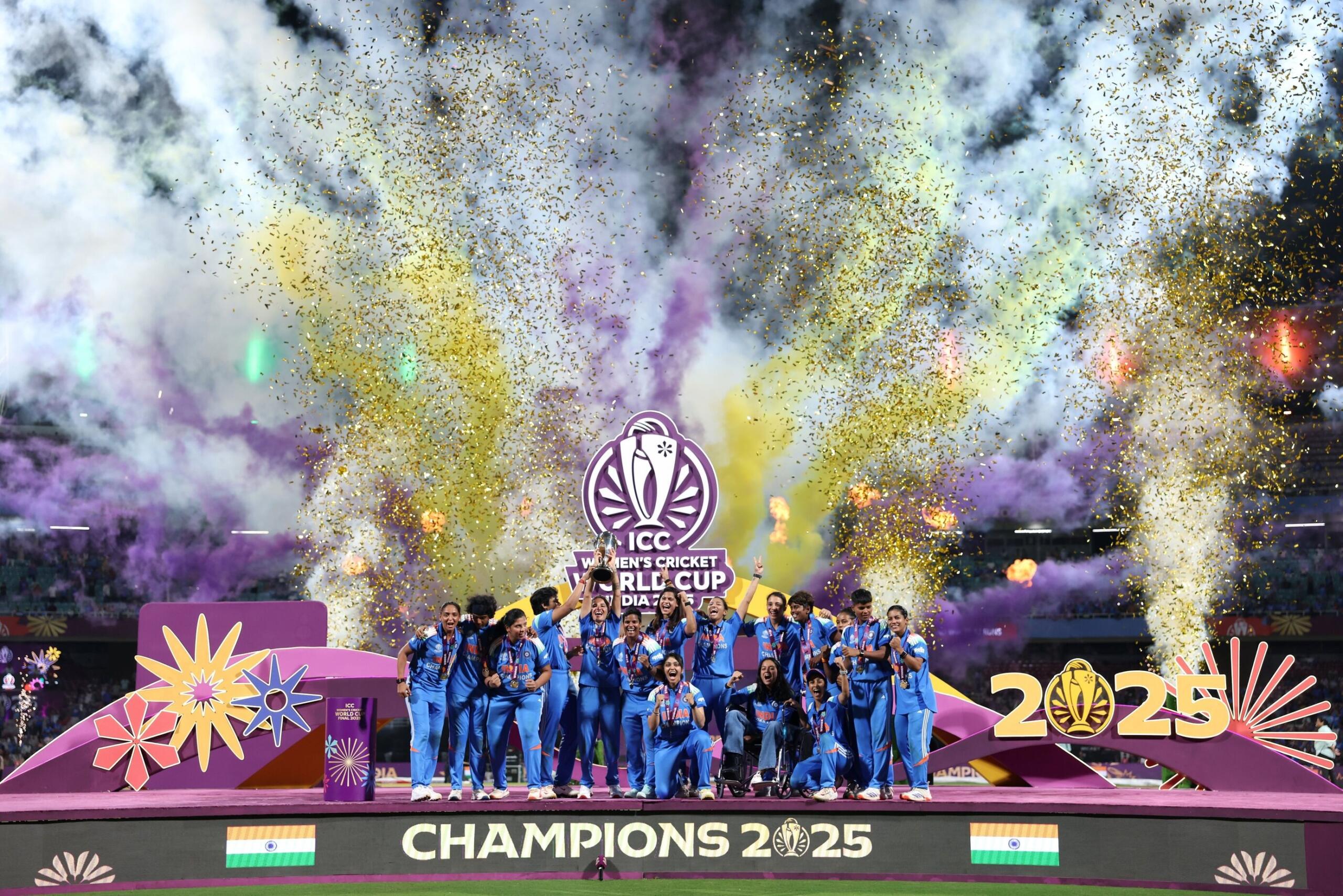
For decades, Indian sport has known the pain of near-misses. Milkha Singh’s heartbreaking fourth place in the 1960 Rome Olympics, the football team’s missed opportunity in the 1956 Games, or Dipa Karmakar’s agonising 0.15-point shortfall at the 2016 Rio Olympics India’s sporting journey has been punctuated by such moments. Women’s cricket too carried its own scars the 2005 and 2017 World Cup finals, both ending in defeat when the dream seemed within reach. But as the sun set over Navi Mumbai on November 2, 2025, that era ended. The Indian women’s cricket team, led by Harmanpreet Kaur, lifted the ICC Women’s World Cup trophy, scripting history that would change the face of Indian sport forever.
“1983 inspired an entire generation to dream big and chase those dreams. Today, our women’s cricket team has done something truly special,” said Sachin Tendulkar, whose words captured the emotion of a billion hearts. “They have inspired countless young girls across the country to believe that they too can lift that trophy one day.”
Just as Kapil’s Devils did at Lord’s in 1983, Harmanpreet’s Warriors have now rewritten destiny not just for cricket, but for every aspiring Indian girl who dreams of making it on the big stage.
A New Chapter in Indian Sport’s Legacy
When Kapil Dev’s men stunned the world in 1983, it didn’t just bring a trophy it brought belief. It gave India’s youth the courage to dream. Four decades later, Harmanpreet Kaur’s team has done the same, but this time for millions of women. This victory isn’t merely a sporting triumph; it’s a social and cultural revolution.
The 2025 World Cup win is the culmination of years of struggle, heartbreak, and perseverance. The ghosts of 2005 and 2017 when India fell just short of glory have finally been laid to rest. For Harmanpreet, who had witnessed that heartbreak first-hand eight years ago, this victory was deeply personal. The image of her catching Nadine de Klerk at extra cover, with commentator Ian Bishop calling it “inspiring generations,” will be etched forever in Indian cricketing history.
Fireworks lit up the Navi Mumbai sky as the team held the trophy high a moment symbolic of the country’s arrival as a powerhouse in women’s cricket. For once, the story wasn’t about what could have been; it was about what finally was a world champion Indian women’s team.
The Numbers Tell a Story: Record-Breaking Viewership and Unprecedented Growth
If 1983 was about awakening cricket’s spirit in India, 2025 is about expanding it. The ICC confirmed that the Women’s Cricket World Cup shattered all previous records, with over 60 million fans tuning in to watch the first 13 matches alone five times more than the 2022 edition. The total watch time exceeded seven billion minutes, underscoring how women’s cricket has captured the nation’s imagination.
The overall prize pool soared by 297%, touching $13.88 million, surpassing even the men’s 2023 World Cup. And while the ICC contributed to this massive growth, the BCCI’s gesture took the nation by storm announcing an additional ₹51 crore cash prize for the players, selectors, and support staff, acknowledging their role in bringing glory to the nation.
“Definitely, we have to thank Jay Shah, who is the chair of ICC,” said BCCI secretary Devajit Saikia. “Just a month prior to this tournament, the ICC increased the prize money by about 300 per cent. But BCCI, on its own, decided to reward the team with ₹51 crore a gesture of pure pride and gratitude.”
The total prize pool for the 2025 Women’s World Cup is Rs 116 crore – nearly three times higher than the Rs 29 crore awarded in the 2022 tournament held in New Zealand. The prize money for the 2025 Women’s World Cup also exceeds that of the 2023 Men’s World Cup, which had a total prize pool of Rs 84 crore.
This victory was also a triumph of India’s sporting ecosystem a validation of years of investment, grassroots development, and changing societal attitudes toward women in sport. The women’s team today stands where the men’s team was expected to respected, adored, and celebrated.
From Empty Stands to Roaring Crowds: The Rise of Women’s Cricket in India
Two decades ago, women’s cricket matches in India were played before sparsely filled stadiums, their achievements barely covered in the media. Today, the contrast is stark. The 2025 Women’s World Cup final saw packed stands at the Dr DY Patil Stadium, with millions glued to their screens. Television networks gave prime-time coverage, mainstream commentators lent their voices, and the lexicon of cricket itself evolved “batters” replaced “batsmen,” and “man of the match” became “player of the match.”
The transformation is visible not only in stadiums but also in schools, workplaces, and homes. Parents now encourage their daughters to take up sports; local cricket tournaments feature women’s teams, and advertisements proudly showcase men wearing jerseys of female players.
Names like Mithali Raj, Jhulan Goswami, and Smriti Mandhana have become household icons not just cricketers, but symbols of empowerment. Harmanpreet Kaur’s leadership and Shafali Verma’s fearlessness have inspired a generation. Their influence transcends cricket they represent the confidence of New India, where women are not just participants but champions.
Even off the field, women have broken barriers. Chandraya Naidu became the first female commentator, Sharda Ugra blazed a trail in sports journalism, Vrinda Rathi stood as the first woman Test umpire, and GS Lakshmi made history as the first female match referee. The growth of the Women’s Premier League (WPL) further amplified the sport’s visibility, creating stars out of young players and ensuring that women’s cricket was no longer an afterthought it was the main event.
World Cup Triumph: A Team Effort in Every Sense
The final itself was a masterclass in composure and teamwork. South Africa, led by Laura Wolvaardt, opted to bowl first after winning the toss. But India’s top order, anchored by a majestic 87-run knock from Shafali Verma, ensured a solid foundation. India posted 298 runs, setting a daunting target.
In response, Wolvaardt led a spirited chase with a century, but India’s bowlers particularly Deepti Sharma, who claimed five wickets, and Shafali, who contributed with two more dismantled South Africa’s batting lineup. India clinched victory by 52 runs, sealing their maiden 50-over World Cup title. Shafali Verma’s all-round brilliance earned her the Player of the Match award.
As Harmanpreet lifted the trophy alongside her teammates, tears of joy and pride rolled down many faces. The weight of two decades of heartbreak had been lifted. This was India’s moment of redemption and recognition.
Beginning of a New Era for Indian Sport
If June 25, 1983, marked the rise of India as a cricketing superpower, then November 2, 2025, will forever be remembered as the day India’s women took that legacy forward. This victory is not just about a trophy it is about transformation. It is about every little girl in a small town who now dares to dream of wearing the India jersey.
Women’s cricket has arrived, and it has arrived with authority. The 2025 triumph will not just change cricket it will reshape the future of Indian sports itself. With record-breaking viewership, increased financial backing, and a newfound respect across all platforms, this is the dawn of a golden era.
In the echoes of Harmanpreet’s victory roar lies the message of a new India confident, fearless, and equal. Just as 1983 did for men’s cricket, 2025 will inspire generations of women to dream, to play, and to conquer. The wait is over. The revolution has begun.