Fatal Tejas Crash Stuns Dubai during Air Show, Investigators Probe Multiple Possibilities

The cause of the Tejas aircraft crash remains officially unknown, early assessments suggest several possibilities, ranging from a sudden technical malfunction in the aircraft’s advanced systems, to a potential human error during a complex maneuver

Fatal Tejas Crash in Dubai Air Show

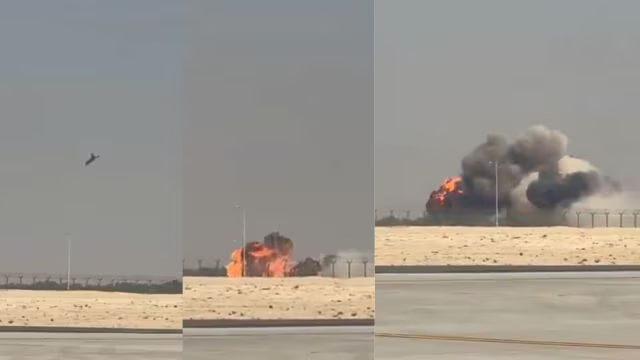
A tragic turn of events unfolded at the Dubai Air Show on Friday afternoon when an Indian Air Force Tejas fighter jet crashed during a high-intensity aerial display, killing the pilot on impact.

While the cause of the accident remains officially unknown, early assessments suggest several possibilities, ranging from a sudden technical malfunction in the aircraft’s advanced systems, to a potential human error during a complex maneuver.

There is also the possibility that the pilot, performing before a global audience, may have pushed the aircraft or his own limits beyond the safe threshold in an attempt to execute a more dramatic, high-performance routine.

The IAF is now tasked with determining which of these factors — alone or in combination — led to the fatal crash that sent plumes of black smoke rising across the Dubai skyline.

Technical, Human, and High-Performance Factors Under Lens

The Tejas light combat aircraft (LCA Mk-1) crashed during a display around 2:10 pm local time, instantly drawing panic among thousands of spectators. The jet went down in a fireball near the airport’s periphery, sending thick plumes of black smoke into the air. The IAF confirmed the death of the pilot, despite immediate emergency response at the crash site.

In its official statement, the Indian Air Force said, “An IAF Tejas aircraft met with an accident during an aerial display at Dubai Air Show today. The pilot sustained fatal injuries in the accident. IAF deeply regrets the loss of life and stands firmly with the bereaved family in this time of grief. A court of inquiry is being constituted to ascertain the cause of the accident.”

The incident has triggered intense scrutiny, not only because Tejas is India’s flagship indigenous fighter aircraft, but also because the aircraft was performing in a high-profile international arena.

What is Tejas? The Aircraft at the Centre of the Disaster

The Tejas Light Combat Aircraft (LCA) is a 4.5-generation, multi-role fighter jet designed by India’s HAL (Hindustan Aeronautics Limited), capable of offensive air support, close combat, ground attack mission and maritime operations.

The aircraft is known for being lightweight, highly maneuverable, and fitted with cutting-edge systems.

The latest LCA Mk-1A variant incorporates major upgrades including AESA radar (Active Electronically Scanned Array), electronic warfare suite, radar warning receiver, jamming capability, digital map generator, smart multi-function cockpit displays, combined IFF (Identification Friend/Foe) interrogator-transponder, modern radio altimeter and improved survivability and combat handling.

For more than two decades, India’s home-grown HAL Tejas maintained one of the cleanest safety records in global fighter aviation. Since its maiden flight in 2001, the Tejas completed more than 10,000 test+ operational sorties without a single crash — a milestone unmatched by many foreign fighter programmes.

Remarkable Beginning of Tejas: 23 Years, Zero Crashes

The Tejas made its first flight on January 4, 2001, marking the start of India’s indigenous fighter programme’s most critical phase. From that day onward, and for twenty-three continuous years, the LCA flew close to 5,000 developmental test flights, thousands of squadron-level sorties, weapons trials, high-G manoeuvres, and long-endurance missions, regular operational deployments. All without a single accident.

This spotless record placed Tejas among the safest light combat aircraft ever developed, especially compared to foreign jets that suffered multiple crashes even during early testing.

First Crash: March 12, 2024 — Jaisalmer Training SortieTwenty-three years after it first took to the skies, the Tejas LCA experienced its first accident on March 12, 2024, during an operational training sortie near Jaisalmer, Rajasthan.

The key facts of the incident in Jaisalmer include that the pilot ejected safely, sustaining no serious injuries, a court of Inquiry pointed to a likely engine seizure (GE 404). The seizure was traced to an oil pump malfunction. Crucially, investigators ruled out any design flaw or systemic issue in the Tejas fleet
In other words, it was an isolated mechanical failure — not a reflection of the aircraft’s aerodynamics, systems reliability, or structural performance.

Possible Causes Under Investigation

A crash during a display flight can stem from one or more of three broad categories that include technical failure, human error and operational overreach (pushing aircraft or pilot limits). The Court of Inquiry will examine all three.

Technical Malfunction: A Strong Possibility

Even the most advanced aircraft can face sudden failures. Potential technical glitches include:

Engine failure: High-thrust maneuvers during air shows put enormous stress on engines. A flameout, compressor stall, or loss of power can be catastrophic at low altitude.

Hydraulic Failure: Hydraulics control flight surfaces such as flaps, ailerons, stabilizers. Any loss of hydraulic pressure can cause the aircraft to stop responding.

Avionics or sensor malfunction
Fuel delivery issues: A blocked pump or fault in fuel flow system could starve the engine even when tanks are full. Given the complexity of Mk-1A electronics, a software or system-level failure is also possible.

Human Error

Air show flying is far riskier than standard operational flying. Pilots often operate at lower altitudes, higher speeds, sharper turns, tighter margins
A slight miscalculation during a dramatic maneuver could cause the aircraft to lose lift or altitude faster than expected. At high speed, even a one-second delay in recovery can mean the difference between a near-miss and impact.

Stress or distraction
Crowd pressure, timing of maneuvers, or miscommunication with ground control can cause errors. While IAF pilots are highly trained, air show displays push everyone — including the best toward razor-thin margins.

Did the Pilot Push His Limits? A Crucial Angle

Air shows often tempt pilots to perform more dramatically, more sharply, or more aggressively than standard protocols allow.

Investigators will examine whether the pilot Attempted a maneuver at an unsafe speed or altitude. Tried to tighten a loop or roll beyond planned parameters Or Pushed G-limits or angle-of-attack beyond safety thresholds and Tried to outperform his own rehearsal routine or previous displays.

A Personal and Irreplaceable Loss

Beyond its technical and strategic implications, the loss is deeply personal and profoundly painful. Fighter pilots represent an elite cadre within the armed forces—individuals who undergo years of rigorous training, intense psychological conditioning, and relentless physical preparation before they are entrusted with high-performance aircraft like the Tejas.

Each pilot embodies not only skill, but also national investment, institutional pride, and the collective hopes of the Air Force. When an accident of this magnitude occurs, it shatters far more than a machine; it extinguishes a life shaped by discipline, sacrifice, and exceptional courage.

For the IAF, HAL, and the nation at large, such a tragedy is not just a professional setback but an emotional blow, one that underscores the immense risks pilots accept every time they take to the skies—whether in combat, training, or for the world’s applause at an international air show.

Exit mobile version