






















A safe, green, and sustainable environment is a fundamental right—one that every citizen should enjoy irrespective of region, class, or political standing. In India, however, this ideal remains difficult to realize. Despite the government’s intentions and various conservation initiatives, environmental protection continues to be entangled in a complex web of challenges: smuggling of natural resources, terrorism, illegal NGOs, corruption, and, most significantly, the activities of extremist groups such as the Naxalites. What should be a universal movement toward clean air, healthy forests, and ecological preservation is often misused as a convenient front for violence, political disruption, and anti-state agendas, let alone extremism.
India’s environmental problems are deeply structural. Illegal logging, wildlife smuggling, unauthorised mining, encroachment into protected forests long with Left-wing extremism all contribute to environmental degradation. These illegal industries are often fuelled by organised crime networks and insurgent groups who profit from them. In such a scenario, environmental activism becomes a sensitive space—genuine environmental activists advocate for sustainability, whereas extremist groups sometimes camouflage their violent actions under the guise of ecological protection. This blending of motives creates confusion among citizens and complicates governmental responses.
Among these groups advocating extremism, the Naxalites have, at times, positioned themselves as guardians of the forest and tribal rights. Their narrative often claims that they are defending indigenous communities and preserving natural resources from exploitation. At first glance, such rhetoric may seem aligned with legitimate environmental concerns. However, their actions frequently reveal a different agenda—one driven by political violence, coercion, and the ambition to undermine the state rather than genuinely protect nature.
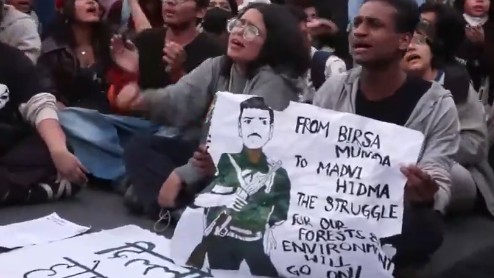
The recent inclusion of Hidma’s poster—featuring the notorious and now-killed Naxalite commander—within what was framed as a protest for clean air raises an important and troubling question: If the cause is environmental protection, what is a symbol of Left-wing extremism doing at the forefront? The juxtaposition of a deadly militant leader with a supposedly peaceful, eco-focused demonstration exposes the underlying attempt to hijack environmental sentiment for political and violent purposes.
This kind of appropriation is not new. Extremist groups across the world often exploit legitimate social issues to lend credibility to their movements. By embedding themselves within protests or public campaigns, they gain visibility and create an illusion of popular support. In the Indian context, the Left voice of extremism, Naxalites have long used the grievances of marginalized communities—land displacement, tribal rights, and environmental degradation—to strengthen their influence. While these issues are real and deserve serious attention, the Naxalite approach ultimately harms the very communities they claim to represent. Their violent tactics invite militarization, disrupt development, and inhibit democratic processes that can lead to real solutions.
The environmental cause deserves better. It cannot be tainted or overshadowed by symbolism of extremism or violent histories. Nature cannot be held ransom to rejuvenate or glorify Left-wing terrorism. A movement for clean air, unpolluted rivers, and healthy forests must remain purely ecological, inclusive, and grounded in law and democratic engagement. When such movements are infiltrated by extremist propaganda, they lose credibility and alienate ordinary citizens who would otherwise participate wholeheartedly.
Furthermore, environmental protection requires cooperation—not conflict. It demands collaboration among government agencies, local communities, scientists, NGOs, and citizens. The presence of ideology advoocating extremism disrupts this cooperation, instills fear, and diverts attention from genuine environmental challenges. Moreover, environmental activists who work within the legal and democratic framework often suffer because security forces must distinguish between genuine activism and extremist activity—a distinction that becomes blurred when the two are artificially mixed.
To ensure that environmental causes remain unpolluted by extremist agendas, three steps are essential.
First, clear boundaries must be maintained between legitimate activism and any authentic symbolism of extremism. Organisers of environmental campaigns should be vigilant about preventing infiltration by groups that aim to misuse the platform for ideological purposes.
Second, public awareness needs to be strengthened. Citizens should be encouraged to evaluate the motives behind any movement they support. When extremist leaders or violent ideologies are inserted into environmental protests, participants should question the credibility of the organisers and reject such appropriation.
Third, the government and civil society must continue addressing the core grievances of affected communities—land rights, displacement, and environmental damage—while simultaneously countering extremism. Empowering local voices and ensuring transparent development can weaken the appeal of groups that exploit these issues.
Environmental protection is too vital, too urgent, and too universally necessary to be used as a pretext for violence. India faces real ecological threats—air pollution, loss of biodiversity, depleting groundwater, and accelerating climate change. These threats demand united action, not ideological fragmentation. They call for scientific rigor, responsible policy-making, and community participation, not the glorification of individuals associated with bloodshed.
Ultimately, the integrity of the environmental movement must be preserved. It should stand as a beacon of hope and cooperation, not a platform for reviving or legitimizing extremist networks. Clean air, clean water, and a green future are causes that transcend politics. They belong not to militants or extremism but to every citizen who dreams of a healthier, safer, and more sustainable India.