






















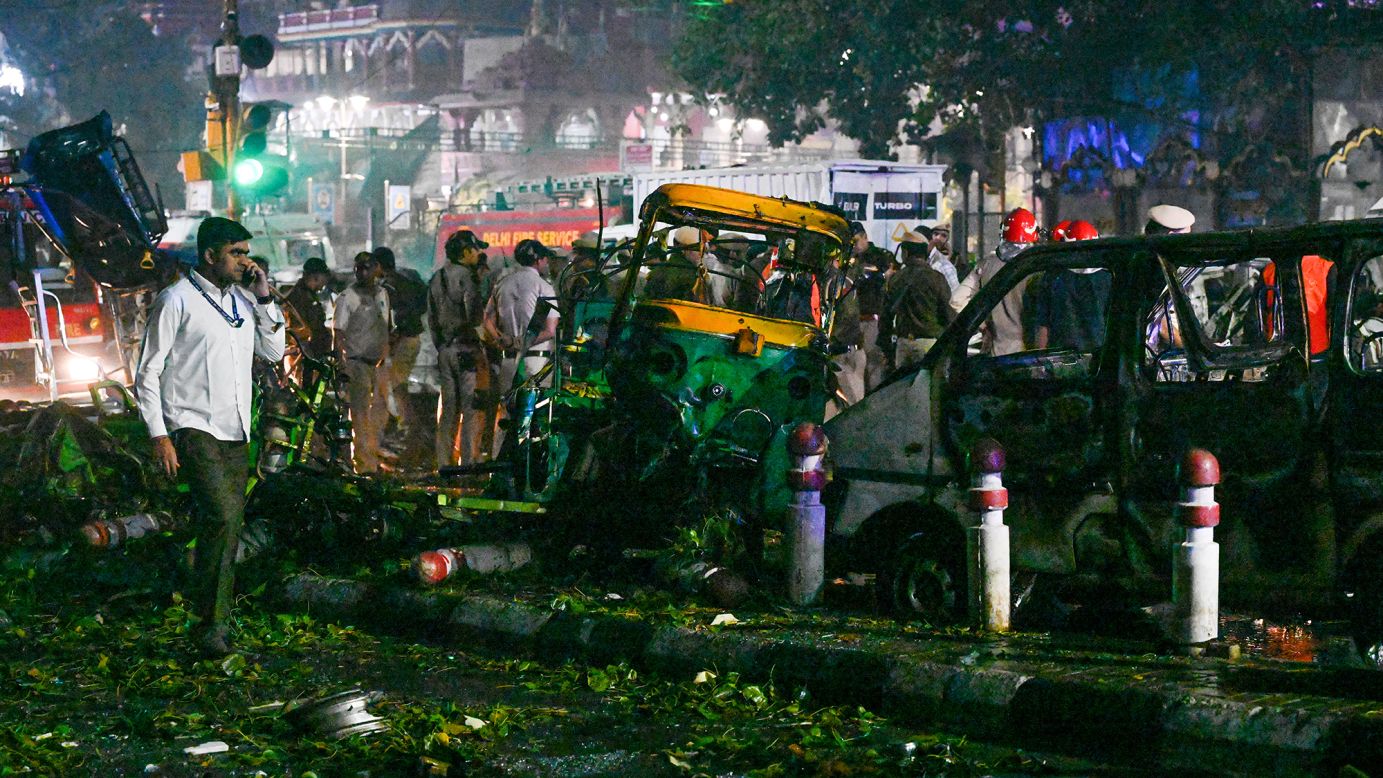
The car bomb that tore through Delhi’s calm near the Red Fort on November 10 has forced India’s security establishment to confront an uncomfortable truth: you do not need RDX to engineer a mass-casualty terror attack. What investigators have pieced together so far shows that the perpetrators relied on ANFO ammonium nitrate mixed with fuel oil a crude yet devastating explosive whose lethality comes not from chemical sophistication but from scale. The seizure of hundreds of kilograms of ammonium nitrate in Faridabad, just hours before the blast, has sharpened the central question now confronting security agencies: how did a terror cell quietly assemble industrial quantities of a commonly traded fertiliser and transform it into a weapon that ripped open one of India’s most sensitive zones?
Initial casualty counts varied between nine and twelve, but the human cost and the symbolic audacity of detonating a bomb beside an iconic national monument—remains beyond dispute. Early panic was fuelled by rumours of RDX, a material synonymous with surgical, high-brisance terror attacks. But forensic clarity soon replaced that speculation: the bomb was not a compact military-grade device but a high-volume, low-tech ANFO charge, packed into a Hyundai i20 and likely triggered manually. The real story, investigators now say, is not about cutting-edge explosives but about how bulk, access, and concealment can be more dangerous than precision chemistry.
RDX cyclotrimethylenetrinitramine is one of the world’s most tightly controlled secondary explosives, prized for its extraordinary detonation velocity and shattering brisance. Found in plastic explosives like C-4 and modern warheads, RDX has a relative effectiveness (RE) factor between 1.5 and 1.6. A few kilograms can obliterate reinforced structures or slice through steel with ease. Because of its destructive efficiency and compactness, its production and movement are restricted almost exclusively to defence and military ecosystems.
Ammonium nitrate, by contrast, is an agricultural fertiliser and oxidiser that becomes explosive only when mixed with fuels like diesel or kerosene. Its reaction is slower, less concentrated, and far less brisant. ANFO’s RE hovers around 0.75. It does not shatter; it pushes. It kills by producing vast volumes of hot gas and sustained pressure rather than delivering a supersonic shockwave. In essence, RDX is about the quality of energy per kilogram; ANFO is about quantity delivered in bulk.
These differences, however, do not make ANFO any less threatening. In the hands of terrorists, its very accessibility becomes its advantage. Fertiliser-grade ammonium nitrate is widely available, diesel is everywhere, and together they can be weaponised into car or truck bombs capable of causing catastrophic destruction. The Oklahoma City bombing of 1995, which killed 168 people, used around 2,300 kg of ANFO. The accidental Beirut port explosion of 2020 demonstrated even more horrifyingly how improperly stored ammonium nitrate alone can wipe out entire districts.
Thus, while early reports of RDX would have pointed to a sophisticated, possibly transnational supply chain breach, the confirmed use of ANFO brings its own disturbing implications chief among them the ease with which large volumes can be collected under the cover of legitimate commerce.
A joint operation by Jammu & Kashmir Police and Haryana Police in Faridabad on November 9–10 uncovered nearly 350 kg of ammonium nitrate from two residential locations linked to Dr. Mujammil Shakeel, an employee at Al-Falah Hospital, and two associates, Dr. Adil Ahmed Rather and Dr. Shahina Shaheed. Officials also recovered more than 2,000 kg of additional explosive material from the same network. Intelligence agencies believe the cache is tied to Jaish-e-Mohammed operatives, adding a dangerous international dimension to what initially appeared to be a localised plot.
When news of the seizures first broke on the morning of November 10, early fear centred on reports that RDX had been found—a natural response considering the device’s association with precision terror. But subsequent forensic examinations made clear that the Red Fort blast was triggered by ANFO, not military-grade RDX.
The distinction matters. RDX would indicate access to defence supply chains, theft from restricted facilities, or foreign-state facilitation. ANFO, while chemically “amateur,” signals something equally alarming: the emergence of a terror network with enough reach and organisational capacity to stealthily gather massive quantities of dual-use chemicals, store them in domestic properties, and transport them without triggering alarms.
The presence of medical professionals at the heart of the network has raised critical red flags about radicalisation pathways and the misuse of educational and healthcare institutions as logistical hubs. Their familiarity with chemicals, supply systems, and community networks may have aided in aggregation, concealment, and transport.
Under the Explosives Act, 1884, and subsequent rules notified in 2012 and amended in 2021, ammonium nitrate and mixtures containing more than 45 percent of it are classified as explosives. Licences are required for manufacture, storage, and transport, and storage in populated non-industrial areas is prohibited. Yet the compound remains deeply embedded in agriculture, mining, and construction, creating sprawling, fragmented supply chains ideal for exploitation.
Experts say India faces a dual challenge: strict enforcement risks paralyzing legitimate industrial sectors, while lax monitoring creates loopholes that terror cells readily exploit. What the Faridabad network appears to have practiced is “aggregation laundering” small, seemingly legal purchases siphoned into clandestine stockpiles. Similar patterns were observed in the 2006 Mumbai train blasts, the 2010 Pune bombing, and the 2011 Mumbai attacks.
Compounding the threat is the known hybridisation technique used by terror outfits worldwide: combining RDX with ammonium nitrate to use the former as a booster and the latter as a volume amplifier. Investigators are meticulously testing residues from the Hyundai i20 blast to determine whether pure ANFO was used or whether traces of RDX or PETN are present a finding that could drastically shift the investigative trajectory.
The most chilling revelation emerged on November 13, when forensic DNA analysis matched samples from the Red Fort blast site with those of the mother of Dr. Umar Mohammad, also known as Dr. Umar Un Nabi, a medical professional from Pulwama, J&K. This confirmed him as the bomber. The explosion at 6:52 p.m. killed nine people and grievously injured nearly a dozen others, marking one of Delhi’s deadliest terror episodes in recent years.
Investigators say Umar was linked to Al-Falah University in Faridabad and was in direct contact with a Türkiye-based handler code-named “Ukasa,” believed to have coordinated the operation remotely. This connection signals the possibility of a broader, externally aided terror architecture using India-based professionals as operatives.
The Red Fort blast is a stark reminder that modern terrorism does not always rely on high-end explosives or military-grade precision. Instead, the real danger lies in the silent, incremental accumulation of everyday chemicals, the exploitation of regulatory gaps, and the radicalisation of highly educated individuals who can blend seamlessly into urban life. India’s security challenges now revolve around monitoring dual-use materials without crippling legitimate sectors, strengthening intelligence links across states, and detecting early signs of radicalised micro-cells operating under professional cover.
What unfolded in Delhi was not just an explosion it was a warning that the era of low-tech, high-volume terror has fully arrived, and India must recalibrate its defences accordingly.