



















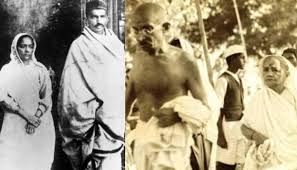
History has celebrated Mohandas Karamchand Gandhi as the “Father of the Nation,” a symbol of truth, non-violence, and moral discipline. Yet behind this iconic figure stood his wife, Kasturba Gandhi, who lived a life of immense suffering, sacrifice, and silent endurance. Married at a tender age to a man who would later guide India’s freedom struggle, Kasturba’s personal journey was marked by emotional neglect, authoritarian treatment, and at times, even cruelty from her husband. Far from the image of an ideal domestic life, Kasturba’s story reveals the darker and less-discussed side of the man revered as the Mahatma.
A Childhood Marriage and Early Life
Kasturba Gandhi was born on 11 April 1869 in Porbandar, Kathiawar, six months older than Mohandas Gandhi. She was the third daughter of Gokuldas Makanji, a modest trader. Like most women of her era, she was deprived of formal education, as society did not value female literacy. At the age of seven, she was engaged to six-year-old Mohandas, and at thirteen, their marriage was solemnized.
From the very beginning, her life was dictated by the rigid expectations of child marriage, leaving her little space for self-identity or independence. While Gandhi pursued education, travel, and later a political mission, Kasturba remained tethered to the domestic sphere, often treated more as an extension of Gandhi’s ideology than as a partner with her own agency.
Neglect During Gandhi’s England and South Africa Years
The first striking example of Gandhi’s disregard for Kasturba came in 1888, when he left for England to study law. For nearly twelve years, their lives were largely lived apart, first due to his studies and then due to his extended activism in South Africa. Kasturba accompanied him only later, after years of loneliness and separation.
Even in South Africa, their differences were sharp. Kasturba was deeply religious, refusing to consume meat or liquor even when seriously ill. She stood firm in her values, yet Gandhi rarely acknowledged or respected her choices. Instead, his public mission overshadowed his personal responsibilities, with Kasturba often left to quietly endure.
Kasturba’s Own Struggle in the Satyagraha Movement
In 1913, a law in South Africa invalidated all marriages not registered under Christian rituals, effectively rendering Hindu, Muslim, and Parsi marriages illegal. Gandhi organized resistance, yet shockingly, he did not even consult Kasturba about joining the movement.
When she realized this exclusion, Kasturba confronted him and chose to participate voluntarily. She was arrested along with three other women and imprisoned for three months. Inside prison, she endured half rations, harsh treatment, and severe weakness, emerging frail and emaciated. This episode highlighted not only her personal courage but also Gandhi’s lack of recognition for her strength. Kasturba was not merely Gandhi’s shadow; she was a fighter in her own right, though history rarely credits her.
A Husband’s Harshness: The Jagannath Temple Incident
One of the more disturbing glimpses into Gandhi’s behavior came during a tour of Odisha. Gandhi refused to visit the Jagannath temple in Puri because of its ban on entry for non-Hindus and certain communities. He expected Kasturba to support his stand. But she, along with Mahadev Desai’s wife and another companion, chose to visit the temple anyway.
This act enraged Gandhi. Accounts suggest that he was so furious that he not only scolded her but may have even struck her. Mahadev Desai, Gandhi’s close aide, later remarked with bitter truth: “It is difficult to be Gandhi’s secretary, but it is most difficult to be Gandhi’s wife.” This single incident reflected the deep imbalance in their relationship—while Gandhi was revered as a moral reformer, within his own home he imposed rigid control, leaving Kasturba with little dignity or freedom.
The Agony of Her Final Days
The Quit India Movement of 1942 landed Gandhi in detention at the Aga Khan Palace in Pune, where Kasturba stayed with him. By then, her health was deteriorating rapidly. She suffered from bronchitis, heart attacks, and pneumonia. Doctors strongly recommended penicillin, a life-saving treatment. But Gandhi opposed its use, declaring modern medicine as “violence” and insisting only on “natural remedies.”
Kasturba, ever obedient, said she would accept penicillin if Gandhi approved. Yet he refused to give consent, claiming she could decide for herself. In reality, his denial left her without effective treatment. Even when their son Devdas brought the injection, Gandhi blocked its use.
On 22 February 1944, Kasturba Gandhi died in captivity, on the festival of Mahashivratri. Her death was not only a personal tragedy but also a consequence of Gandhi’s uncompromising and often harsh ideals.
A Lonely Woman Behind the Mahatma
Kasturba’s personal suffering was compounded by emotional isolation. The death of Mahadev Desai, Gandhi’s trusted secretary, in 1942 was a severe blow to her. She mourned him deeply, often visiting his grave and lamenting, “It should have been me, why did Mahadev go?” For Kasturba, Desai had been one of the few who empathized with her pain.
Her life—marked by child marriage, separation, imprisonment, humiliation, and finally medical neglect—paints a portrait of a woman who carried immense burdens silently. Though she was revered as “Ba,” the mother figure to Gandhi’s followers, in her private life she endured profound suffering.
The Unseen Truth of Kasturba’s Life
Kasturba Gandhi’s life story forces us to confront an uncomfortable truth. Behind the grandeur of Gandhi’s image as the Mahatma, there existed a deeply troubled marriage and a wife who bore silent scars. While Gandhi preached ideals of equality, truth, and compassion to the world, he often denied those very principles to the person closest to him.
Kasturba was not just the “wife of the Mahatma.” She was an individual of immense strength, resilience, and conviction—yet she was overshadowed by a man whose fame came at the cost of her dignity. History has remembered Gandhi as the father of the nation, but perhaps it is time to also remember Kasturba as a woman who lived through unimaginable struggles, carrying the weight of silence while the world idolized her husband.