













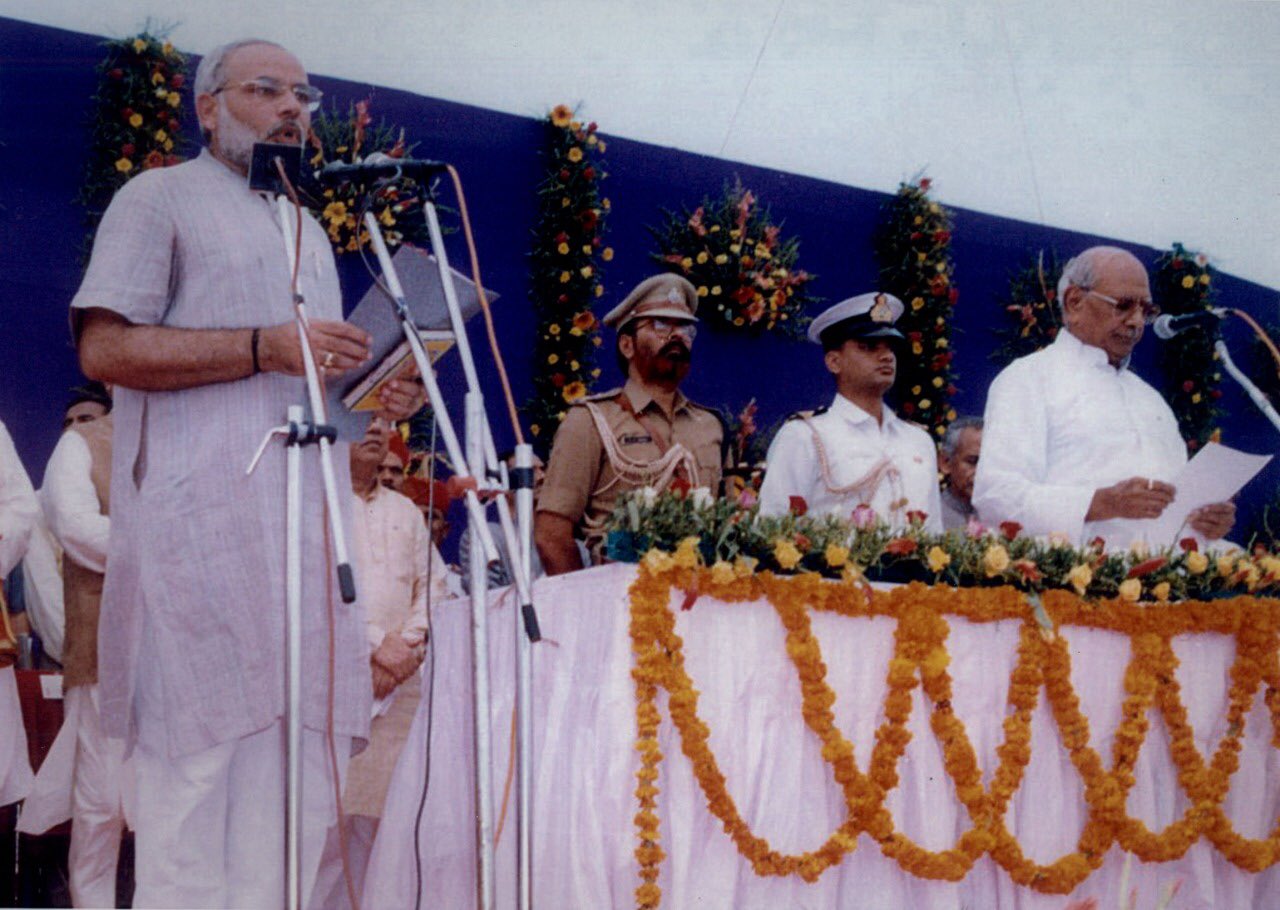
On October 7, 2001, a new chapter began in India’s political history when Narendra Modi took oath as the Chief Minister of Gujarat. What appeared to be a routine administrative change turned out to be the start of a political transformation that would redefine India’s governance model. The rise of a man who had no prior experience in state administration but carried an unshakable resolve was no coincidence it was a moment of destiny shaped by conviction, trust, and the vision of India’s then Prime Minister, Atal Bihari Vajpayee. Modi’s leadership in Gujarat would soon pave the way for his national emergence, built on principles of development, decisiveness, and nationalism. From being an RSS pracharak to the one of the longest-serving head of an elected government, Modi’s journey represents a tale of grit, vision, and unwavering faith in India’s potential.
The Seeds of Leadership: From RSS to BJP’s National Stage
Before 2001, Narendra Modi was already a known name within the Bharatiya Janata Party (BJP) and the Rashtriya Swayamsevak Sangh (RSS). Having joined the Sangh in the early 1970s, Modi’s organizational acumen was noticed during key political campaigns, especially during the 1995 and 1998 Gujarat assembly elections. His strategic inputs led the BJP to decisive victories, catching the attention of party stalwarts, including Atal Bihari Vajpayee and Lal Krishna Advani.
Recognizing his ability to connect with the grassroots and his disciplined execution, the party brought Modi to Delhi in 1995 as National Secretary. There, he was entrusted with managing the BJP’s affairs in Haryana and Himachal Pradesh. His growing influence and results-oriented approach marked him as a rising star someone who could bring both ideological commitment and administrative precision into politics.
The Turning Point: Bhuj Earthquake and a Leadership Vacuum
The defining moment for Narendra Modi came in 2001, when Gujarat was devastated by the Bhuj earthquake. Thousands of lives were lost, infrastructure was in ruins, and the state government led by Keshubhai Patel was facing a setback. His deteriorating health forced the BJP’s central leadership to rethink Gujarat’s political leadership.
In Delhi, serious deliberations took place within the top ranks of the BJP. Amid two parallel realities Patel’s decline and Modi’s meteoric rise Atal Bihari Vajpayee took a historic decision. He summoned Modi to his residence at 7, Race Course Road (now 7, Lok Kalyan Marg) and instructed him to return to Gujarat immediately. In that fateful meeting, Vajpayee told Modi that the time had come for him to shoulder full responsibility for his home state.
Atal Bihari Vajpayee’s Faith: The Catalyst for Change
It was not an easy decision. Senior leaders like L.K. Advani were initially hesitant to hand over the state to someone with no administrative experience. Some even suggested that Modi should serve as Deputy Chief Minister under Keshubhai Patel. But Modi firmly declined the proposal, stating that he would either take full responsibility or none at all. His confidence and sense of accountability impressed Vajpayee, who decided to stand by him.
Atal Bihari Vajpayee’s trust in Narendra Modi was both political and personal. Vajpayee had seen Modi’s unwavering discipline, his deep understanding of ground realities, and his ability to deliver results. On October 4, 2001, the Governor of Gujarat invited Modi to form the government, and three days later, on October 7, 2001, Narendra Modi was sworn in as the 14th Chief Minister of Gujarat marking the beginning of an era that would later redefine Indian politics.
First Test of Fire: The Akshardham Temple Attack
Barely a year after assuming office, Narendra Modi faced one of the gravest challenges of his political career. On September 24, 2002, terrorists trained in Pakistan launched an attack on the Akshardham Temple in Gujarat. Armed with grenades and assault rifles, they opened fire on devotees, killing over 30 and injuring more than 80 others.
It was a moment of national crisis one that tested both the Gujarat government and the NDA government at the Centre. Acting swiftly, Chief Minister Modi requested immediate deployment of the elite National Security Guard (NSG) commandos. Operation Vajra Shakti was launched, and by early morning on September 25, the two terrorists were neutralized. The entire operation lasted nearly 14 hours, and though lives were lost, the temple was successfully secured. Modi’s quick decision-making, coordination, and calm under pressure earned him national praise and redefined his image as a leader capable of decisive action.
A Historic Electoral Triumph and the Rise of the ‘Gujarat Model’
The Akshardham attack became a turning point in Gujarat politics. While critics predicted the end of Modi’s tenure, he led the BJP to a massive victory in the 2002 Assembly elections. This victory was not merely political it was ideological, marking the public endorsement of Modi’s leadership.
Over the next 12 years, Modi transformed Gujarat into one of India’s fastest-growing states. His focus on industrial growth, infrastructure, energy reforms, and welfare delivery created what came to be known as the “Gujarat Model” a template of governance that combined efficiency, transparency, and people-centric policies. He introduced initiatives that connected rural areas to urban markets, modernized irrigation systems, and ensured round-the-clock electricity through the Jyotigram Yojana.
This combination of vision and execution turned Gujarat into a showcase of development, earning Modi admiration across India and paving the way for his national ascent.
From Gandhinagar to Delhi: The March Toward 2014
By 2013, Narendra Modi’s popularity had far surpassed the borders of Gujarat. His success story became the BJP’s biggest political capital. As India struggled under the corruption-plagued UPA government, the people sought a strong and incorruptible leader. Modi, with his image as a reformer and nationalist, became the natural choice.
In 2014, under his leadership, the BJP secured a historic majority the first for any single party in three decades. The son of a tea seller from Vadnagar had become the Prime Minister of the world’s largest democracy. The traits that defined his tenure as Gujarat CM decisive governance, focus on development, and an unflinching commitment to national security became the foundation of his governance at the national level.
The Legacy of 7th October: 21 Years of Unbroken Leadership
As of 2025, Narendra Modi completed 24 uninterrupted years of holding constitutional office first as Gujarat’s longest-serving Chief Minister and then as India’s Prime Minister. His political journey, rooted in the ideals of selfless service and nationalist vision, stands as one of the most remarkable success stories in democratic history.
From Gujarat’s earthquake ruins to India’s global rise, Modi’s story is a reflection of what relentless determination and visionary leadership can achieve. It was Atal Bihari Vajpayee’s trust that ignited the spark, but it was Modi’s perseverance that turned it into a flame that continues to guide India’s destiny.
From Atal’s Faith to Bharat’s Future
Narendra Modi’s rise to power is not merely a story of political success it is the story of India’s transformation. When Atal Bihari Vajpayee placed his faith in an untested leader in 2001, he set in motion a journey that would redefine India’s political, economic, and cultural narrative. Modi’s leadership since that day has embodied the spirit of Aatmanirbhar Bharat, national pride, and decisive governance.
Two decades later, the moment when Modi took oath as Gujarat CM on October 7, 2001, stands as one of the most significant turning points in India’s modern political history a day when Atal’s vision and Modi’s resolve converged to shape the future of Bharat.