



















On October 23, 1943, under the blazing sun of Singapore’s parade ground, Netaji Subhas Chandra Bose stood before a crowd of young Indian women and proclaimed the birth of a new kind of army one that would shock the British Empire and inspire generations to come. It was the inauguration of the Rani of Jhansi Regiment, an all-women’s military unit of the Indian National Army (INA). The regiment was named after Rani Lakshmibai of Jhansi, the fiery queen who led her troops against British rule during the revolt of 1857.
To Bose, this was not merely a symbolic gesture it was a bold declaration that Indian women would no longer remain confined to their homes while their nation was enslaved. For the first time in modern Indian history, women were being trained as soldiers, ready to fight shoulder to shoulder with men for their country’s freedom.
The formation of the Rani of Jhansi Regiment was a revolutionary idea that challenged both British colonialism and patriarchy. Bose, a visionary who believed that “freedom is not given, it is taken,” saw in women the same strength, determination, and patriotism that had once driven Rani Lakshmibai to battle.
Netaji’s Vision: Women as the Torchbearers of Freedom
Bose’s dream of forming a women’s regiment was rooted in his belief that India’s freedom struggle had to include every citizen, regardless of gender. While many nationalist leaders spoke of independence, Bose wanted to build an army of action, one that would fight and, if necessary, die for the motherland.
At that time, thousands of Indians lived across Singapore, Malaya, and Burma, many of them descendants of indentured Tamil laborers who toiled in rubber plantations. The news of India’s struggle for independence had reached even these distant shores through newspapers, radio broadcasts, and the fiery speeches of Netaji. His arrival in Singapore on July 2, 1943, breathed new life into the Indian diaspora.
Bose appealed directly to the women of these communities, urging them to join the INA and fight for India’s freedom not only as mothers and sisters, but as soldiers of Bharat Mata. His rallying cry was electrifying:
“This must be a truly revolutionary army. I am appealing also to women. Women must be prepared to fight for their freedom and for India’s independence. Along with independence, they will gain their own emancipation.”
Moved by his vision, hundreds of young women, many barely in their teens, came forward to enlist. For them, this was more than military service it was a chance to reclaim dignity, identity, and purpose.
Rigorous Training and Discipline: A New Breed of Warriors
The Rani of Jhansi Regiment was formally established on July 12, 1943, and training began in Singapore on October 23, 1943 exactly the date Bose chose to honor Rani Lakshmibai’s spirit. The regiment was placed under the leadership of Dr. Lakshmi Sahgal, a doctor from Madras who had settled in Singapore. She would go on to become “Captain Lakshmi,” a name synonymous with courage and leadership in India’s independence movement.
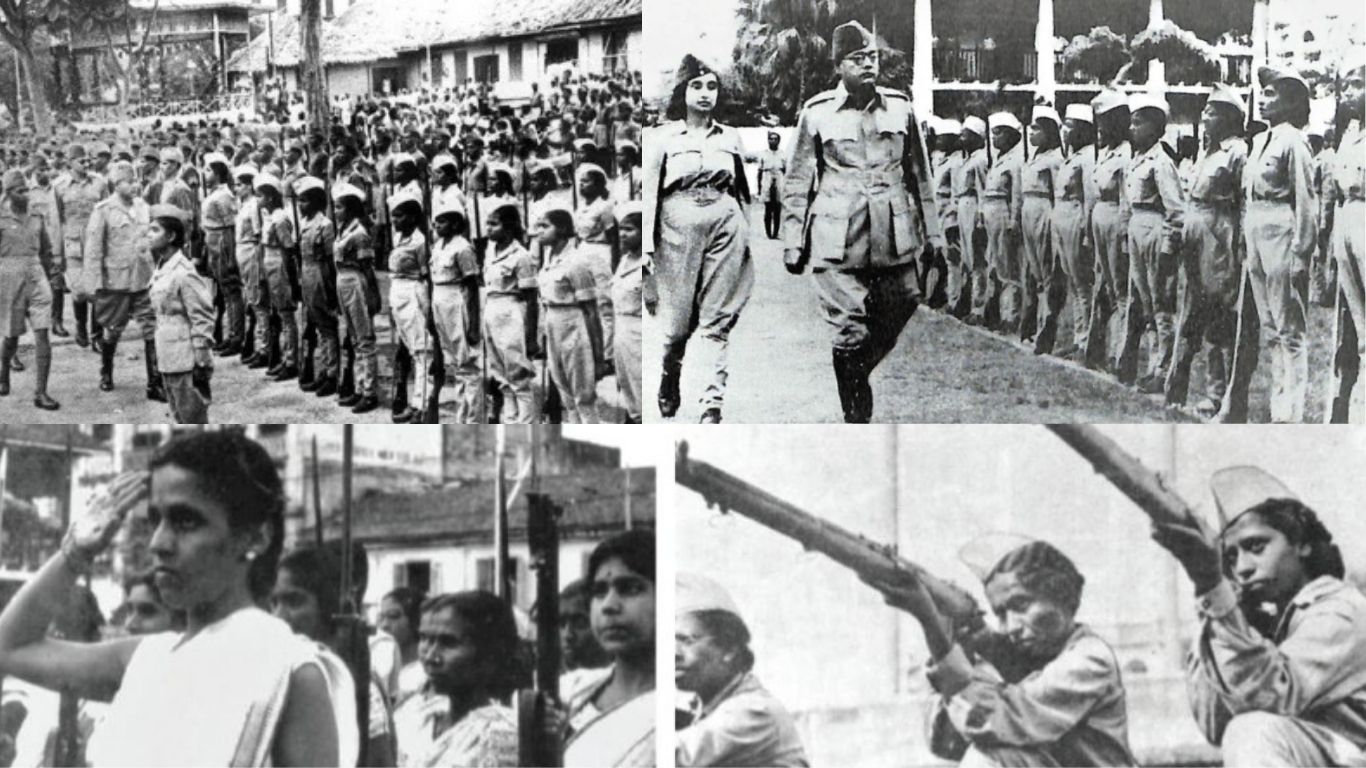
The women underwent rigorous military and combat training similar to their male counterparts in the INA. Under Japanese supervision and Indian instructors, they were taught rifle shooting, hand grenade use, bayonet fighting, route marches, and physical endurance drills. The sight of hundreds of Indian women in khaki uniforms, rifles slung over their shoulders, marching in unison under the Indian tricolor became a symbol of defiance against colonial domination.
Their camps were located across Singapore, Malaya, and Burma (now Myanmar), and it is estimated that more than 1,000 women served in the regiment. About 20 percent of them were educated and became officers, while the remaining 80 percent were daughters and wives of Tamil plantation workers most of them illiterate but burning with patriotic zeal.
Training was tough, and discipline was uncompromising. The women had to shed centuries of social conditioning cutting their long hair, wearing military attire, and learning to live and fight like soldiers. For many, it was a transformation not just of body, but of spirit. They learned to handle fear, fatigue, and hunger and to stand tall as equals among men.
Unity in Diversity: Breaking Barriers of Caste and Religion
In a deeply divided colonial society, the Rani of Jhansi Regiment became a rare example of true Indian unity. Women from different regions, languages, religions, and castes came together for one purpose India’s freedom.
Bose abolished all social hierarchies within the regiment. He ordered that all members eat together, sleep together, and communicate only in Hindustani, the national language of the INA. To overcome linguistic diversity, Hindustani was written in the Roman script, ensuring every recruit could read and write commands.
Inside the camp, no woman was a Brahmin or a laborer, Hindu or Muslim they were all Raniz, daughters of Bharat Mata. The sisterhood they forged transcended barriers that had divided Indian society for centuries. This sense of equality and shared purpose became one of the INA’s most powerful legacies.
Legacy of the Rani of Jhansi Regiment
Rani of Jhansi Regiment’s role in redefining India’s freedom struggle remains monumental. Many served as nurses near battle zones in Burma, caring for wounded INA soldiers. Others remained in active reserve, ready to march whenever Bose gave the command.
When the war ended in 1945, many of these women returned to civilian life, but the memory of their service lived on. Their courage was celebrated by Bose himself, who called them “the daughters of India who made the impossible possible.”
Captain Lakshmi Sahgal continued to serve India even after independence as a doctor, social worker, and parliamentarian keeping alive the ideals of Netaji and her fellow Ranis.
The Rani of Jhansi Regiment was more than a military force it was a revolution in consciousness. It proved that the spirit of Indian womanhood was not limited to the domestic sphere but was capable of facing bullets and bayonets for the nation’s honor.
On this day in 1943, when training began in Singapore, hundreds of young Indian women picked up rifles, not out of hatred, but out of love love for their land, their culture, and their freedom. They carried forward the legacy of Rani Lakshmibai, transforming myth into history, and history into inspiration.
Their story stands as a proud reminder that India’s independence was not won by men alone it was also written in the courage of women who dared to dream of a free Bharat Mata and were ready to die for her.