























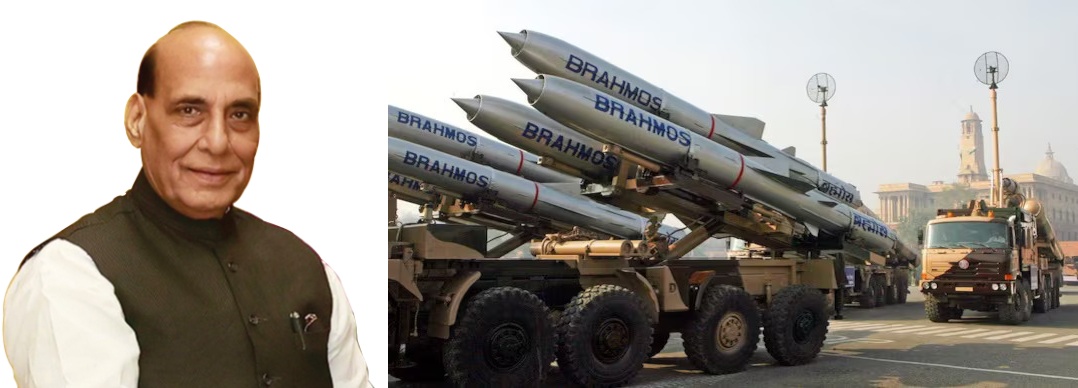
In a momentous milestone for India’s defence and manufacturing sectors, the first batch of BrahMos supersonic cruise missiles produced at the newly-inaugurated BrahMos facility in Lucknow will be officially handed over on Saturday, October 18. The handover ceremony will be led by Defence Minister Rajnath Singh and Uttar Pradesh Chief Minister Yogi Adityanath, signaling a major leap in India’s indigenous weapons production capabilities.
The facility, located in the Bhatgaon area under the Uttar Pradesh Defence Industrial Corridor, was inaugurated earlier this year on May 11—celebrated as National Technology Day. During the inauguration, Defence Minister Rajnath Singh addressed the nation virtually, stating, “Operation Sindoor was not just a military action, but a symbol of India’s political, social and strategic willpower.” This statement underlined the growing synergy between domestic defence production and operational military readiness.
India’s New Defence Production Powerhouse
The BrahMos facility has been built with an investment of ₹300 crore and spans across a sprawling 80 hectares. It is equipped with state-of-the-art production lines capable of large-scale, high-precision missile manufacturing. Initially, the facility is targeting the production of 80 to 100 missiles annually. However, once the full operational rhythm is achieved, production can scale up to 150 missiles per year.
This missile plant is a key part of India’s broader defence production ambitions under the Defence Industrial Corridor initiative, launched by Prime Minister Narendra Modi during the 2018 Global Investors’ Summit. The initiative aims to promote indigenous defence manufacturing through dedicated zones spread across six nodes: Lucknow, Kanpur, Aligarh, Agra, Jhansi, and Chitrakoot. The foundation stone for the Lucknow node was laid in 2021, and in just a few years, the city is now poised to become a major contributor to India’s defence ecosystem.
BrahMos: A Symbol of Strategic Strength
The BrahMos missile, developed jointly by India’s Defence Research and Development Organisation (DRDO) and Russia’s NPO Mashinostroyeniya, stands as one of the fastest and most accurate supersonic cruise missiles in the world. It is capable of being launched from land, sea, and air platforms, making it a versatile asset for the Indian armed forces. The missile is an unmanned supersonic cruise vehicle armed with a precision-guided warhead and advanced guidance systems, known for its pinpoint accuracy and rapid speed.
Its successful deployment and performance during Operation Sindoor, conducted earlier in 2025, have further bolstered its reputation. During the operation, Indian forces used BrahMos missiles in combat for the first time, reportedly achieving significant success against Pakistani military targets. Indian strikes penetrated enemy air defences and reportedly caused heavy damage to military airfields in Skardu, Bholari, Jacobabad, and Sargodha, with radar facilities in Sialkot and Pasrur also being hit.
Multiple defence analysts believe that BrahMos missiles were used in combination with other precision weapons like SCALP and Hammer munitions, making the strikes highly effective and tactically coordinated. This marked a defining moment in India’s military doctrine, with indigenous and jointly-developed weapons playing a central role in combat operations.
Strategic and Economic Implications
The commissioning of the BrahMos facility in Lucknow has broader strategic implications. Firstly, it significantly reduces India’s dependence on foreign weapon systems, aligning with the national vision of ‘Aatmanirbhar Bharat’ (Self-Reliant India). Secondly, it will generate hundreds of high-skill jobs in Uttar Pradesh and attract ancillary industries, thus boosting the regional economy.
This facility also positions India to become a global supplier of advanced missile systems. With several countries expressing interest in acquiring BrahMos, including the Philippines which has already signed a deal, the Lucknow unit could be pivotal in fulfilling export orders in the near future.
Looking Ahead
The handover of the first locally-manufactured BrahMos missiles from the Lucknow facility is more than a ceremonial event—it is a testament to India’s rising capabilities in high-end defence production. As the plant ramps up to full capacity, and with the experience of successful deployment in live combat situations, India is poised to not just secure its borders but also to strengthen its role as a responsible defence exporter.
With the Defence Industrial Corridor shaping up rapidly and projects like the BrahMos facility delivering tangible results, India’s ambition to become a global defence manufacturing hub is steadily becoming a reality.