























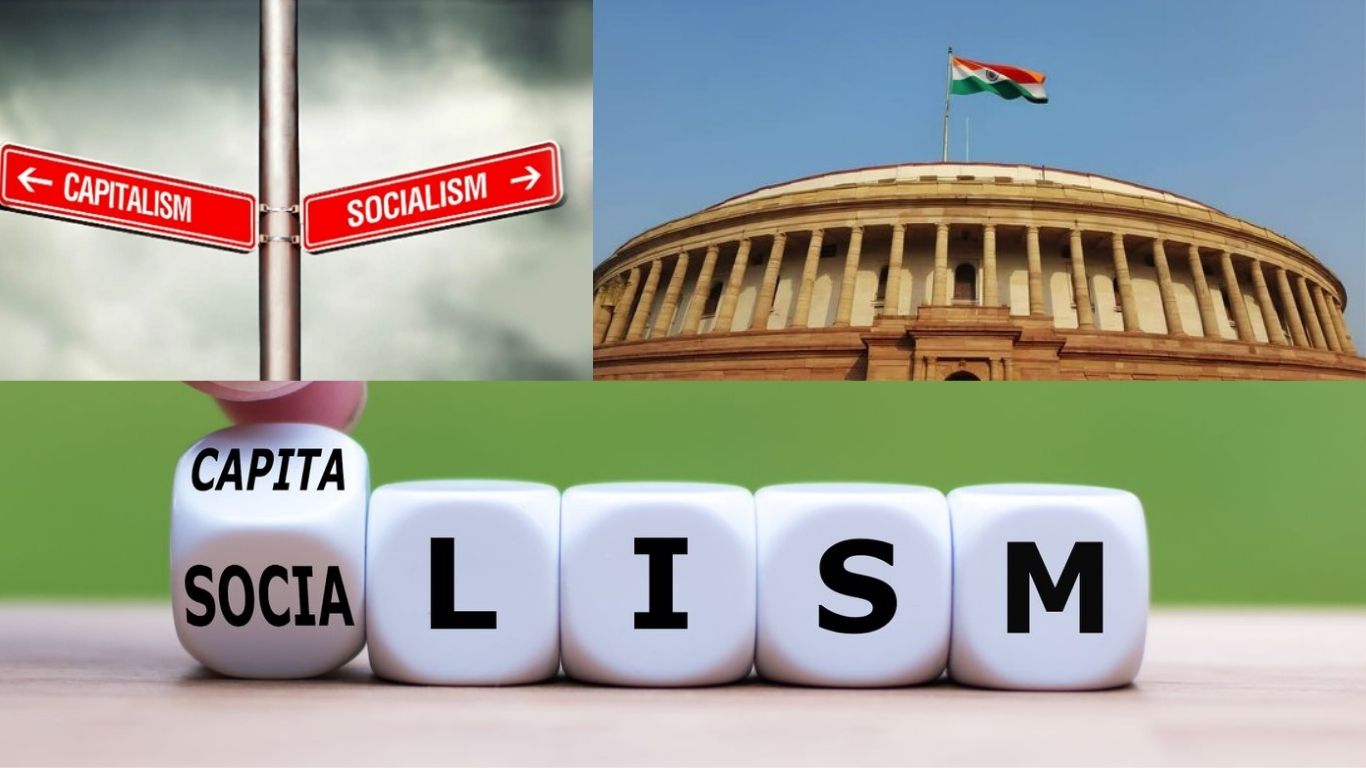
India’s socialistic capitalism fuses ancient values with modern innovation, offering a people-centric development model. Rejecting exploitative Western systems, it empowers citizens through digital inclusion, welfare platforms, and economic dignity. Rooted in moral economics, it influences governance, diplomacy, and security. This replicable model offers a sustainable, humane alternative for both developing and declining economies worldwide.
The Development Debate
For decades, the world has relied on Western economic models—either capitalist or socialist—to guide national development strategies in most of the countries. But both models, in their native forms, have failed to create holistic, equitable growth. Capitalism has driven inequality and environmental degradation. Socialism, on the other hand, often stifled innovation and fostered dependency.
The Western capitalist model is inherently rooted in a binary: either exploit or be exploited. For centuries, this allowed colonial powers to extract wealth from colonized nations while insulating their own populations through entitlements and resource access. However, this exploitative structure is now collapsing under its own contradictions. The formerly exploited nations are asserting their agency, while the exploiting nations are burdened with societies built on unsustainable luxury, entitlement, and demographic decline.
At the global level, platforms like the World Economic Forum (WEF) continue to reinforce the dominance of Western economic narratives. Discussions and proposals at such forums, directly or indirectly, prioritize safeguarding the interests of the Western world. Despite claims of inclusivity, very few of these discourses genuinely center on solving the structural economic exploitation faced by the Global South. The environment fostered is often psychological and rhetorical—aimed at preserving the primacy of economic colonisers while offering lip service to the developmental needs of the economically exploited nations. The intellectual bankruptcy is glaring: the same celebrated economists—predominantly from Western academia—armed with intricate models and data-driven rhetoric, consistently fail to rescue even their own economies from stagnation and decay. Their inability to provide effective solutions for third world countries, except to push them deeper into sophisticated forms of economic dependency, reveals both the moral and structural failures of the dominant global economic order.
In contrast, India offers a third way—Socialistic Capitalism, a system that isn’t just an economic model but a development model rooted in cultural ethos, moral economics, and inclusive growth. Unlike Western frameworks that reduce development to GDP growth, India’s model seeks development of people, by people, and for people.
1. Civilizational Roots and Foundations
India’s socialistic capitalism is not an imported ideology but a continuation of its 7000 year old civilizational values. Ancient Indian governance, outlined in texts like the Arthashastra, emphasized decentralized prosperity through guilds, local industries, and kingly responsibility (rajdharma). Rulers were moral guardians, not extractive elites. The Vedic principle “Sarv jan hitāya, sarv jan sukhāya” (for the welfare and happiness of all) guides this approach. Pre-colonial India accounted for more than 25% of global GDP, a result of empowered local economies, skilled artisans, and robust trade networks.
Colonialism converted India into a loot economy, dismantling industries, imposing regressive taxes, and eroding self-sufficiency, bring it down to less than 2%. After 1947, India had to reconstruct from economic and psychological colonialism, experimenting with systems to overcome the problems of poverty, fragmented infrastructure, and a population hungry for dignity.
2. The Ethos: Growth with Dignity and Equity
India’s approach is driven not by ideology but moral economics. It believes that markets must serve people, not the other way around. Unlike the atomized, individualistic capitalism of the West, India’s model fuses economic freedom with social responsibility. This ethos has been translated into transformative policies. The Jan Dhan Yojana has connected over 470 million unbanked people to formal finance. Direct Benefit Transfers have ensured ₹34 lakh crore reaches intended beneficiaries, cutting leakages. The Ujjwala Yojana has liberated 96 million women from smoke-based cooking. Ayushman Bharat, the world’s largest health insurance system, has provided critical medical security to hundreds of millions. These are not mere welfare schemes—they are platforms for empowerment that restore dignity.
3. Evolving into a Development Model
Following the 1991 liberalization, India moved toward a market-based economy. However, since 2014, this framework has matured into a holistic development strategy. Entrepreneurship and innovation are promoted through Startup India and the PLI schemes. A robust digital infrastructure has been built, for example, with the JAM Trinity, UPI, and CoWIN platforms. Mass skilling is facilitated through programs like Skill India, PMKVY and ITIs. Public goods such as housing, toilets, electricity, LPG, and insurance are being universally provided. This ensures that economic growth is intrinsically linked to human development.
4. Implementation Strategy
India’s development model emphasizes scalable platforms rather than transient populism. It delivers services through digital-first platforms such as JAM, DigiLocker, CoWIN, and UPI. It directs targeted investments into key sectors through the PLI scheme. It facilitates large-scale skill development and supports MSMEs as engines of employment. Importantly, this is done while maintaining fiscal discipline. This comprehensive approach ensures implementation that is fast, equitable, and resilient.
5. Governance Architecture
Real-time and transparent governance lies at the heart of this model. Digital dashboards monitor the implementation and outcomes of welfare schemes. Citizen grievances are addressed through platforms like MyGov and CPGRAMS. Financial transparency is reinforced through GST implementation and faceless income tax systems. Local governance is strengthened through empowered Panchayati Raj institutions, ensuring that governance is both participatory and decentralized.
6. Hurdles and Their Overcoming
India’s developmental journey has encountered numerous obstacles. Early challenges included corruption, inefficiency, digital illiteracy, and infrastructural deficits. These were overcome through innovative mechanisms. Aadhaar-based Direct Benefit Transfers minimized leakages and ensured that subsidies reached the right people. BharatNet and digital literacy programs expanded connectivity. The SWAMITVA scheme reformed rural land ownership and ensured legal clarity. These interventions have produced tangible gains: over ₹2.7 lakh crore saved in subsidies, 290 million informal workers registered under e-Shram, and over 500 million monthly UPI transactions signaling the digitization of finance.
7. Tangible Impact on Populations
The outcomes have been transformative. Between 2015 and 2023, more than 250 million people were lifted out of multidimensional poverty. Under PM-KISAN, ₹2.8 lakh crore has been directly disbursed to 110 million farmers. Infrastructure expansion and MSME development have created over 50 million jobs. Women’s empowerment is reflected in the fact that 60% of Jan Dhan accounts are held by women, enabling financial inclusion and independence.
8. Deep Integration Across Sectors
India’s socialistic capitalism thrives through cross-sectoral integration. In healthcare, Ayushman Bharat and the National Digital Health Mission have improved affordability and access. The New Education Policy and DIKSHA have transformed educational delivery. Industrial transformation is being driven by Make in India and PLI schemes. Scientific advancement is reflected in ISRO’s achievements, Semicon India, and ONDC. Revenue systems have been restructured with GST and digital taxation. In foreign affairs, India now exports Digital Public Infrastructure through the G20 and the ITEC platform, offering low-cost governance solutions to the world. Crucially, this development model shapes India’s foreign policy outlook, prioritizing South-South cooperation, technology transfers, and inclusive trade. It guides import-export preferences, aligning industrial policy with national goals of self-reliance and value-added exports. It even influences India’s armed forces strategy by embedding economic resilience, civil-military synergies, and innovation-driven defence production into the broader vision of national security.
9. Deconstructing Western Failures
Western development models have become self-limiting. Their core structures are closed systems, narrowly focused on economic growth at the cost of long-term societal health. Crass capitalism has led to alienation, inequality, and environmental degradation, while crass socialism has produced inefficiency and entitlement. The post-Cold War West built societies on unsustainable consumption and extreme wealth concentration. Today, these societies are plagued by demographic decline, eroded social trust, and economic stagnation masked by debt. Meanwhile, formerly exploited nations are asserting themselves.
India avoids these extremes. Its open and value-based model regards development not as a mechanical result of economic growth but as a holistic and moral transformation of society. It is a people-first, ethics-anchored framework.
10. Strengthening the Indian Model
To make this model more robust, India must enhance investment in health and education, targeting 3% and 6% of GDP respectively. Climate-proofing rural infrastructure will be essential. Bridging the gap between the formal and informal economy must become a policy priority, aided by legal reforms and digital integration. Emerging technologies such as AI and blockchain should be deployed to audit and enhance transparency in governance and welfare.
11. Framework for Third World Countries
India’s model offers a replicable framework for Global South nations. Implementation should begin with issuing unique IDs and establishing financial inclusion. This can be followed by direct welfare transfers to citizens, the rollout of digital public goods in healthcare and education, and support for local MSMEs through skilling and infrastructure. India can assist through ITEC capacity building, transferring technologies like CoWIN and UPI, and helping replicate the India Stack architecture.
12. Framework for First World Economies in Decline
First world countries grappling with economic stagnation and social unrest can also benefit. By implementing Digital Public Infrastructure, these nations can ensure inclusive service delivery. Re-skilling initiatives can reinvigorate their industrial base. Supporting SMEs and deploying decentralized social welfare platforms can create productive, self-reliant citizenry. The objective is not to create new welfare states but to enable empowered states that support dignified livelihoods.
13. India as Development Partner
India is not merely advocating this model—it is actively sharing it. Through platforms like the G20 DPI initiative, the India-Africa Growth Corridor, and multilateral cooperation programs, India offers its model as a tool for practical transformation. This is done in a spirit of humility, partnership, and adaptability—not prescription.
From Economic Growth to Civilizational Development
India’s socialistic capitalism is more than an economic structure—it is a civilizational approach to development. It fuses ancient Indian wisdom with 21st-century digital innovation. It combines moral responsibility with economic pragmatism. It emphasizes local empowerment alongside global cooperation. As the world seeks new development paradigms beyond GDP worship and ideological rigidity, India provides a living, tested, and humane alternative—one that is rooted in people, purpose, sovereignty, and long-term prosperity.