


















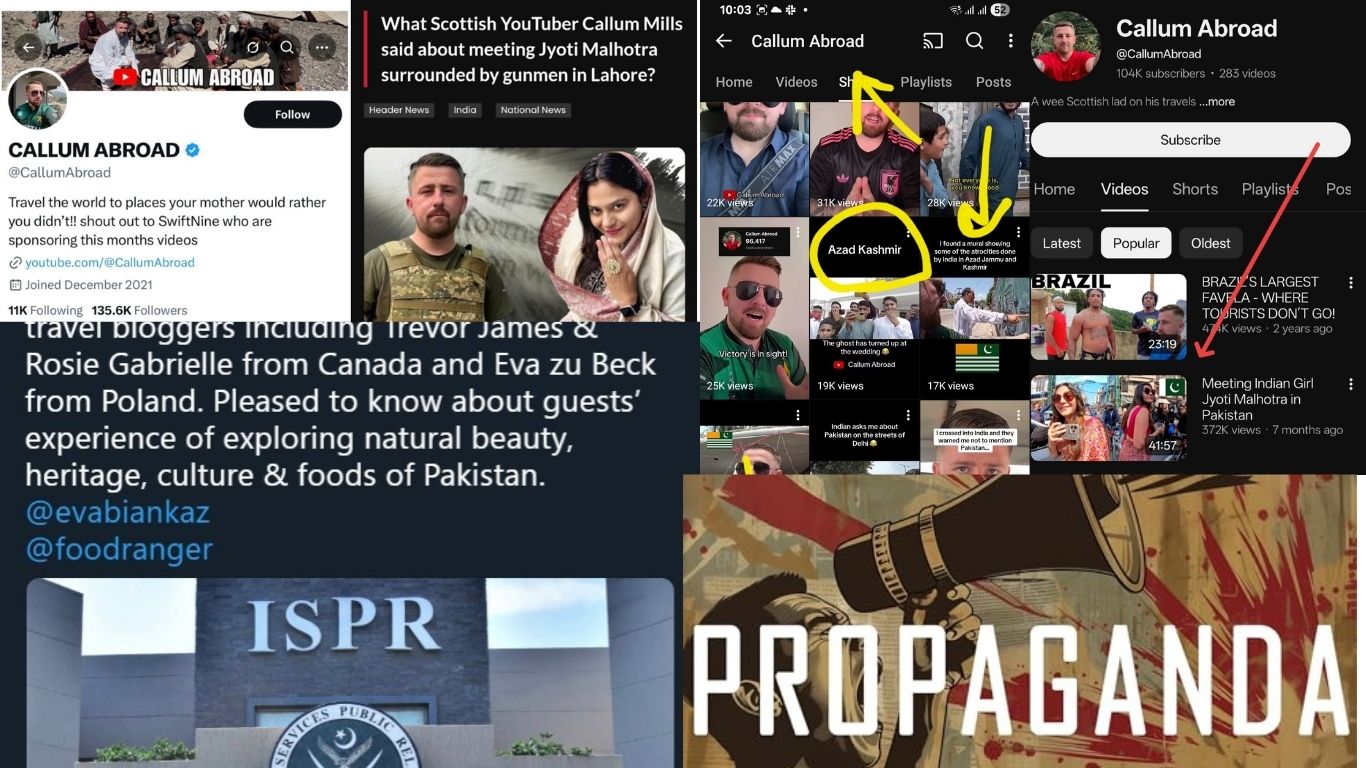
In recent months, a disturbing new front has emerged in Pakistan’s anti-India propaganda campaign Western YouTubers funded by the Pakistani military’s media wing, the ISPR, and intelligence agency ISI, have begun infiltrating India’s digital space to spread false and negative portrayals of the country. What began in 2019 as a limited effort to pay foreign vloggers to “promote Pakistan’s tourism” has evolved into a full-blown narrative war a hybrid strategy that uses influencers, social media algorithms, and fabricated ground videos to malign India’s global image.
The Rise of ISI’s Paid Vloggers
According to credible online watchdogs and independent digital analysts, Pakistan’s Inter-Services Public Relations (ISPR) began sponsoring Western vloggers nearly six years ago to project Pakistan as a “peaceful and hospitable nation” while simultaneously painting India as chaotic, unsafe, and intolerant.
A striking example of this is Scottish vlogger Callum Mill, who runs the YouTube channel Callum Abroad. Mill, who has reportedly visited Pakistan at least five times since 2019, gained notoriety for creating “contrast videos” that glorify Pakistan while mocking India. In one of his India videos, he described a BJP rally as ‘chaotic’ and showed the Ganga River as ‘polluted’. Yet in his Pakistan videos, the same vlogger called Pakistan Occupied Kashmir “beautiful” and Pakistani hospitality “unmatched.”
Social media users soon uncovered that Mill had maintained direct contact with ISI agent Jyoti Malhotra, a Haryana-based YouTuber who was arrested earlier for spying for Pakistan. Footage even shows Callum touring Lahore’s Anarkali Bazaar with Malhotra, surrounded by armed guards carrying AK-47 rifles a clear indication of their official protection and links to Pakistan’s establishment.
Despite this background, Callum was later granted an Indian visa to visit villages and towns across the country on what he claimed was a “cultural exploration trip.” Shockingly, his travel arrangements were reportedly facilitated by a Pakistan-based tour agency believed to be an ISI front.
A Pattern of Propaganda, Not Tourism
Callum Abroad’s social media content fits neatly into a larger pattern of psychological operations (PsyOps) run by Pakistan’s military. Each of his videos about India consistently targets Indian traditions, food, dress, and governance, while his Pakistan vlogs highlight “progressive youth” and “modern hospitality.”
When Indian users called him out for biased and racist portrayals, Callum locked his social media accounts and blocked several critics clear proof that his so-called travel vlogging is not spontaneous exploration but a carefully scripted campaign to malign India’s global perception.
As one Indian user on X pointed out, “This racist YouTuber travels to remote parts of India just to mock and insult Indians for content. When called out, he blocks people. The more we ignore such fringe propagandists, the more they exploit it.”
Experts say this is part of a “digital insurgency” orchestrated by ISPR. By funding foreign content creators mainly from Europe and North America Pakistan seeks to circumvent bans placed on its domestic propaganda channels and push an “outsider’s perspective” to discredit India internationally.
A Web of Foreign Propagandists
The operation isn’t limited to Callum Abroad. Investigations suggest that Azerbaijani journalist Anastasia Lavrina has also been hired by Pakistan’s ISPR as a lobbyist and propagandist on the Kashmir issue. Lavrina, who regularly appears on Pakistani television panels, frequently echoes Islamabad’s anti-India stance on international platforms.
Earlier, Pakistan managed to buy favourable coverage in Western media through so-called “pay-to-play” articles. A notable example was a Forbes article declaring Pakistan the best country for solo female travellers, which later turned out to be a paid placement funded by Pakistani agencies.
These efforts form part of Pakistan’s ongoing information warfare strategy after repeated defeats in conventional and diplomatic fronts against India. Following India’s successful surgical strikes and the destruction of terror bases in Muridke and Bahawalpur during Operation Sindoor, Islamabad is resorting to non-kinetic tactics propaganda, disinformation, and digital infiltration to save face internationally.
Just how retard are Indian agencies
This person Callum Abroad was in constant touch with ISI agent Jyoti Malhotra and has a full video touring Pakistan with her
Still we issued him Visa to come inside India on a Pakistan tour agency (ISI front office) sponsored trip to spread… https://t.co/DdaSsXsLEe pic.twitter.com/E3WeMINCaV
— Viceroy Muji Pepe, Earl of Lutyens (@mujifren) October 26, 2025
The Need for Digital Vigilance
Many Indian citizens have questioned how the Ministry of External Affairs approved visas for foreign vloggers who had previously collaborated with Pakistani propaganda agents. Critics argue that basic background checks could have prevented such infiltration attempts.
Security analysts have urged the government to strengthen digital intelligence monitoring and restrict foreign collaborations that originate from countries with hostile intentions. India has already banned several Pakistani YouTube channels including those run by Arzoo Kazmi, Syed Muzammil, ARY News, Furqan Bhatti, Shoaib Akhtar, and Basit Ali for spreading misinformation and anti-India rhetoric.
However, the new approach by Pakistan outsourcing propaganda to Western influencers poses a tougher challenge. Their foreign nationality gives them credibility among global audiences, making their content harder to flag as politically motivated.
India Must Counter Digital Subversion
Pakistan’s ongoing attempt to weaponize Western vloggers marks a dangerous evolution in its anti-India strategy. The ISI and ISPR’s recruitment of foreign influencers represents a modern form of hybrid warfare, where the battlefield is digital and the ammunition is perception.
India’s strength lies not only in its military and economy but also in its narrative. As Pakistan’s disinformation networks grow more sophisticated, India must respond with strategic communication, robust visa scrutiny, and digital counterintelligence.
Paid vloggers can be bought, but truth cannot and India’s resilience, progress, and democracy remain its strongest answers to those who seek to defame it for profit or politics.