




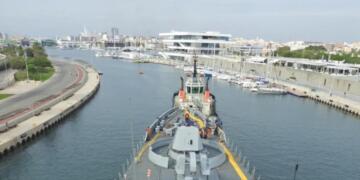

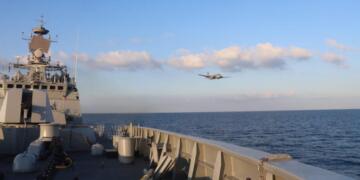










In October 2025, the US Central Command publicly praised the Pakistan Navy for seizing nearly $1 billion in narcotics from two stateless dhows in the Arabian Sea during a Combined Maritime Forces (CMF) operation.
On paper, this is the story Islamabad wants the world to hear is that Pakistan is a frontline partner in keeping drug routes off the sea. CMF statements and global coverage echoed that message, highlighting the size of the haul and the speed two boardings within 48 hours. Western militaries applauded the effort, noting that stateless dhows carrying crystal meth and cocaine continue to test patrols in the Arabian Sea and Gulf of Oman.
But there is another, older record that complicates this neat picture. Pakistani press and officials have themselves acknowledged that elements within security and paramilitary structures have been involved in cross-border smuggling. In October 2023, Pakistan’s caretaker interior minister said some armed forces officials had taken part in smuggling and vowed court-martial and jail for those caught. That admission undercuts the idea that the security apparatus is a clean, unified wall against illicit trade.
Allegations stretch back decades. A 1994 US Congressional Record entry, citing a consultant hired by the CIA, warned that drug corruption had ‘permeated’ many layers of Pakistani society, including institutions linked to security. While dated and politically charged, it remains part of the public archive often invoked by critics to argue that facilitation and protection rackets long predate today’s seizures at sea.
Court and media reporting inside Pakistan also show how official complicity can intersect with smuggling economies. In 2015, Dawn reported arrests of police officials in a Quetta arms-smuggling case. This was a reminder that uniform roles have not always been a firewall against illicit trades. In 2020, Geo News cited an internal probe naming a retired Frontier Corps officer as a key player in a diesel-smuggling racket. None of these cases alone proves a top-down smuggling policy but they paint a pattern–parts of the enforcement chain can become part of the supply chain.
Meanwhile, the maritime route remains stubborn. UNODC describes a ‘Southern Route’ that pushes Afghan-linked heroin and, increasingly, methamphetamine out via Pakistan and Iran’s Makran belt on wooden dhows. The boats often sail without nationality, mix cargoes, and blend into legitimate fishing traffic before fanning toward Oman, the UAE or East Africa. CMF and partner navies publish the occasional giant haul. Most runs, however, do not make headlines.
The result is a double image. One side shows televised burn-piles of seized drugs and crisp photos of boarding teams on deck. The other side, built from admissions, court files and local reporting, shows how coastal smuggling survives because it buys cooperation or at least silence, along the route. When a state both hunts and, in parts, helps smugglers, enforcement becomes selective and unpredictable. The system is designed to deliver visible wins and invisible waivers.
This is why the October 2025 busts triggered debate in the region. Supporters point to clear benefits–fewer drugs reaching Gulf streets, stronger interoperability with partners and proof that Pakistani crews can execute complex CMF tasks under Saudi command. Detractors counter that big seizures may also serve as public relations, a way to show ‘action’ while the broader pipeline continues, lubricated by local networks and protected relationships on shore. Both can be true at once.
Gulf authorities regularly report crystal-meth cases on land. The onshore end of the same chain that starts at sea. That demand makes the maritime lanes hard to close, especially when small crews can move high-value meth in volumes that fit a dhow’s hold. UNODC’s analysis and years of CMF communiqués explain why seizures recur in the same waters–the method works for traffickers, even with losses.