



















RelatedPosts
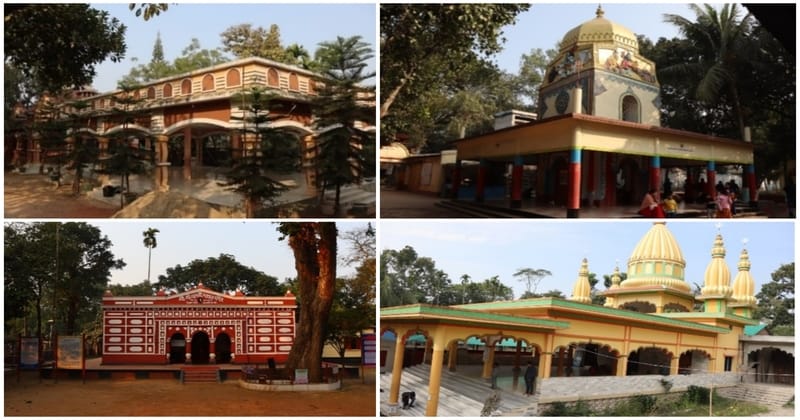
These Shakti Peethas are not merely pilgrimage centers; they are also symbols of resistance, sacrifice, and devotion of Sanatani men and women who defended them through foreign rule and persecution. The efforts of dharmic leaders like Adi Shankaracharya, who emphasised their revival, continue to resonate as Hindus today seek to reconnect with these sacred shrines.
Bhabanipur Shakti Peeth – The Seat of Rani Bhabani’s Devotion
Located in Karatoya, in Bogra district, Bhabanipur Shakti Peeth is one of the most significant Shakti shrines in Bangladesh. It is believed to be the site where the left ear of Mata Sati fell, and here she is worshipped as Mata Aparna, with Bhairav Vaman as her protector. Mentioned in the Tantra Churamani, Bhabanipur continues to inspire devotion despite enduring centuries of challenges.
The temple faced severe damage in 2007 when its under-construction guest house was destroyed by hostile forces. However, the Bhabanipur Temple Renovation and Management Committee, which has been preserving the site since 1991, stood firm against attempts by the Archaeological Department to take over its management.
Historically, Bhabanipur is deeply tied to the legacy of Rani Bhabani of Natore (1716–1803 CE), an ardent devotee of the Goddess. After assuming the role of queen, she expanded her kingdom and fiercely defended it against Nawab Siraj ud-Daulah. Her most remarkable feat was protecting her daughter Tara from being taken into Siraj’s harem. Rani Bhabani was not just a warrior queen but also a philanthropist. During the Great Bengal famine of 1770, she employed doctors at her own expense to serve the poor. She funded Sanatani resistance movements, supported the Sanyasi rebellion against the British, and donated generously to temples and social causes across India, including Durga Kund Mandir in Varanasi and Tarapith in Bengal.
Bhabanipur today stands as a testimony to her resilience, embodying both her devotion and her spirit of resistance. Its revival is essential not just for spiritual reasons but to honour the memory of one of Hinduism’s most inspiring queens.
Trisrota Bodeshwari Shakti Peeth – Where Pran Narayan Fought the Mughals
The Bodeshwari Shakti Peeth, located in Panchagarh district, is another vital dharmic site. It is believed to mark the spot where Mata Sati’s ankle fell. The temple, reconstructed by King Pran Narayan of Cooch Behar, lies at the sacred confluence of three rivers – Karatoya, Yamuneshwari, and Buri Teesta.
Historically, this site is inseparable from the heroic saga of Pran Narayan, who fought against Mughal domination in the 17th century. In 1661 CE, he even captured Dhaka, though he was later forced to retreat. Taking refuge at the Shakti Peeth, he prayed to the Goddess and launched a series of guerilla attacks that eventually allowed him to reclaim his kingdom. The temple was later renovated as an offering to the Mata in gratitude for his victory.
This Shakti Peeth also carries memories of tragedy. On Mahalaya in 2022, a boat carrying pilgrims capsized on the way to the temple, claiming 71 lives. They are honoured today by the Mahalaya Akshay Smriti Smarnik shrine at the site.
Despite lacking modern facilities like clear boundaries, parking spaces, and infrastructure, Bodeshwari remains a vibrant symbol of the survival of Sanatan Dharma in the face of Mughal aggression. Its connection to broader Hindu resistance, including the Ahom victory at the Battle of Saraighat (1671 CE), makes it one of the most historically significant Shakti Peeths in Bangladesh.
Jeshoreshwari Shakti Peeth – The Goddess of Jessore
Located in Ishwaripur village in the Satkhira district, Jeshoreshwari Shakti Peeth is dedicated to Mata Jeshoreshwari Kali. This temple, though modest today, was once a grand seat of worship, mentioned in the Tantra Churamani. It is believed that part of Mata Sati’s body fell here, sanctifying the land as a site of eternal divine presence.
The temple was historically associated with the old Jessore district, and reaching it requires a long journey via Satkhira and Shyamnagar. Despite these challenges, it remains one of the most revered shrines for Hindus in Bangladesh. Pilgrims see it as a living reminder of the unbroken thread of dharma that connects present-day Hindus to their ancient roots.
Sugandha Shakti Peeth – The Sacred River Temple
Situated by the Sugandha River in Barishal, this Shakti Peeth marks the spot where Mata Sati’s nose is said to have fallen. Its Bhairav counterpart stands across the river, though without a formal temple structure.
The temple has a turbulent history, facing repeated looting during the pre-1971 era and again during the Bangladesh Liberation War. Yet, the present murti of the Goddess stands as a symbol of survival and reconstruction. The shrine continues to be revered by local Hindus, who consider it a center of spiritual and cultural identity in southern Bangladesh.
Sita Kund Shakti Peeth – The Sacred Fire of Chittagong
In the district of Chittagong, at Sita Kund Upazilla, lies another sacred site of Shakti worship. Known as Sita Kund, it has long been regarded as both a Shakti Peeth and a sacred tirtha. Some debates continue over whether it qualifies strictly as a Sati Peeth, but for Hindus, its sanctity is beyond question.
Perched on Chandranath Parbat, a picturesque hill believed to house a self-manifested form of Shiva, Sita Kund draws pilgrims for its spiritual intensity. Ancient records link the site to Darbhanga Maharaj, who compared its divine strength to Mount Kailash. For Hindus of Chittagong and beyond, it is a place of profound religious and cultural pride.
Kala Gul Shakti Peeth – Sylhet’s Sacred Hill
In Sylhet’s Dakshin Surma region, on Sri Saila Parvat, lies the Kala Gul Shakti Peeth, where the neck (Griba) of Mata Sati is believed to have fallen. Mentioned in the Shakti Peeth Stotram composed by Adi Shankaracharya (8th–9th century CE), this site enshrines Mata as Mahalakshmi, with Bhairav as Sambaranand.
Its history links Sylhet, or ancient Srihotto, to the broader cultural and religious landscape of Bengal and Assam. Despite encroachments and lack of facilities, this Shakti Peeth remains a beacon of dharmic continuity in Bangladesh.
Kanaighat Shakti Peeth – The Forgotten Shrine of Jaintia
The Kanaighat Shakti Peeth, also known as Bamojonga, lies in Jaintia (close to Meghalaya). It is believed that the left thigh of Mata Sati fell here. Maintained in earlier times by the Jaintia Maharaj family, the shrine was declared a Debottar land, though in modern times its management has become disorganised, with concerns of anti-Hindu influence.
The site today lacks proper infrastructure no motorable roads, no guest houses, and encroached ponds. Yet, its sacredness endures, testified by symbols of the Jaintia Raja and records of prominent political and religious leaders visiting the shrine. Pilgrims see it as an important but neglected dharmic landmark that deserves restoration.
Reviving the Sacred Flame of Bangladesh’s Shakti Peeths
The seven Shakti Peethas of Bangladesh are more than ancient temples. They are the living embodiment of Hindu heritage, representing centuries of devotion, resistance, and resilience against oppression. From Rani Bhabani’s fearless defence to Pran Narayan’s guerilla war, these sites tell stories of Sanatanis who fought to protect dharma under the most trying circumstances.
Yet, the current state of many of these shrines lacking infrastructure, threatened by neglect, or struggling against encroachments highlights the urgent need for their revival. Just as Adi Shankaracharya once emphasised the restoration of dharmic pilgrimage circuits, modern Hindus too must see these Peethas as vital for reconnecting with their roots.
Rebuilding and preserving them is not only a spiritual duty but also a cultural necessity ensuring that future generations remember the sacrifices of their ancestors and continue to draw strength from the eternal power of the Divine Mother.