















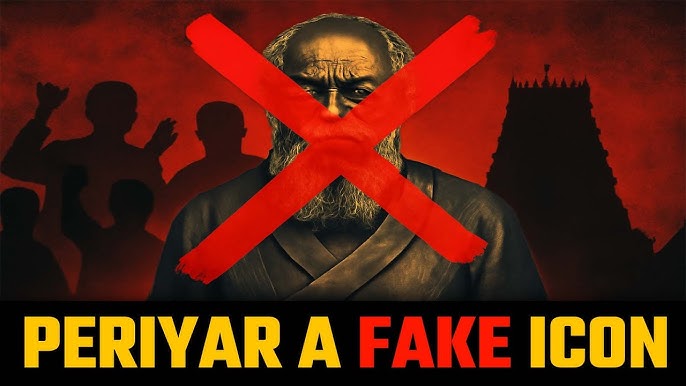
On his 147th birth anniversary, it is important to revisit the man hailed as “Periyar” by Dravidian parties. The carefully constructed image of E.V. Ramasamy Naicker as a messiah of Tamils, a champion of rationalism, and a crusader of self-respect crumbles under historical scrutiny. His followers equate him with social justice, atheism, rationalism, and women’s empowerment, but a closer look at his speeches, writings, and actions shows otherwise. Far from being the savior of Tamils, Periyar was in many ways anti-Tamil, anti-Hindu, and even indifferent to Dalit struggles. His legacy is riddled with hypocrisy, double standards, and contempt for Tamil culture, literature, and people.
Periyar’s Hatred Towards Tamil Language
Despite being projected as the father of Tamil identity politics, Periyar himself dismissed the Tamil language with disdain. In multiple issues of his paper Viduthalai, including on October 11, 1967, he called Tamil a “kaatumiraandi mozhi” a barbarian tongue. He went so far as to say Tamil was not even fit for begging and should be discarded in favor of English. Instead of promoting Tamil, he mocked it and encouraged people to abandon their mother tongue. Ironically, the very man celebrated as a Tamil icon was in fact its harshest critic, exposing the hollowness of his so-called “Tamil pride.”
Attacks on Tamil Literature and Epics
Periyar’s contempt for Tamil civilization extended to its greatest literary treasures. He dismissed Silappadikaram, one of the most revered Sangam-era epics, as Aryan propaganda. He slandered Kamba Ramayanam, calling it a “storehouse of falsehood” and accusing it of betraying the Tamil race. Even Thirukkural, admired globally for its universal wisdom, was insulted by him as “excreta in a golden plate.” Such views reveal Periyar’s deep-rooted hostility towards Tamil heritage. Rather than preserving Tamil literature, he undermined it and ridiculed those who cherished it.
Periyar’s Contempt for Tamil Society
In his writings during the 1960s, Periyar repeatedly described Tamils as backward, irrational, and incapable of progress. He argued that Tamils contributed nothing worthwhile to civilization except “backward elements” like grinding stones and bullock carts. He accused Tamils of having no racial pride, no nationalism, and no humaneness. This is the same man who is today celebrated as the liberator of Tamils. But his actual words paint a different picture a leader who not only disrespected Tamil society but actively humiliated it.
The Forgotten Truth: Periyar’s Collusion with Separatism
While Mohammad Ali Jinnah divided India along religious lines, Periyar attempted the same along linguistic and racial lines. He propagated the British-invented Aryan-Dravidian racial theory and advocated for a separate Dravidistan. He even reached out to Jinnah for support, though Jinnah dismissed him as irrelevant. His dream was to break India, not to build Tamil Nadu. Yet, Dravidian parties continue to glorify him as the protector of Tamil rights when, in reality, he attempted to divide India and reduce Tamil Nadu into a separatist pawn.
Periyar’s Hypocrisy on Hindi
One of the biggest myths around Periyar is his image as an anti-Hindi crusader. Dravidian leaders claim that he saved Tamil Nadu from Hindi imposition. Yet, historical records show that in 1927, Periyar donated his own house in Erode to set up the first Hindi training college under the Dakshin Bharat Hindi Prachar Sabha. Thousands enrolled in Hindi courses from his premises. His later opposition to Hindi was nothing more than opportunistic politics to consolidate his base. Far from being a defender of Tamil, Periyar played both sides depending on political expediency.
His Betrayal of Dalits and Women
Another dimension of Periyar’s contradictions is his attitude toward Dalits and women. Dalit movements led by Ayothidasa Pandithar and others had long before Periyar fought for rights in education, employment, and land. Periyar ridiculed these struggles, saying Dalits begging for rights was shameful. During the Keezhvenmani massacre in 1958, when 44 Dalit laborers were burnt alive, Periyar shockingly refused to condemn the atrocity and instead sided with landlords who belongs to his caste.
On women’s empowerment, his record was equally questionable. In speeches, he crudely claimed women visited temples to be groped and suggested they should dress like men in shirts and lungis. To stop his own wife from visiting temples, he staged a humiliating prank to instill fear in her. Such degrading acts expose how shallow his commitment to women’s rights really was.
Seeds of Hatred That Haunt Tamil Nadu Today
The poison Periyar sowed in the name of rationalism and self-respect continues to haunt Tamil Nadu. The rise of groups like Karuppar Koottam, which insulted Hindu deities and sacred texts like Kanda Sashti Kavasam, can be traced back to Periyar’s venomous legacy. His hatred was not rational critique but targeted bigotry, mostly against Hinduism while leaving other religions untouched. His ideology gave birth to a culture of hate politics, identity divisions, and anti-Hindu propaganda that dominate Tamil Nadu even today under DMK rule.
Periyar Was No Champion of Tamil Nadu
The reality of Periyar is starkly different from the myth. He mocked the Tamil language, insulted its literature, belittled Tamil society, betrayed Dalit aspirations, demeaned women, and attempted separatism that could have destroyed India. His supposed fight against Hindi was riddled with hypocrisy, as he himself once promoted it. His so-called rationalism selectively targeted Hindu traditions while sparing other religions. Far from being the father of Tamil pride, Periyar was perhaps its greatest detractor.
It is time for Tamil society to question the blind glorification of Periyar. Instead of elevating him as a demigod, history must be told truthfully: Periyar was not a savior of Tamils but a man whose ideas were deeply anti-Tamil and anti-Tamil Nadu.