











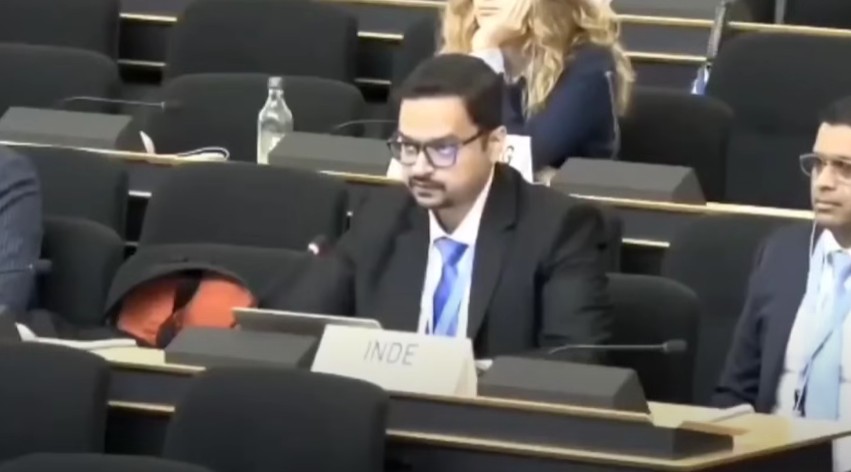
In a fiery takedown at the United Nations Human Rights Council (UNHRC), Indian diplomat Kshitij Tyagi on Wednesday delivered a blistering rebuke to Pakistan, branding it a “failed state” that thrives on propaganda, terror, and tragedy.
Speaking during the 5th meeting of the Council’s 60th session, Tyagi said, “Our measured and proportionate response to the Pahalgam attack made that sufficiently clear. We need no lessons from a terror sponsor, no sermons from a persecutor of minorities, no advice from a state that has conjured its own credibility.”
The diplomat’s remarks came in response to yet another attempt by Pakistan to internationalise the Kashmir issue—an effort that has become routine at the UN.
Reasserting India’s position, he said, “India will continue to protect its citizens with unwavering resolve. We will defend our sovereignty without compromise. And we will continue to expose, time and again, the elaborate deception of a failed state whose survival depends upon trafficking in terror and tragedy.”
Taking the offensive further, Tyagi added in a separate comment, “We are compelled once again to address provocations from a country whose own leadership recently likened it to a dump truck. Perhaps an inadvertently apt metaphor for a state that continues to deposit recycled falsehoods and stale propaganda before this distinguished council.”
He also took aim at Pakistan’s misuse of international platforms, saying, “Pakistan’s systematic abuse of this forum, coupled with its routine manipulation of the OIC as its mouthpiece, has become a familiar pattern. Its pathological fixation on India appears to provide it with existential validation.”
Tyagi’s rebuttal is not unprecedented. In February this year, at the 58th Regular Session of the Human Rights Council, the Indian diplomat had similarly lambasted Pakistan, calling it a nation that “survives on international handouts.”
“It is regrettable to see Pakistan’s so-called leaders and delegates continuing to dutifully spread falsehoods handed down by its military terrorist complex,” he said then, dismissing Pakistan’s repeated attempts to raise Jammu and Kashmir in global forums as “baseless and malicious.”
He further condemned Islamabad for “making a mockery” of the Organisation of Islamic Cooperation (OIC) by using it as a political mouthpiece.
“We do not wish to dignify such propaganda, but are constrained to make a few simple points for the record,” Tyagi had said, reaffirming that Jammu & Kashmir and Ladakh remain “integral and inalienable parts of India.”
Highlighting the rapid progress in the region, he asserted, “The unprecedented political, social and economic progress in J&K in the past few years speaks for itself. These successes are a testament to the people’s trust in the government’s commitment to bring normalcy to a region scarred by decades of Pakistan-sponsored terrorism.”
With each session of the UNHRC, India’s tone has become increasingly assertive, pushing back hard against what it sees as Pakistan’s weaponization of global forums to spread anti-India rhetoric.
Tyagi’s latest intervention cements that stance—and delivers a clear message that India will not stay silent in the face of orchestrated propaganda.





