
























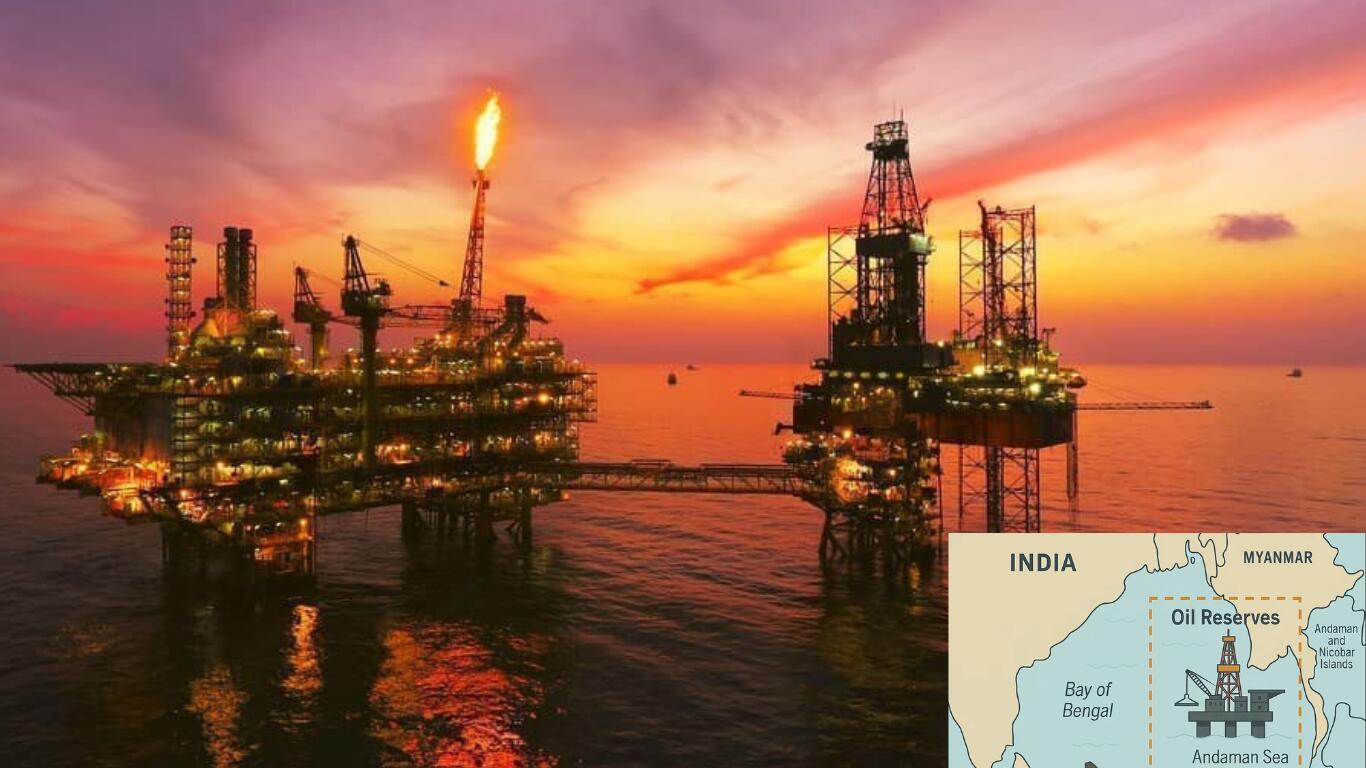
In a significant boost to India’s deepwater exploration ambitions, Union Minister Hardeep Singh Puri announced on Friday the discovery of a substantial natural gas reserve in the Andaman Sea. The find comes from the Sri Vijayapuram 2 well, located just 17 km off the east coast of the Andaman Islands, at a water depth of 295 meters and a target drilling depth of 2,650 meters.
Puri shared the news on X (formerly Twitter), emphasizing that this discovery could play a pivotal role in strengthening India’s energy self-reliance. Currently, India imports around 85 percent of its energy needs, and this find could help reduce dependence on foreign supplies, even as international attention focuses on India’s increasing purchase of Russian oil.
Significance of the Discovery
According to Puri, initial production tests between 2,212 and 2,250 meters confirmed the presence of natural gas, with intermittent flaring observed. Gas samples brought to Kakinada were tested and found to contain 87 percent methane. While the size of the gas pool and its commercial viability will be verified over the coming months, the confirmation of hydrocarbons in the Andaman basin validates long-standing expectations that the region is rich in natural gas. This aligns with hydrocarbon discoveries stretching from Myanmar in the north to Indonesia in the south.
Puri noted that the discovery supports the government’s deepwater exploration mission, announced by Prime Minister Narendra Modi, which aims to expand offshore hydrocarbon reserves through multiple deepwater wells. “This occurrence of natural gas will help us advance our exploration ambitions in coordination with global deepwater exploration experts like Petrobras, BP India, Shell, and ExxonMobil, marking a significant milestone in our journey through Amrit Kaal,” he said.
Geopolitical Context and Energy Security
The announcement comes at a time of heightened energy market volatility. Since Israel conducted airstrikes on Iran in June, concerns over disruption of oil flows through the Strait of Hormuz have surged. About 2 million barrels per day of India’s crude imports transit through this narrow waterway, out of a total of 5.5 million bpd.
However, India has strategically diversified its energy sources, importing oil from Russia, the US, and Brazil, among others. Russian oil, in particular, avoids the Strait of Hormuz entirely, reaching India via the Suez Canal, the Cape of Good Hope, or Pacific shipping routes. This diversification has positioned India to mitigate risks from regional conflicts and ensure stable energy supplies.
A Step Toward Self-Reliance
The Andaman Sea discovery is more than a technical achievement it signals India’s growing capability to secure its energy future. By tapping into domestic deepwater reserves, India reduces its vulnerability to global supply shocks while reinforcing its geopolitical independence. For a country witnessing rising energy demand, this development is a major stride toward achieving self-reliance.
Looking Ahead
With continued collaboration with international energy giants and further exploration in deepwater basins, India is poised to strengthen its position in the global energy landscape. The Andaman Sea find not only bolsters domestic energy security but also underscores India’s commitment to strategic energy diversification and resilience in the face of global challenges.