




















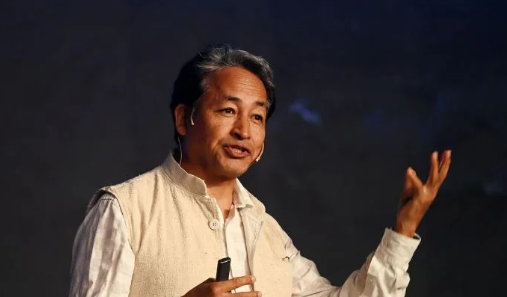
Sonam Wangchuk, once celebrated as an innovator from Ladakh, has over the years transitioned from being hailed as a solution maker to emerging as a political activist. His story, however, is less about genuine contributions and more about repeated failures, controversies, and allegations of foreign influenced agendas that have left Ladakh’s people and India questioning his true role in the region.
Sonam Wangchuk rose to fame by claiming he could solve Ladakh’s acute water crisis through the construction of artificial ice stupas. The concept attracted global attention, and he raised around $125,000 to build prototypes. Initially, the project was hailed as innovative, but soon, it faced backlash from the very community it was supposed to benefit. Farmers in Ladakh accused Sonam Wangchuk of diverting their much needed water resources for creating ice stupas, leaving agricultural needs compromised. The protests revealed that the project was more of a publicity gimmick than a sustainable solution.
Riding on the wave of his international recognition, including the prestigious Ramon Magsaysay Award in 2018, Sonam Wangchuk launched the Himalayan Institute of Alternatives, Ladakh (HIAL) in 2015. It was advertised as a futuristic, sustainable university tailored to Himalayan ecology and technology. The vision seemed ambitious, but on the ground, it collapsed under the weight of mismanagement, regulatory violations, and financial irregularities.
In 2018, the Ladakh administration allotted 54 hectares in Phyang for HIAL. A ₹14 crore lease premium had to be paid within a year, with construction expected to be completed in two. Yet, not only was construction negligible, but the institute also failed to secure UGC and AICTE recognition, which meant that any degrees issued would be invalid. By 2025, unpaid dues escalated to ₹37 crore due to penalties and fines.
Violations also piled up. Reports highlighted how Sonam Wangchuk bypassed council approvals and allegedly misused land, further deepening distrust. On August 21, 2025, the Ladakh Autonomous Hill Development Council officially canceled HIAL’s land allotment, citing regulatory failures and non payment. This debacle left no students with valid qualifications, cementing HIAL as a colossal failure and raising serious doubts about Sonam Wangchuk’s credibility as an institution builder.
After the failure of HIAL, Sonam Wangchuk increasingly shifted focus from education and innovation to activism. Through the New Ladakh Movement, launched in 2013, he began advocating for Ladakh to be included under the Sixth Schedule of the Indian Constitution. By 2025, Sonam Wangchuk’s rhetoric turned sharper, as he called for a so called “Gen Z revolution” over unemployment in Ladakh.
While Sonam Wangchuk publicly urged calm and restraint, his speeches often carried undertones of agitation against the government, blaming unfulfilled promises after the abrogation of Article 370. This political turn has alarmed many, with critics questioning whether Sonam Wangchuk has abandoned genuine development for political theatrics designed to destabilize Ladakh.
One of the most controversial aspects of Sonam Wangchuk’s journey is his alleged foreign influence. In 2025, Sonam Wangchuk participated in a climate conference in Pakistan, raising eyebrows about his priorities and affiliations. His close ties with international NGOs have also come under scrutiny, with allegations that he may be furthering foreign agendas in India’s sensitive border region. Given Ladakh’s strategic importance, such associations are viewed with deep suspicion.
The worry is not unfounded. Ladakh is a treasure trove of natural resources, rich in copper, lead, zinc, gold, borax, sulphur, limestone, and precious stones like rubies. Moreover, its vast reserves of ultra pure silica sand make it a potential hub for India’s semiconductor industry, a sector critical for national security and economic independence. Many believe that keeping the region embroiled in unrest serves the interests of foreign powers who would prefer to see India unable to fully exploit these resources.
The sequence of events surrounding Sonam Wangchuk suggests a pattern. His much publicized innovations have failed to deliver tangible benefits, his educational institution collapsed in disgrace, and his activism is increasingly aligned with narratives that undermine stability in Ladakh. Critics argue that Sonam Wangchuk’s continued prominence is not accidental. Instead, it appears as though he has been kept active in Ladakh to ensure that the region remains mired in conflict and protests, preventing India from carrying out large scale mineral excavation and industrial development.
Whether deliberate or through sheer incompetence, the outcome is the same. Sonam Wangchuk’s actions have repeatedly stalled Ladakh’s progress. Instead of empowering youth with real opportunities, his failed promises and disruptive activism risk pushing the younger generation into perpetual disillusionment.
From being celebrated as a problem solver to becoming a controversial activist, Sonam Wangchuk’s journey reflects a shift from promise to failure. His ice stupas failed to resolve water woes, his dream university ended in financial scandal and cancellation, and his activism now echoes political unrest more than solutions. Against the backdrop of Ladakh’s immense mineral wealth and strategic importance, his role raises uncomfortable questions. Is Sonam Wangchuk truly working for Ladakh’s progress, or has he become a tool, willingly or otherwise, for those who want to keep Ladakh unstable and India deprived of its natural riches?
Indians must remain cautious. Romanticizing Sonam Wangchuk as a lone reformer ignores the pattern of his failures and the potential dangers of his activism. The time has come to separate myth from reality and recognize the risks of allowing individuals like him to dominate Ladakh’s narrative.
The facts in the article is taken from twitter thread posted by Being Political (Username-@BeingPolitical1)
Thread 🧵
From Failed Innovator to Activist: Sonam Wangchuk’s Journey in Ladakh.
1/n pic.twitter.com/eDjrBW1d1h
— Being Political (@BeingPolitical1) September 24, 2025