















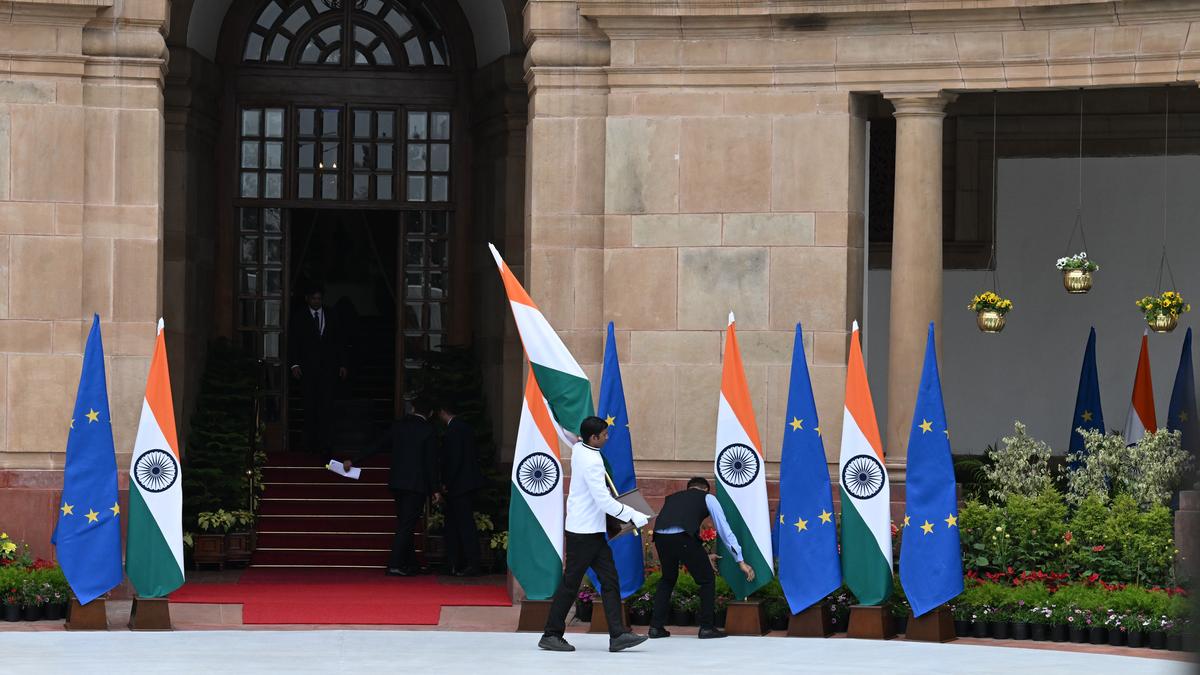
At a time when global geopolitics is undergoing rapid shifts, the European Union (EU) has announced a new strategic agenda aimed at strengthening ties with India across trade, defence, technology, and global governance. Despite pressure from the United States particularly under President Donald Trump, who has urged the EU to impose punitive tariffs on India for purchasing Russian oil Brussels has chosen to deepen its partnership with New Delhi. This decision underscores Europe’s recognition of India as a vital partner for shared prosperity, global security, and sustainable growth.
The initiative, titled EU-India Strategic Agenda for Prosperity and Security, outlines a comprehensive framework that seeks to raise bilateral relations to a higher level. By focusing on free trade, defence cooperation, innovation, and crisis management, the agenda reflects India’s rising global influence and the EU’s intent to build resilient partnerships in an uncertain international order.
Five Pillars of the Strategic Agenda
The EU’s joint communication to the European Parliament and the European Council identifies five central pillars around which the new India partnership will be structured: Prosperity and Sustainability, Technology and Innovation, Security and Defence, Connectivity and Global Issues, and Enablers Across Pillars.
Under the prosperity framework, the EU has committed to accelerating progress on an ambitious Free Trade Agreement (FTA) with India, a long-standing goal that has gained momentum in recent years. The agenda emphasizes expanding investment flows, strengthening supply chains, and boosting joint projects in key sectors like clean energy, infrastructure, and digital innovation.
Technology and innovation are placed at the heart of this cooperation, with proposals to create an EU-India Startup Partnership and extend India’s participation in Europe’s flagship Horizon Europe research programme. By doing so, Brussels seeks to harness India’s rapidly growing tech ecosystem while ensuring Europe remains connected to Asia’s innovation landscape.
Trade, Sustainability, and Global Supply Chains
One of the most striking elements of the strategy is its focus on trade resilience and sustainability. The EU has explicitly recognized India’s central role in global supply chains, especially as companies and governments seek to diversify away from over-reliance on China. By boosting trade flows and enhancing investment partnerships, both sides aim to build stronger economic resilience against global disruptions.
Climate change and green energy also feature prominently in the agenda. The EU and India are expected to step up cooperation on sustainable technologies, energy efficiency, and emissions reduction. Clean hydrogen, solar, and wind energy projects are among the sectors identified for deeper collaboration, tying into India’s own ambitious renewable energy targets under Prime Minister Narendra Modi’s leadership.
Brussels has further highlighted areas like food security, healthcare, and disaster resilience as essential components of bilateral cooperation. These align closely with India’s priorities, given its vast population and climate vulnerabilities, while also supporting Europe’s broader commitment to global sustainable development goals.
Security, Defence, and Crisis Management
The security dimension of the new agenda is particularly significant. The EU has stressed the importance of closer coordination with New Delhi in counter-terrorism, maritime security, cyber-security, and the fight against disinformation. These areas are becoming increasingly important in the digital age, where hybrid threats and information warfare challenge democratic societies worldwide.
Defence industrial cooperation is another critical plank. The EU seeks to work with India to strengthen defence production, secure supply chains, and drive technological innovation. This dovetails with India’s “Make in India” and Atmanirbhar Bharat (self-reliance) policies in defence manufacturing, potentially paving the way for joint ventures and technology transfers that benefit both sides.
Crisis management is another area of focus. As global conflicts and humanitarian crises grow in frequency, Brussels sees India as a vital partner in addressing not just regional issues but also challenges beyond Asia, including Africa and the Middle East. By pooling resources and expertise, the EU and India aim to contribute more effectively to global peacekeeping and humanitarian efforts.
A Balancing Act Amid Global Pressures
The announcement of this agenda comes amid strong pressure from Washington, where President Donald Trump has repeatedly urged the EU to impose harsh tariffs on India as punishment for purchasing Russian oil. Yet, Europe’s decision to strengthen cooperation with India highlights its determination to chart an independent course in global affairs.
By choosing engagement over confrontation, the EU has signaled that it sees India as indispensable in managing the world’s most pressing issues from energy security to climate change, from digital transformation to global governance. The move also reflects a pragmatic recognition of India’s rising stature as one of the fastest-growing major economies and a key player in the multipolar world order.
India and EU Enter a New Era
The unveiling of the EU-India Strategic Agenda for Prosperity and Security marks a decisive step in elevating bilateral relations. Built on five comprehensive pillars, the strategy covers trade, sustainability, technology, defence, and global governance, ensuring that both sides can address the challenges of the 21st century together.
For India, this represents not only a major diplomatic achievement but also a testament to its growing role as a trusted partner in shaping global rules and institutions. For the EU, the agenda offers a pathway to secure economic growth, diversify strategic dependencies, and align with a democratic powerhouse in Asia.
Despite global pressures, the EU’s choice to deepen ties with India underscores a simple truth: New Delhi is no longer just a regional actor but a central pillar of global stability and prosperity. As talks on a Free Trade Agreement accelerate and defence cooperation expands, India and the EU are poised to enter a new era of strategic partnership that could reshape the global order in the decades ahead.